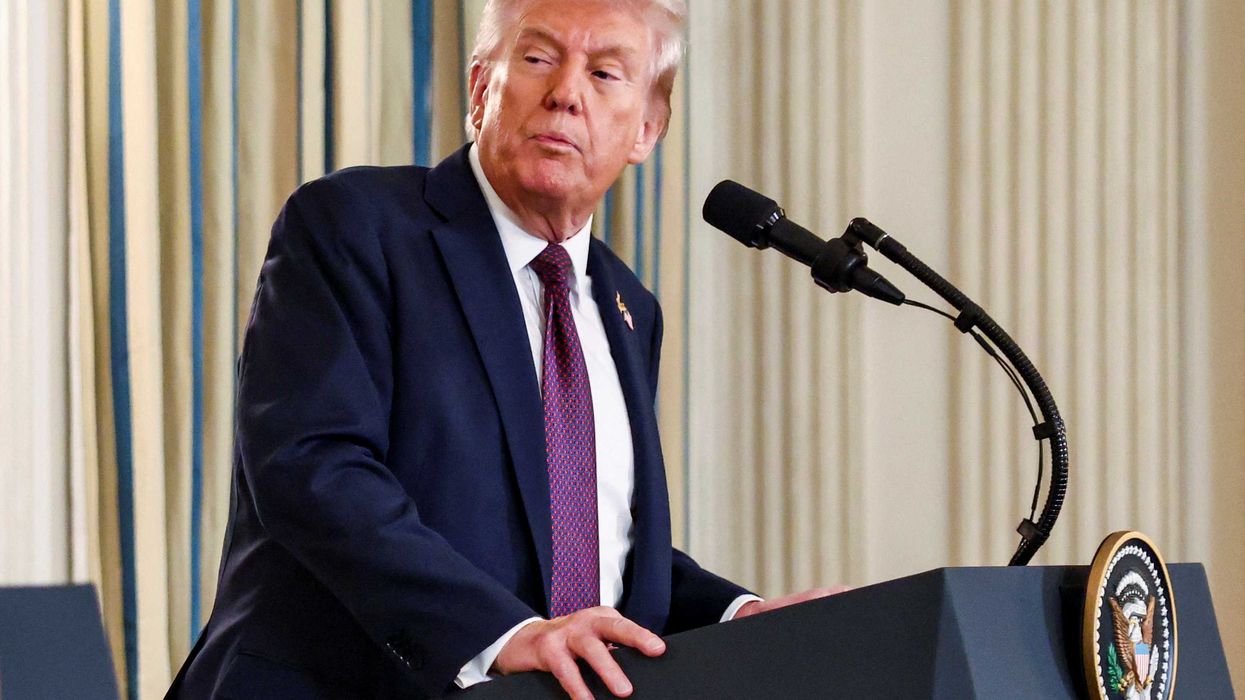
President Donald Trump is responding to Canada's targeted tariffs against his voters by trying to carve out product exceptions that he hopes will benefit them — but his own fellow Republicans disagree with him.
“The Trump administration is in harm-reduction mode and is certainly thinking about the midterms,” one former trade official and Republican staffer who is still close to Trump's administration anonymously told Politico's Ari Hawkins and Oliver Ward on Wednesday. “You cannot change voters’ views on tariffs with an eleventh-hour carveout that was developed without input from the industries affected.”
Hawkins and Ward added that "the carveouts give the vulnerable Maine Republican a concrete concession to tout on the campaign trail. But [Maine's Republican Sen. Susan] Collins stressed in a social media post on Tuesday that the 'significant tariffs' that remain in place, including on forest products, will lead to higher costs for Mainers and uncertainty for businesses."
Additionally, Politico pointed out that "the trade war still tilts toward Democrats’ favor despite the exemptions, said Jon McHenry, a vice president at North Star Opinion Research Group whose firm worked on Florida Republican Gov. Ron DeSantis’ 2018 gubernatorial campaign. Carveouts for products like road salt and cement can help at the margin, particularly in close races like Michigan and Maine."
McHenry further told Hawkins and Ward that "any adjustment that benefits Republicans should be helpful," but that it won't change the underlying cost variables. “It’s much easier for Democrats to say, ‘Oh, another trade war, this is driving up prices,’ than it is for Republicans to say, ‘We are protecting American jobs.’”
McHenry added, “It seems likely to put a little bit of a thumb on the scale to the advantage of Democrats, because trade wars tend to increase prices, and prices are high enough."
Similarly, former Sen. Rand Paul (R-KY) lobbyist Brian Darling said "having an exemption on one good does not mitigate the fact that they’re getting hammered with tariffs on a number of other goods that they love."
Speaking to AlterNet in August, former President Bill Clinton economic adviser Dr. Robert J. Shapiro echoed the Republicans' statements about Trump's trade war hurting ordinary Americans, explaining that "just this week, Trump announced 50 percent tariffs on our largest trading partner, Canada, which will further increase inflation."
Similarly, speaking to AlterNet earlier in September, Dr. Richard D. Wolff — professor emeritus of economics at the University of Massachusetts — explained that Prime Minister Mark Carney has political incentives to continue raising tariffs on Americans.
"It's not just Mr. Carney, he is the expression of something that he knows as a politician is now a very popular view in Canada," Wolff told AlterNet. "He's not going to be held to blame because this or that difficulty happens. If he can show, as he often can, that the United States' hostility, tariff policy number one, is the root cause, then he gets a pass. The kind of anger that might often be addressed to a politician won't be, because they correctly perceive that the problem is something else. And so they appeal to the politician when he comes up with solutions or attempted solution to keep workers' needs in mind."
On one occasion, Canada even admitted they almost were amused by the Trump administration's approach to trade negotiations. When they kept trying to alter the terms of tariffs on a specific type of automobile product, a Canadian official said it "almost got funny" that they had to speak so emphatically and repetitively about key principles to the administration.