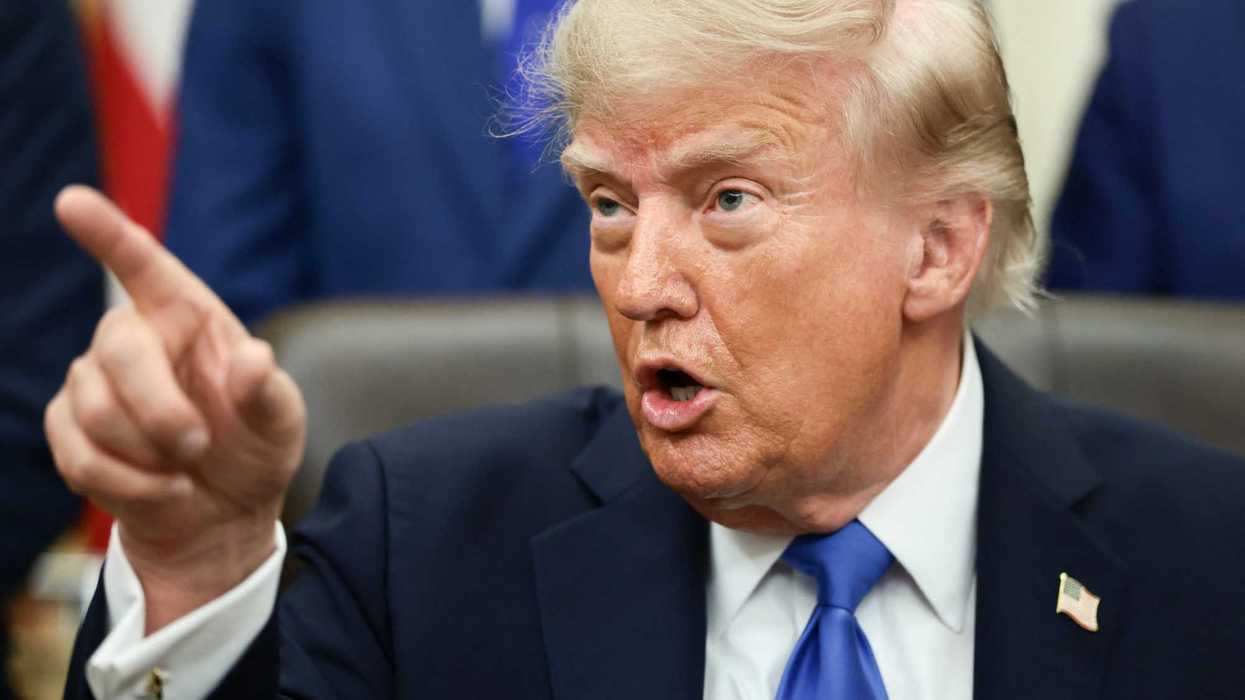
A Nobel Prize-winning economist has a warning for supporters of President Donald Trump: They have no idea how much permanent harm he has done to America's economy and standing in the world.
After describing how Canada will never again trust the United States because of Trump's belligerent and insulting language and actions toward their nation, Paul Krugman described how Trump's war against Iran has similarly caused permanent destabilization of the American economy.
"It's not just the war," Krugman told MS NOW anchor Katy Tur on Tuesday. "I mean, the war continues. There's no hint of the war ending. Some oil is making its way out of the Strait of Hormuz or other routes out of the region, but there's another war. Those diesel prices, those gas prices are even higher than you would expect given the price of crude oil. And that's because there's another war, which is Russia attacking Ukraine and Ukraine striking back at Russian refineries, which is driving up — nobody burns crude oil. You burn gasoline and diesel, and there's a worldwide shortage of refinery capacity because of the other war. So there's no relief in sight for people at the gas pump."
He added, "So when you're talking about no relief in sight, what does that mean exactly? Are we going to see prices hovering where they are? Should we expect them to go higher? I mean, at some point with this war being priced and all the other stuff you were talking about, will there be an adjustment in global markets on how to get this stuff out to market? Well, you're already kind of seeing that. In some sense, the world is gradually finding ways to get around the blockade of the Strait of Hormuz. But on the other hand, that is becoming increasingly less relevant. So even if somehow, miraculously, love and peace broke out between Donald Trump and the Iranian regime tomorrow, we will probably still have high prices of gasoline and diesel for a long time to come because it's not the only source."
He also described how Trump has undermined the integrity of a program on which 63 million Americans rely, Social Security.
"Just a few years down the road, there will not be enough money coming in from the payroll tax to continue paying full benefits, so something must be done," Krugman told Tur. "You could just cut benefits, but older Americans vote. So that's kind of unthinkable, that we're going to do that."
He added, "If you are not going to cut benefits, you've got to find more money somewhere. And what's interesting is that apparently even some Republicans are willing to support not raising the tax rate — not increasing the share of your paycheck that gets taken by FICA — but there's a cap at a certain point. If you earn enough money, at a certain point you stop paying taxes because you've reached the upper limit, and they're willing to raise that cap, which is a tax increase on higher-income Americans. It's not the tax increase I would prefer — I'd love to see it really going to taxing Mark Zuckerberg and Elon Musk — but it would be taxing relatively high-income Americans to keep this vital program going. So it's not the ideal solution, but if this is something that can actually pass, do it. Do you think it can?"
Krugman concluded, "Grover Norquist says it's suicide, that Republicans, whenever they run on anything regarding raising taxes, they lose — that their only real gain is to say that they will cut taxes. Well, but something has to pay for Social Security. And there's a reason people used to call Social Security the third rail of politics: touch it and you die."
Speaking with AlterNet on Monday, a fellow economist shared Krugman's observation about the long-term consequences of America fraying its relationship with Canada.
"Our government is busy strong-arming people around the world in every way that it can, militarily, economically, politically, and discovering time after time to their amazement, if you take them seriously, that the folks are going to resist. And that's what's going to happen," Dr. Richard D. Wolff, professor emeritus of economics at the University of Massachusetts Amherst, told AlterNet.
Another economist speaking to AlterNet likewise reinforced Krugman's point about how the Iran war is harming the American economy.
“I would guess that yes, destruction of Iranian (and some other) energy facilities in the Persian Gulf area will have at least a medium-term effect keeping prices for crude oil and chemical fertilizer high, and that in turn means gasoline prices may come down only slowly,” Dr. Ed Gresser, Vice President and Director for Trade and Global Markets at the Progressive Policy Institute, told AlterNet in April. “Same for other petroleum-based products such as plastics, skin creams, and so on. The high potential of conflict also adds risk premiums to shipping and other costs.”
He continued, “Longer-term, lots of open questions. One is whether the administration will really concede that Iran has a right to close the Strait of Hormuz and assess tolls on shipping passing through it. That would make the smaller Gulf monarchies and to some extent Iraq reliant on Iranian good will for all of their exports. Likewise, Asian countries are the main buyers of Persian Gulf energy, and their supplies would be much less secure.”
Speaking with AlterNet in August, former Social Security Commissioner Martin O'Malley argued that the Trump administration — including the world's richest man, Elon Musk — have designs on that agency's massive cash reserves.
"They believe a person with a disability who can't work is a waste!" O'Malley told AlterNet. "That an elderly person is a waste! That an orphan child is a waste!"
He added, "That's why so many of the hardest-right ideologues — like Elon Musk, who says empathy is the greatest weakness in the Western mind — are going after Social Security. Not only is it the one agency with money in the bank they can rob, but it's also an agency that defends a principle most of us still cling to: that in America, there's no such thing as a spare American — no such thing as a human being who is a waste. That's what these ideologues, eugenicists, and monopolists are going after."
- YouTube youtu.be