

Ivy League economist drops a bomb on Trump's reckless Canada ambush
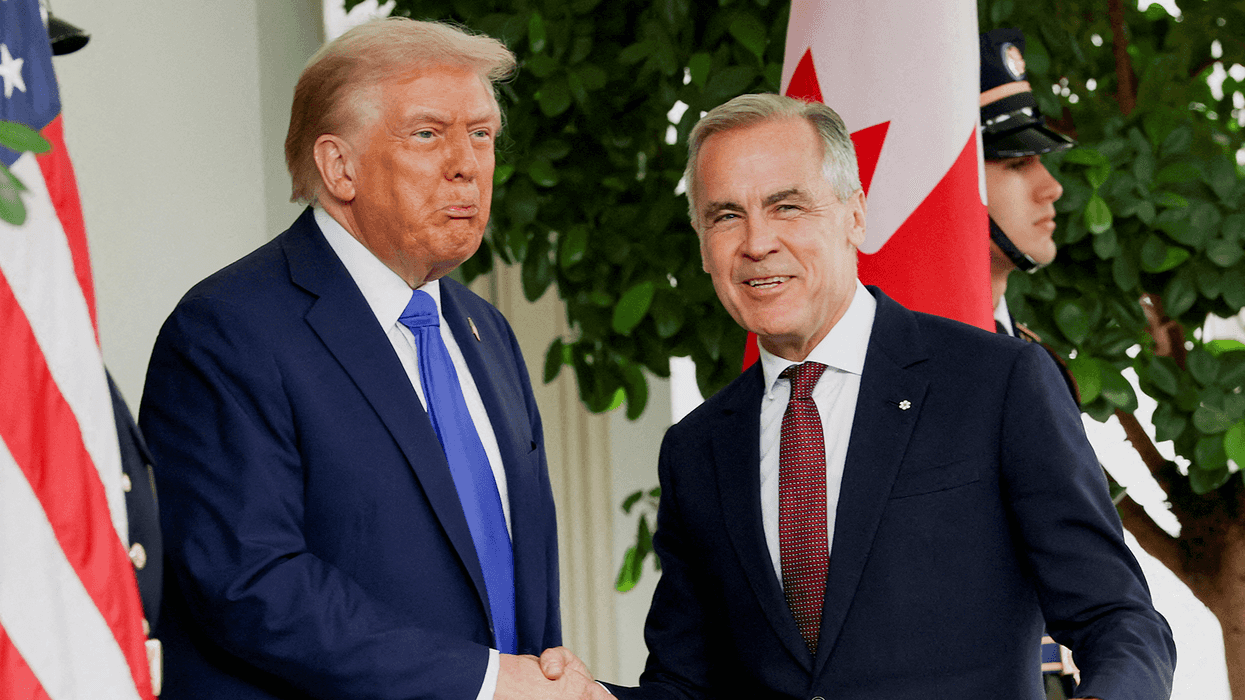
President Donald Trump's war on the American economy continues unabated, despite many of the Republican's own supporters turning against him as a result. From insulting Canada while levying unprovoked tariffs against them to gutting the Social Security benefits on which 63 million people rely, it is impossible to live in the United States without either being directly impacted by Trumponomics or knowing someone who is.
To understand the impact of these policies, AlterNet spoke with Dr. Ioana Marinsecu, a professor at the University of Pennsylvania School of Social Policy & Practice who also works for that college''s Economics Department and the Wharton School of Business (BEPP).
The Wharton School of Business, you may recognize, is the alma mater of Trump himself.
The following interview has been lightly edited for length, clarity and context.
ROZSA: What are the likely consequences for ordinary American consumers of what Trump is doing with Canada?
MARINSECU: So, very likely prices are going to go up. And that's because you are removing — so usually when we import things, it's because they are better. And better might mean better quality, unique properties, and/or cheaper than what you could get domestically. And so it kind of means that those things we can either no longer import, and/or that now have tariffs, are made more expensive, so on net they're clearly going to increase the prices that consumers experience. So essentially, the price of buying stuff — if you want to keep to the same consumption bundle — and this is actually a good thought experiment that we like to think about in economics. Imagine you're a consumer and you want to buy, over a whole year let's say, so it includes all sorts of different things you're buying, the same thing as in the past.
Once you have tariffs — all of these additional tariffs that have been introduced — if you stick to the same basket of goods, buy the exact same thing as in the past, just because of those tariffs, it's going to cost you more one way or the other. Even if you're sometimes able to switch to a different product that's not imported, etc., usually it's going to end up in your having to pay more, and/or get a worse quality, from the overall bundle of goods. You're not going to be as happy with what you have, because in some cases you're going to have to give up — it's become too expensive — so you're going to give up on your favorite maple syrup or whatnot, and the quality is also worse, right? So it's definitely — the immediate effect is definitely negative for the consumer.That doesn't mean there couldn't be arguments for tariffs in the longer run, but the immediate effect is definitely negative for consumers.
ROZSA: Right now, Canada is responding by accepting Trump's tariffs because they are, frankly, insulted by the rhetoric used by him and other members of his administration — referring to Canada as the 51st state, renaming Lake Ontario, saying that Canada's little yippy dog. Do you believe there is any merit to this rhetorical approach toward Canada in these trade conflicts, regardless of whether the tariffs themselves are independently justifiable?
MARINESCU: I don't know, that would be for somebody who deals in political strategy and negotiation strategy. It can be very tough to say what's a good negotiation strategy, because when you study — like we do in economics — game theory, it often depends on beliefs. So, if I do this, what do you infer about me and my future willingness to do this and that? And it's a very strategic, self-referential game, so it's often quite unpredictable, especially when you're dealing with people who perhaps aren't using the usual playbook. So when we are in a context that is very well understood, it's easier to understand what the terms of the negotiation are.
When something changes — we have some new objectives, some new visions about trade, etc. — the negotiation strategy can also be more difficult to come through, because it changes the assumptions in the background that you're making to understand the other person's, or the other counterpart's, behavior.
So I think it's very difficult, for either side, because we are in a new game here that isn't the one that was played before.
ROZSA: Now I want to talk about the future of Social Security and other New Deal-era programs under President Trump. Gutting Social Security, eliminating protections for labor unions — this is not New Deal, but the elimination of the Consumer Finance Protection Bureau, at least in terms of the bulk of it — you can look at the gutting of the FDA. What kinds of changes has he made to programs on which ordinary Americans rely, and what will the impact be on those Americans?
MARINESCU: If you reduce Social Security benefits, that is going to impact obviously retirees, but it will disproportionately impact lower-income people, because higher-income people have other sources of savings for their retirement, like their 401(k). So even though it would be a loss for everybody who is going to get Social Security when they retire and would get less or none, that would be a loss if that were to happen. But the loss would be felt to a greater extent, and be more negative in its impact, for lower-income people, because they don't have other sources easily available, other sources of income. And because, as we say in economics, there's decreasing marginal utility of income, meaning that the more money you have, the less the additional dollar matters.
So for somebody who has almost no savings otherwise, but would have Social Security in retirement, if that's being reduced or even eliminated, that would be really dramatic for them, in terms of how that would affect their wellbeing. And the whole point of Social Security was created because, at the time, it was very common for people to live in poverty because they're old, they don't work, and if you're poor you don't have savings — what are you going to do? In the past, people lived with families; now it's less common. So it would create severe issues for the lowest-income and lowest-wealth people.
By the way, Social Security — we can see in the data, the poverty in old age decreased dramatically after implementing Social Security. So doing the opposite plausibly would increase poverty in old age.
ROZSA: And you were just discussing Social Security. I also mentioned the CFPB, the FDA, weakened labor protections. What are your thoughts on those policy changes?
MARINESCU: So, to the degree that there's weaker labor protections — first, let me say that unionization in the US, and around the world, but let's talk about the US, has been in decline. So obviously, any change that would further weaken protection for unions probably would further accentuate that trend. This is an important juncture in the economy — for example, with the changes happening with artificial intelligence and technological change — where workers potentially stand to, at least in the transition, lose. In the end it could be great for everybody, but policy matters, and unions are one of the conduits through which the benefits of technology can be shared more broadly, and shared with workers.
So, depending on what you're trying to achieve — if part of the goal is to make sure that a technology like AI benefits everyone, one of the ways to do that is to support unions. Obviously that's one way. And even so, there are certain scenarios where it will benefit people, but if you want to make sure that workers have a say, that's one of the elements where unions could be helpful.
ROZSA: I'm going to return to Canada, just because that's such a fascinating subject right now. What is your position on the ability of Trump's tariffs on Canada to do what he claims they will do and re-stimulate manufacturing in this country?
MARINESCU: Well, (laughs) so, obviously the tariffs will hurt both sides. Like I explained about the US consumer, it will also hurt the Canadians, who now can't export the way they used to. Now, it's not quite — just like with consumers, consumers do have other options, and Canadians also have other options of places they can export to, so that cushions the blow a little bit. But there's no question that it hurts Canadians, and it hurts Canadian exporters, and thereby, more broadly, Canada — and it hurts US consumers. And so, in terms of whether it will relocate certain activities to the US, it might do that at the margin, but that seems fairly unlikely, because there are other countries where one can import these goods from.
So, basically, it's all a matter of relative costs — this is economics — so after tariffs, if you're comparing the costs of importing goods, not just from Canada but from other countries you could import them from, you take the best deal. Obviously, you could put tariffs so high that at some point it might become worthwhile to relocate certain production to the US. But that likely would require very high tariffs, and you also have to understand that this is a dynamic game. So there's also the question of: okay, these are the tariffs now, but for how long are they going to be that high? If government policy in the US changes and tariffs come back down, then the new factories that have been built and are producing certain goods at high cost — that are not competitive if it weren't for the tariffs — are going to be in trouble once the tariffs are brought back down.
So that's why it has a plausibly very limited effect, because, again, number one, there are other options besides Canada, and number two, the investors who would want to rebuild sectors in the US would have to trust that these very high tariffs are here to stay. And there's a lot of uncertainty — we don't know that that's going to be the case. Does that make sense?
ROZSA: It does.

