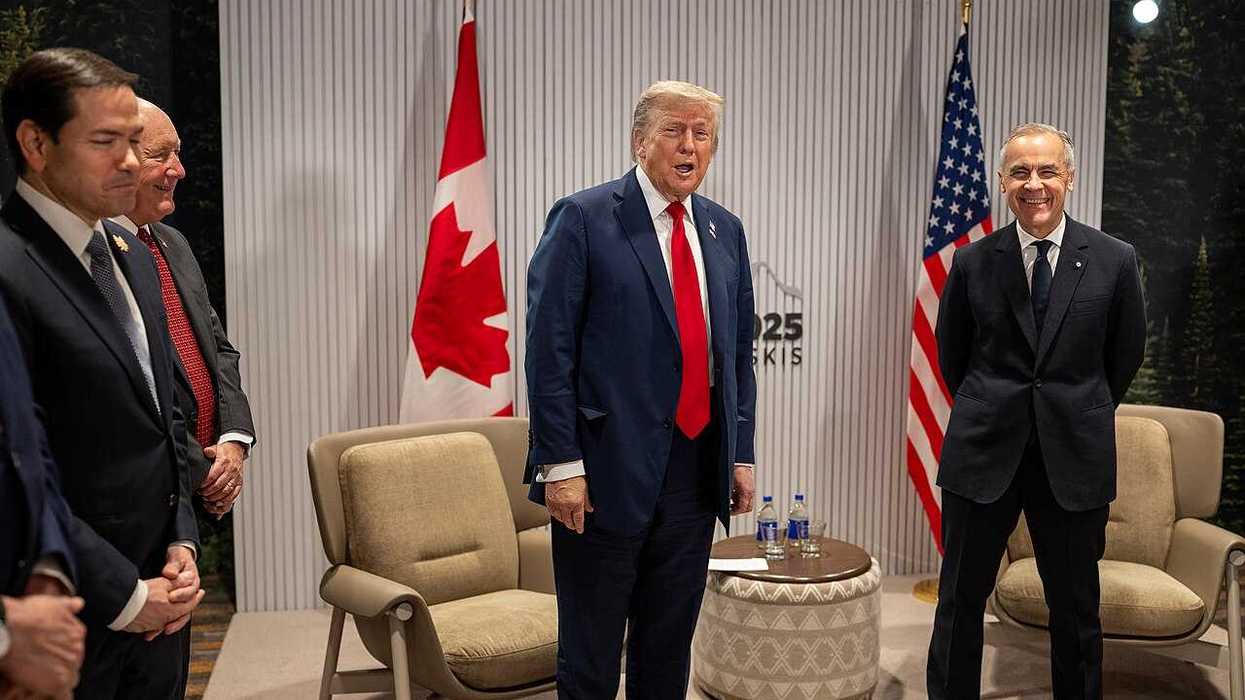
President Donald Trump and his top officials keep insulting Canada as they wage their unprovoked trade war against the country. From renaming Lake Ontario as "Lake America" to joking that Canada is "America's 51st state," the Trump administration has assumed that Canada would bend the knee to the United States — and a new report indicates that their actual response is not at all what they expected.
"[Flavio Volpe, the president of the Automotive Parts Manufacturers’ Association of Canada] said that auto parts makers were not intimidated," reported The New York Times' Ian Austen on Monday. "He said that last year, when the Trump administration proposed collecting tariffs on Canadian auto parts, “they understood that it would shut down the auto industry in a week.”
He added: “Ultimately, I think they will back off that. But if they don’t, they can have at it.”
Earlier in the article, Austen reported about Prime Minister Mark Carney that he "made clear last week that he was in no hurry to return to negotiations and was focused instead on diversifying Canada’s trade and expanding its domestic economy." In fact, Austen added that "with an insulted and angry nation solidly behind him, Prime Minister Mark Carney of Canada is charging ahead in a bitter trade war with the United States, risking a further fraying of what once was one of the world’s closest friendships."
Importantly for him politically — and unlike Trump — polls that show Carney has his nation overwhelmingly behind him.
"Canadian officials have suggested that many of the targeted American items come from states where voters supported Mr. Trump, though some political analysts question how much pressure that will actually put on the White House," Austen reported. "The list also includes items with little significance for the Canadian economy, including the metal bands that attach erasers to pencils, migratory bird identification bands and fish egg incubators."
He added, "Polls show that Canadians strongly back Mr. Carney’s decision to end trade talks with Washington last month and hit back with tariffs on about $20 billion in American products entering Canada. But there is also concern over what might happen next. Mr. Trump has repeatedly threatened another round of American tariffs if Canada follows through on its plan."
Austen also ticked off various new ways that Trump and his administration have insulted the Canadian people as they proceed with their trade war.
"Last week, Scott Bessent, the U.S. Treasury secretary, rejected that framing, arguing that Canada is too small an economic power to battle the United States," Austen reported. "'I don’t think you can be in a tit-for-tat with someone who’s 13 times larger than you are,' Mr. Bessent said on CNBC."
In an interview with Trump's daughter-in-law, RNC chair Lara Trump, Bessent also said about Canada that "this little yippy dog that used to just bark away and for a long time a 110-pound German shepherd was ignoring the Dachshund and then one day she had enough."
Austen continued that Trump "said that he might 'end all trade with Canada' and other countries that have trade surpluses with the United States. Mr. Trump has frequently made dramatic threats during trade negotiations that have gone unrealized, such as floating the idea of a 100 percent tariff on Canadian goods in January.
Separately, the U.S. commerce secretary, Howard Lutnick, said Mr. Carney had shut down the talks to gain 'political leverage' at home, not because of what the U.S. side had offered."
Canada is doing more than accepting America's challenge. Ontario Premiere Doug Ford recently urged Carney to target imports from states that have supported him and on which he still politically relies including "Alabama, Arkansas, Florida, Iowa, Missouri, Montana, Texas and Wisconsin." Speaking with AlterNet, Dr. Richard D. Wolff — professor emeritus of economics at the University of Massachusetts Amherst – broke down exactly why Canada is doing this.
"I am not surprised that our government is surprised," Wolff wrote. "Our government is busy strong-arming people around the world in every way that it can, militarily, economically, politically, and discovering time after time to their amazement, if you take them seriously, that the folks are going to resist. And that's what's going to happen."
Drawing a connection between the US-Canada trade war and the US-Iran war, Wolff noted that "Israel and the United States thought they could bomb Iran June 2025, and that was a 12-day war because they couldn't get them to bend over and surrender. So they went to work, tried it again February 28th of this year. And they're not doing it. And so now you discover, gee, the people of Canada being threatened in this way and that way by the tariffs are not bending and are putting pressure on their leaders to find a way other than capitulation."
Wolff emphasized that Carney is reflecting the will of the people who was elected to serve.
"It's not just Mr. Carney, he is the expression of something that he knows as a politician is now a very popular view in Canada," Wolff explained. "He's not going to be held to blame because this or that difficulty happens. If he can show, as he often can, that the United States' hostility, tariff policy number one, is the root cause, then he gets a pass. The kind of anger that might often be addressed to a politician won't be, because they correctly perceive that the problem is something else. And so they appeal to the politician when he comes up with solutions or attempted solution to keep workers' needs in mind."
Canada is not the only longtime American ally that is tired of the United States' ongoing tariff strategy.
"Europe has now, having been for the last 75 years, the junior partner of the United States," Wolff told AlterNet. "That was the situation that came out of World War II. Europe, empire over, new empire, the Americans, and the Europeans can come along for the ride, but they're the junior partner. Well, they've now been attacked with tariffs too, and they're very upset and they're very angry and they're not about to make deals with the United States anywhere like they used to, because of that reaction. And now it'll be a struggle between them and Mr. Trump over how this gets worked out. But it is, I can assure you, this whole attack, counterattack is shaking up every corner of European politics."
Speaking with AlterNet in August, a former economic adviser to President Bill Clinton pointed out that Trump's tariffs on Canada are not only alienating Canadians. They are also worsening the inflation problem Trump inherited.
"Trump announced 50 percent tariffs on our largest trading partner, Canada, which will further increase inflation," Dr. Robert J. Shapiro said.