
2026 Midterm Elections

GOP 'meltdown': House Republicans are running out of time — and out of control

House Speaker Mike Johnson (R-La.) is realizing that anything legislative might be shut down for the rest of the summer.

Politico reported on Monday that Johnson's leadership circle has realized there's no chance of passing anything immigration related. Politico's Meredith Lee Hill reported that sources told them, "A handful of House GOP hardliners tell us they will tank the rule this week without a plan on [immigration] and more as Johnson struggles to regain control of the House floor."

Johnson already sent the House members home early ahead of the July 4th recess after "the last GOP floor meltdown," Hill added.

On Monday, Johnson was at Camp David with White House officials and legislative affairs staff as they worked through what was next. All Johnson would say, however, is "further specifics will be provided later in the week."

Hill said that "moderates and even some hardliners still need to be convinced."

So, the first step is to stop the internal revolt in the GOP, reported Politico.

Some, like Rep. Anna Paulina Luna (R-Fla.), are following President Donald Trump's orders that anything passed must include his voting-related "SAVE America Act." She was responsible for bills being blocked from votes before the July 4 break, leading to the GOP frustration and early exit.

Trump's "Safeguard American Voter Eligibility America Act" has become his red line, meaning the Republican agenda is stalled out until Trump backs down or Republicans force vote in the bill.

Speaking in an interview last week, Rep. Craig Goldman (R-Texas) said, “Not one member can understand the thought behind it. The hope is that when we come back, we start moving legislation again.”

Another issue is that hard-line conservatives wanted a strong immigration bill, and they got a handshake agreement on it from Johnson. However, the speaker hasn't delivered. So, those Republicans are threatening their own blockade of the House floor, too. Most Republicans have agreed that they can't sign off on the bill that the far-right members are demanding.

The House leadership is so concerned that they're calling the White House to beg for help, the report said. Vice President JD Vance is being dispatched to the caucus lunch on Tuesday to lean on those who refuse to play ball. Most of those GOP members, however, are in safe seats and have already advanced through GOP primaries. It gives the White House zero leverage over them, whereas Trump could persuade GOP lawmakers ahead of their primaries by threatening to pick their opponents for endorsements.

One way the leadership has tried to convince the members is by passing a number of toothless bills critical of things like the Supreme Court ruling on birthright citizenship or condemning sanctuary cities. They aren't laws, however, and serve little purpose other than congressional finger-wagging.

On the Senate side, the spending battles are “as dead as Woodrow Wilson,” said Sen. John Kennedy (R-La.), according to Politico.

'Idiocy': George Conway unloads on 'flailing' Trump’s strategic failures

As President Donald Trump grapples with the implications of his failed negotiations for peace with Iran, one DC insider formerly of his orbit isn’t holding back, blasting the “flailing” Commander in Chief for his historic “strategic failure.”

This is according to George Conway, former husband of first-term Trump advisor Kellyanne Conway and current Democratic congressional candidate, who took to X on Monday to post his unvarnished thoughts on the president’s declaration that the U.S. would “keep” and “run” the Strait of Hormuz.

“The problem, ultimately,” posted Conway, “is that restoration of free passage in the Hormuz Strait would require a massive combined-arms offensive that would be extremely costly in blood and treasure, that would necessitate involvement of Western allies who no longer trust us and won't fight with us, and for which there would be little, if any, domestic political support.” Were the situation different, he elaborated, and the Iranians had taken control of the strait “unilaterally without our provocation, the conditions for such a massive response — involving ground troops, allies, and Congressional authorization — might have been possible. Which is why the Iranians never did that.”

From there, Conway hammers on the profound degree of Trump’s botched “excursion,” asserting, “Now Trump — and we — are stuck. And the Iranian regime knows it. They correctly perceive Trump's flailing as weakness, and their new leaders, having gained the upper hand after a decapitation strike, know they have the upper hand. They don't give a s–– about Trump's threats. It's hard to imagine a greater and graver strategic failure than this one, which has resulted solely from Trump's idiocy, ignorance, incompetence, impulsiveness and insanity.”

Conway shared his thoughts along with a post from conservative political commentator Shermichael Singleton, who offered a similarly no-holds-barred assessment of Trump’s war and how it is fanning the headwinds Republicans face heading into the November elections.

“Going into midterms in the midst of a war that’s materially impacting gas prices,” wrote Singleton, “when the cost of living is the top issue for voters, doesn’t make sense and will certainly have a negative impact on the Republican majority in the House. The incoherent strategy has caused predictable uncertainties for a resolution when the GOP should be focused on the very evident pain points for voters, but can’t. The best thing for the administration is a swift resolution and prioritization of the tangible issues impacting millions who will vote this fall.”

In a follow-up post responding to Conway, Singleton elaborated on how badly the war has backfired, writing, “Iran is now behaving like a quasi-superpower. They may lack nuclear warheads, but it is clear as day that they now know they have the ability to exert real control over the global economy by restricting passage through the strait. The dilemma is multifaceted for us: the very valid points [Conway] made on the cost and toll, as well as the simple fact that we can’t be there forever. Regardless of what agreements are made, I think the Iranian regime is now positioned to be far more powerful than it was before.”

The real inflation story Washington completely ignores

There is a looming financial crisis that Washington politicians are not only ignoring, but they're also making it worse by ignoring it.

The New Republic's Grace Segers wrote Monday that food prices are continuing to rise as fuel prices drive up transportation costs. Wages, which continue to remain stagnant amid inflation, mean that many Americans are struggling to pay for everyday things like gas and groceries. So, they're turning to high-interest-rate credit cards or other forms of borrowing that put them in an even greater financial bind.

So-called payday loans or pay later loans give families an early boost, but at a high cost. On a credit card with a 25 percent interest rate, an individual pays $125 for $100 of groceries. Other pay-later lenders charge interest rates of 300 percent or more, even 600 percent in some states, explained one credit union.

The report recalled the high egg prices ahead of the 2024 election, in part due to the avian flu outbreak, but now high beef or bread prices have taken over.

“The war is just exacerbating all the angst around,” said Mark Zandi, the chief economist at Moody’s Analytics. “It’s a real problem financially, but also it’s being supercharged in the minds of people because people are really focused on the cost of food and groceries.”

Zandi explained that, unlike in 2024, with a few high-ticket items, the concern is that so many of the items are now higher-priced. “Almost everyone has a food item that they’re focused on [that] they buy regularly ... [and] use as a benchmark for the cost of living and their financial situation.”

At this point, even if President Donald Trump were to end the Iran war this week, the economic impact will be felt for the next several years. He asserted he's "already solved inflation."

“There’s no going back on energy costs, at least not in the next couple, three, four years,” Zandi said. “I think we’re all going to be paying a lot more for energy, and that will translate into higher costs for everything, obviously including groceries and food more broadly.”

Beyond the financial impact on the country as a whole, Segers frames it as part of a troubling trend and as a sign of deeper economic stress for most Americans, particularly lower-income families, who are more likely to use pay-later lenders.

The ultimate result is that rising costs for essential items put people on a kind of endless hamster wheel that they can't break. It's a problem that Congress could fix by investing in safety-net programs and expanding access to credit counseling. The problem is that Republicans made astronomical cuts to such programs in the so-called "Big, Beautiful Bill" passed in 2025.

The real story behind the GOP's beef with James Talarico

The 2026 midterms are here, and negative campaign messaging is flooding screens across the U.S. In Texas’ Senate race, Republican Attorney General Ken Paxton’s comments about Democratic Texas Rep. James Talarico have gone viral.

Rather than simply suggesting Talarico is weak on border security or inflation economics, Paxton’s campaign has taken a different rhetorical approach. To quote Fox News host Jesse Watters, “The major factor in this race … is whether Tala-freak-o is a vegan.”

Though Talarico maintains he is not vegan, Paxton has referred to his opponent as “Tofu Talarico.”

Paxton and Watters aren’t the only ones making these dietary accusations.

Earlier this year, after Talarico ordered a potato, egg and cheese taco from a restaurant in Austin, Texas Gov. Greg Abbott posted to his campaign social platform X account: “Homie is not beating the vegetarian allegations.”

Texas Sen. Ted Cruz joked that if a soy latte could speak, “that would be Democrat James Talarico.” Even President Donald Trump has chimed in: “He’s a vegan in Texas, and you can’t get elected as a vegan in Texas.”

Again, Talarico denies being a secret vegetarian or vegan. “I’m an eighth-generation Texan,” he has said. “I’ve been eating barbecue since before Ken Paxton’s first indictment.”

The accusations likely stem from a 2022 appearance with the Texas Humane Legislation Network when Talarico suggested Americans reduce their meat consumption for climate reasons. His girlfriend follows a plant-based diet. Nonetheless, Talarico says that his campaign “runs on barbecue.”

As communication scholars who study the symbolic roles of meat and meat-eating in political communication, we see the construction of “Tofu Talarico” not as a one-off political jab but as part of a more sophisticated rhetorical strategy by which politicians appeal to voters.

Attacks on Talarico show how, across American politics, what people eat is a metaphoric marker of who they are, from political affiliation to regional belonging and cultural values. Eating meat – or not – plays a huge role in the political process, and accusations of meat avoidance, regardless of whether they’re true, can be a potent rhetorical weapon.
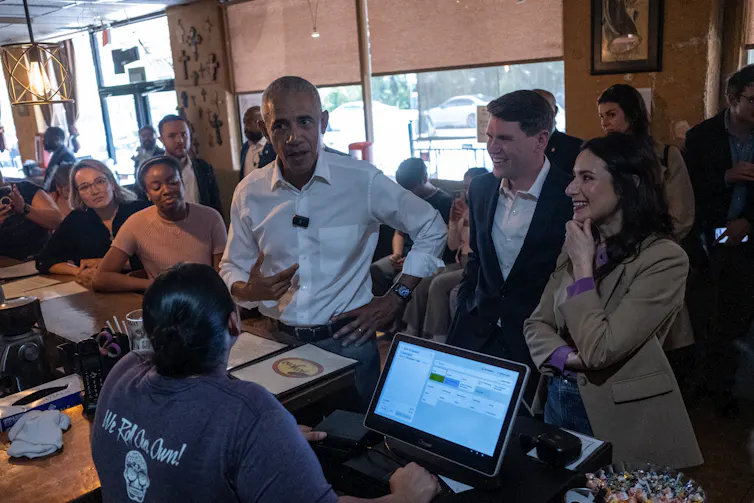
Three people stand at a counter in a taco restaurant From left, former President Barack Obama, Texas Democratic Senate candidate Rep. James Talarico and Texas Democratic gubernatorial candidate Gina Hinojosa visit the Taco Joint in Austin in May 2026. Talarico’s order – potato, egg and cheese tacos – drew ridicule from Republicans, feeding vegetarian and vegan attack lines that he denies. AP Photo/Joel Angel Juarez, Pool

Meat, metaphor and political communication

Communication scholarship shows that metaphors, when a word or phrase denoting one object or idea is used in place of another, are more than literary decoration; they shape the way we perceive reality, acting as part of a “conceptual system” that enables snap judgments and decision-making.

As mental shortcuts, or heuristic devices, metaphors are common in political communication. They’re a means to “see something in terms of something else.”

For example, in the case of Paxton and Talarico, allegations of vegetarianism and veganism are not about Talarico’s nutritional profile or even his environmental ethics. Here, “vegan” and its analogues metaphorically stand in for weakness and nonconformity, whereas “meat” and its affiliates stand in for strength, traditionalism and the stereotypical Texan way.

This usage is consistent with what food politics researchers call the “sexual politics” of meat, wherein meat imagery is often used in displays of traditional masculinity. This is evident in other jabs levied at Talarico. For example, Watters linked Talarico’s diet to his sexual orientation, joking on Fox News that Talarico was a “gay vegan” with a fake girlfriend.

Dietary demographics and election modeling

Dietary preference also links to key political demographics. For example, political scientists have explored whether the concept of a Republican vegan is an oxymoron due to the deep entrenchment of meat-eating and meat production in primarily conservative regions.

Overwhelmingly, vegans tend to be women, young and liberal. Across all political identifications, being male and white correlates with higher meat consumption.

Even the choice of where to purchase meat can be an electoral measure. Political journalist Dave Wasserman has suggested that the 2012 election was a contest between “well-educated, Democratic-trending Whole Foods markets and down-home, Republican-trending Cracker Barrel outposts.”

Meatless political appeals

The “meatless” have long been framed as social and political threats, levied in discussions of whether they should be politically elevated or subordinated. Historically, Western norms during the 19th and 20th centuries held that to not eat meat is odd at best, and suspicious at worst.

In the late 1800s, colonialism in Asia was partially justified on the grounds that Asian men were but “effeminate rice eaters” who, according to 19th-century neurologist James Leonard Corning, lacked “the intellectual vigor of flesh-eating men.”

Negative appeals to veganism again flourished in 2019 after Democratic Representative Alexandria Ocasio-Cortez’s “Green New Deal,” a resolution proposing to combat climate change. Conservative senators like Joni Ernst and Marsha Blackburn attacked the environmentally progressive initiative as a “war on meat,” posing an existential threat to meat eaters and cattle farmers. Notably, the Green New Deal did not contain meat mandates. In the Green New Deal discussion, though, this hypothetical meat ban effectively functioned as metaphorical shortcut for progressive political overreach.

This demarcation is not confined to one political party. In a Democratic primary debate in 2019, New Jersey Senator Cory Booker – a vegan since 2014 – was asked by a debate moderator if, as president, he would demand Americans follow his diet. Booker, surprised by the personal question, said no. He did not win the nomination.

More meat, less elite

Meat, or lack thereof, has gathered more significance in the second Trump presidency via Health and Human Services Secretary Robert F. Kennedy Jr.’s Make America Healthy Again initiative. Kennedy, who touts his “carnivore diet,” says he “only (eats) meat or fermented foods.” He has even modified the food pyramid – the Department of Agriculture’s visual nutrition guide – shifting red meat from a food to be consumed sparingly to a high dietary priority.

Meanwhile, multiple Republican-leaning states have banned cell-cultured meat, or meat produced in a lab, for not being “real” and, so, being dangerous. After signing a ban on cultured meat, Florida Governor Ron DeSantis declared that the bill represented a battle against the global elite and its “authoritarian goals.”
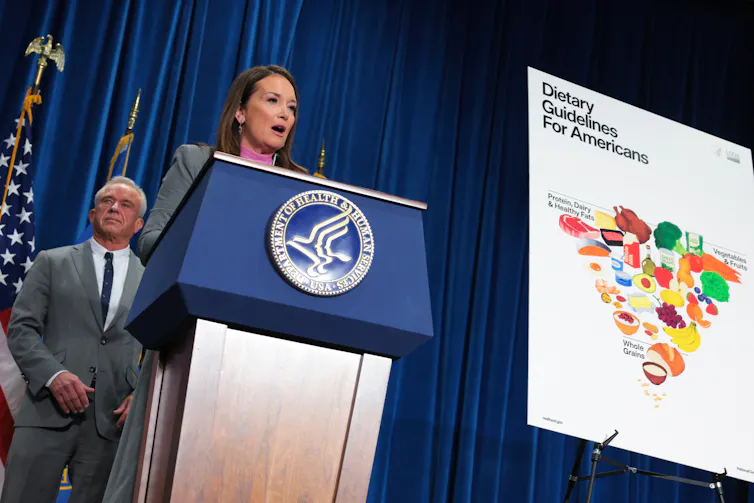
A woman speaks from behind a podium, a poster showing an inverted food pyramid on display nearby Secretary of Agriculture Brooke Rollins speaks at a Department of Health and Human Services event in January 2026. The Trump administration announced new dietary guidelines emphasizing proteins. Anna Moneymaker/Getty Images

2026 and beyond

While the beef between Paxton and Talarico will likely resolve after the 2026 midterms, appeals to meat, meat eaters and meat-eating in U.S. political communication will not.

As available meat substitutes increase, economic burdens on ranchers rise and debates over the meat industry’s impact on climate change intensify, we expect meat’s culture war cachet to surge too.

“Tofu Talarico” is just one of what will be numerous examples of meat symbolizing what the future of the country, its leaders and its citizens should be.The Conversation

S. Marek Muller, Associate Professor of Communication Studies, Texas State University and David Rooney, Associate Professor of Practice, University of Wyoming

This article is republished from The Conversation under a Creative Commons license. Read the original article.

DC insider warns of very real GOP plot to stop Dem takeover after November victory

Veteran campaign consultant James Carville is warning that Democrats need to keep their eyes open for Republican hijinks as the election nears.

The Daily Beast reported that Carville was responding to listener emails for his podcast, "Politics War Room," when someone asked about Speaker Mike Johnson "playing games" with the swearing-in of Arizona Democrat Adelita Grijalva, despite her winning the special election after Rep. Raúl Grijalva (D-Az.) passed away. The younger Grijalva was ultimately sworn in, but Johnson appeared to be dodging a discharge petition, forcing the bill over releasing the Jeffrey Epstein files

The listener expressed fear that Johnson could refuse to swear in Democrats if they take over Congress. It's a very real concern, agreed co-host Al Hunt.

Both men suggested that Democrats begin speaking with the "best" lawyers now so they are prepared to go to court. Hunt cautioned, "There's nothing that they won't do" to cling to power.

Carville said he agreed. "And also just send as many early warning things as you can. Warn people they’re going to try this. The best defense against all this is an early warning system, some version of NORAD."

NORAD runs the early warning system, prepared to respond if the U.S. is under attack.

“You cannot talk about it enough. It’s too dangerous, and they’re going to try. You have to have not just good lawyers. You have to have good preparation. You’ve got to be ready to go when it happens, to stoke what I think would be huge outrage in this country,” Carville said.

Carville acknowledged that it's a heavier lift than many might believe, particularly when compared with other kinds of election-specific hijinks.

"I’m not saying they’re not going to try, but I think it’s going to be very hard for them to do, very hard, particularly when you’re forewarned," he explained.

“But they’re going to try, no question," Hunt maintained.

Despite Republican success with mid-decade redistricting and gerrymandering to eliminate Democratic-leaning seats, the GOP is still expected to lose the House in the election. There is an overwhelming anger from voters with Congress over the inability to accomplish legislative solutions to deal with the affordability crisis, the government shutdowns and stop Trump's war in Iran.

Grijalva blasted Johnson in her first speech on the House floor, saying, “One individual should not be able to unilaterally obstruct the swearing-in of a duly elected Member of Congress for political reasons."


- YouTube www.youtube.com

Democrats could flip the House—but the Senate is a whole different story: analysis

If Democrats flip either or both branches of Congress in the United States' 2026 midterms, it will be a major setback for President Donald Trump. A Democratic majority in the U.S. House of Representatives would likely subject Trump to a wide variety of investigations, and a Democratic U.S. Senate majority would make it much harder for Trump to get his nominees confirmed. But according to pollsters and political scientists interviewed by the New York Times, Democrats are facing a lot of obstacles in their fight for control of Congress in the midterms.

Carlos Odio, founder of Equis Research, told the Times, "All signs point to a Democratic House majority. But there is a drag on Democrats keeping them from a larger tsunami. My informed suspicion is that groups that swung the most toward Trump in 2024 haven't entirely turned against his party — yet. For a Senate majority, Democrats need to win in at least two states where Trump won by double digits. Even in the blue wave of 2018, only two incumbents (Jon Tester in Montana and Joe Manchin in West Virginia) did that. Today, I can see Democrats pulling off one miracle — but it's too early to anticipate more. I still think Maine will move on from (Sen.) Susan Collins."

Pollster Nate Silver, who publishes the Silver Bulletin newsletter, warns Democrats that they are facing a major uphill climb in the Senate.

Silver told the Times, "With the Democratic lead on the generic ballot (currently about D+6), you'd expect them to overcome the Republican advantage from redistricting. That could grow, because most polls right now are among registered voters, and Democrats are likely to have an enthusiasm advantage that will show up once there's a switch to likely-voter polls. In the Senate, to win those four seats, Maine is a problem. There's not much polling on non-Platner alternatives versus Collins, and any bridge burning by him on the way out could make it hard to unify around the new nominee. Coupled with the recent Times/Siena Senate polling, that makes for more combinations where Democrats come up short."

Medium Data's Charlotte Swasey is equally skeptical about Democrats' chances of flipping the Senate, telling the Times, "Democrats are very, very likely to win a House majority. They're only a few seats shy, and midterm elections are highly thermostatic, with the president's party losing seats in every midterm since 2002. The real question is if they can get a Senate majority to match it. I think not quite — the overall Democratic shift seems likely to sweep North Carolina, but past that you run into a wall of states with either unusually strong Republican candidates (Maine) or solid Trump margins (Ohio, Alaska, Texas, Iowa)."

Lynn Vavreck, a political scientist at the University of California, Los Angeles (UCLA), stresses that GOP and Democratic strategists will need to keep a close eye on Pennsylvania between now and November.

Vavreck told the Times, "Josh Shapiro is on the ballot in November seeking a second term as governor of Pennsylvania, and I'm watching. It's not a competitive race, but he's a popular Democratic governor in a swing state (he won by 15 points in 2022), he has a national profile, and he'll use all of this to try to swing Pennsylvania's highly competitive Republican-held districts. If the Democrats pick up the 7th and 10th Districts, they are probably on track for a House majority. If the 8th District flips, they are expanding into working-class territory, raising the possibility that places like northeastern Pennsylvania remain open to Democrats like Shapiro. Results like these will deepen the conversation about the party's post-2026 future — and Shapiro's potential role in it."

According to Echelon Insights' Patrick Ruffini, inflation will play a major role in the midterms' outcome.

Ruffini told the Times, "Inflation is a key indicator — and more to the point, gas prices. Figuratively and literally, gas prices are the scoreboard people drive by every day that tells them if things are going well or poorly in the economy. They’re also a decent barometer of whether Trump will have succeeded in extricating the country from the war in Iran. A national average price of $3.50 or lower — they are currently at about $3.90 — is probably table stakes for any chance that the GOP has of exceeding expectations."

Trump's 'half-hearted' and 'flimsy' new stunt perfectly sums up his huge decline

President Donald Trump has touted a new initiative to try and address a major economic pain point for midterm voters, but as a new piece from MS NOW argued, it is a "half-hearted" and "flimsy stunt" that perfectly encapsulates the collapse of his presidency.

Earlier this week, Trump took to Truth Social to tout "Freedom Fuel," a network of 25 gas stations in Pennsylvania and Southern New Jersey that would be "lowering the price at the pump to $3.47 for our 47th President." As reporter James Downie noted in a Sunday piece for MS NOW, the post and an accompanying video were meant to give viewers "the impression that the administration, whether through subsidy or takeover, was directly intervening to lower gas prices."

It remains unclear at this time who is actually behind the Freedom Fuel locations and how they are managing to lower prices at their pumps. The only information available about its incorporation, per materials from the Delaware Department of State, shows that it was set up on June 23, and nothing else. The situation also drew some criticism that Trump was engaging in precisely the sort of "communist" government intervention policies that he has recently been railing against Democrats for supposedly espousing.

"But whoever is behind Freedom Fuel, Trump’s praise is emblematic of his second year back in the White House: a half-hearted, poorly thought-out stunt," Downie wrote about the whole affair. "Trump is apparently hoping for copycats. For days, he has complained that gas prices are not as low as they were before he recklessly started a war with Iran. Now he is lobbying for other retailers to do what Freedom Fuel has done. 'This Retailer is taking the lead,'” he wrote in that social media post praising the mystery retailer. 'And others should follow.'”

He continued: "Trump, in other words, is asking for volunteers to ease the economic pain that his own policies have caused. Such presidential requests have a checkered history. Herbert Hoover, the president with whom Trump most fears comparisons, declared more than a year into the Great Depression that the 'local communities through their voluntary agencies have assumed the duty of relieving individual distress and are being generously supported by the public.' He said, 'The result of magnificent cooperation throughout the country has been that actual suffering has been kept to a minimum during the past 12 months.' The suffering was in fact far from minimal, and the economy would find salvation not in private enterprise or individual fortitude, but in government spending and relief."

Downie called Trump's Freedom Fuel post a "particularly poor attempt" at his usual tactic of trying to "claim credit" whenever a company lowers prices. The attempt also "reminds drivers how much prices have jumped since Trump launched the Iran war," as $3.47 is still around $0.50 above what the national average was for gas prices before Trump's Iran war.

Republicans plead for more money as race in 3-time Trump state looks unwinnable

Republicans in North Carolina are begging the national party to dump more money into its Senate race, according to Politico, as Democratic candidate Roy Cooper looks increasingly unstoppable in the state that was once seen as reliably red.

Cooper is currently running to fill the seat being vacated by Republican Trump critic Sen. Thom Tillis, who has opted to retire after his current term. He will face former RNC Chair Michael Whatley in the general election, with polls recently shifting the race to "lean Democrat" amid the GOP's increasingly brutal midterm headwinds.

Cooper has long been considered the Democratic Party's best hope for flipping a Senate seat this cycle, given his popularity in the state as its former governor. His potential win would mark a major coup for the party in the state, given that it swung for Trump in the last three presidential races and has not gone for a Democratic president since Barack Obama in 2008, which also marked the last time a Democrat won a Senate race in the Tarheel State.

In a Sunday report, Politico revealed that the North Carolina GOP is hoping that they can avert a Cooper win if Washington sends in the "cavalry," in the form of more spending, which they believe could help turn around his polling and fundraising deficits, as well as his biggest overall problem against Cooper. To date, Cooper has raised north of $13 million, compared to Whatley's much more modest $5 million haul.

"Republicans believe Whatley still has time to turn around those steep deficits — but only if the national GOP opens its deep pockets sooner than later, according to interviews with nearly a dozen North Carolina Republicans and national strategists," Politico detailed. "A massive infusion of cash ahead of the typical late summer and early fall spending spree, they say, would combat Whatley’s biggest problem: a lack of name ID."

“He has an uphill climb,” Tuesday Sauer, chair of the Bertie County GOP, told the outlet. “Even though he was the RNC chair, a lot of people who aren’t politically involved really don’t know who Michael Whatley is.”

Some Republicans told Politico that Whatley's campaign has, so far, been too "generic" to compete with Cooper, who the outlet described as a "blue-chip opponent" from the left. This mediocre approach, the party worries, just "won’t cut it" given the brutal national environment for Republicans amid voter revolt against Trump's failures.

“That money needs to be brought to North Carolina, so the people of North Carolina can be reminded of what a crappy Governor Roy Cooper was,” GOP state Sen. Amy Galey told Politico, referring to the "massive $350 million warchest" of fundraising hauls held by Trump's MAGA Inc. PAC.

“Getting his name, face recognition in 100 counties is tough, especially in North Carolina, with just plain geographics of going from Manteo to Murphy,” another GOP state lawmaker, Rep. Donnie Loftis, added. “It comes down to funding. That money drives your message, and if you don’t have the money, you can’t get your message out there.”

“Whatley and his allies have been caught lying time and again, but the truth is Roy Cooper spent his career locking up criminals while Whatley pushed for prisoners to be released during COVID,” Cooper campaign spokesperson Kate Smart said in a statement to Politico.

“The reality of all of it is that between Republican super PACs and the RNC, they just have way more money,” Morgan Jackson, a veteran North Carolina Democratic strategist and adviser to Cooper, added. “There’s no white horse coming, the way that Republicans are waiting on their savior to come.”

Ex-RNC head says Trump's new scare tactic undone by 'history and common sense'

President Donald Trump appears to be trying to revive the Cold War-era "Red Scare" with his newest line of attack against Democrats, but as one former RNC Chair wrote for MS NOW, his effort falls apart in the face of "history and common sense" — and his own administration's machinations.

In the face of his own withering popularity and Democratic momentum heading into the midterms, Trump has taken to slamming his opponents as "godless communists" in various speeches, most notably his America 250 address at Mt. Rushmore. This tactic appears driven by a recent trend of self-described Democratic Socialists finding strong success in Democratic primaries in places like New York City and Colorado.

"These are not mere political disagreements, like differences over taxes or regulations," Trump said. Communism is a mortal threat to American liberty. … The godless communist morality states that anything is justified to bring about inhuman visions. … They don’t want good, they don’t love God, and they don’t want God."

Writing in a piece for MS NOW Saturday, Michael Steele, who led the Republican National Committee from 2009 and 2011 and has emerged as an outspoken conservative Trump critic, argued that this sort of "Red Scare" rhetoric will not play well in the modern context, and dismissed the notion that modern socialists are anything like Cold War-era communists.

"Trump’s speech comes at a very different time than [Joseph] McCarthy’s, however," Steele wrote. "The West won the Cold War decades ago; the remaining communist countries, such as China and Vietnam, have mixed economies, and even Cuba has adopted some market reforms. The 'communists' Trump is attacking are democratic socialists who want to do things like expand Medicare and start city-run grocery stores in needy areas, not seize the means of production."

Steele further noted that, when the original Red Scare began, average incomes were much higher in the U.S. than they are now, meaning that Americans had reasons "to be optimistic about their economic futures and to see capitalism as a system worth protecting." Now, not so much.

"In fact, if anyone is trying to create a government-run economy, it’s not the democratic socialists; it’s Trump himself," Steele argued. "The president has imposed illegal tariffs and is now subsidizing farmers suffering under those tariffs to the tune of $44 billion by the end of this year. He spearheaded partial state ownership of private companies. As recently as this week, the administration even announced so-called 'Freedom Fuel' centers to offset uncertainty at the pump caused by Trump’s war with Iran, which he entered without congressional approval. All the while, Trump has not only insulated his own riches from the disastrous economic policies he’s implemented, but he’s multiplied them."

He added: "Even more sinister, the president has embraced the same authoritarian tactics associated with actual communist leaders. Since Day One of his second term, his administration has worked overtime to purge the federal workforce of anyone he suspects of disloyalty. His Homeland Security Department has detained people for writing op-eds and flooded cities with masked federal agents. His Justice Department has targeted perceived enemies with the full might of the U.S. criminal justice system."

Desperate GOP trying a 'risky strategy' to survive a midterm blue wave

Anticipating a major potential blue wave in the coming midterms, numerous Republicans in vulnerable districts have, according to The Hill, adopted a "risky strategy" for success: embracing President Donald Trump, despite his cratering approval.

"Republicans in swing-seat House districts are welcoming President Trump to their districts and embracing him as the leader of the party despite his underwater approval ratings," the Saturday report explained. "It is a somewhat surprising move for vulnerable lawmakers who might be expected to distance themselves from the president for fear of alienating critical swing voters."

Breaking down this unexpected tactic further, The Hill bluntly noted that Trump "is not popular," with Real Clear Politics putting his average approval rating at around 40 percent. Traditionally, the party that occupies the White House does poorly in the midterms, as voters vent their frustrations with the president, and this has held true even for presidents with much higher approval than Trump. With that in mind, most observers have predicted that Republicans would aim to steer clear of him as much as possible leading up to November, but strategists who spoke to The Hill explained why some members of Congress have opted to do the opposite.

"National Republican strategists, though, see using the president’s popularity with the GOP base as a way to boost turnout and defy historical midterm trends that foretell losses for the president’s party," The Hill explained. "Republicans can afford only a handful of losses and retain their slender majority."

“We want to have the largest electorate possible. We showed in 2024 that when everybody comes out to vote in a presidential election, we were successful in Pennsylvania,” Rep. Ryan Mackenzie, a first-term Pennsylvania Republican in a vulnerable district, told the outlet. “I flipped a seat. Dave McCormick flipped a Senate seat. President Trump won. We want large voter turnout, and so in an election like this, we know from past elections that President Trump does drive Republican turnout, and so we would like to see everybody getting out to vote."

In addition to a recent campaign appearance for Mackenzie, Trump has also been doing the rounds to try to muster support for other Republicans in swing districts, including Iowa Reps. Zach Nunn and Mariannette Miller-Meeks. While some of these lawmakers have embraced Trump enthusiastically, The Hill noted that others, like Rep. Mike Lawler of New York, are "toeing a careful line."

"He’s the president of the United States. Many of my constituents do support him, many others don’t," Lawler told the outlet last month. "Ultimately, you have to be able to engage with and deal with the presidents. Why, when Joe Biden was president and he came to my district, I showed up. Donald Trump’s president, came to my district, I showed up. You have to be able to work with the president."

Trump’s strong-arm tactic backfires as new bill takes effect without him

President Donald Trump's effort to muscle Congress into passing his doomed legislative obsession has backfired and fallen flat, per The Hill, as the bill he tried to hold hostage has taken effect without his signature.

Despite GOP leaders stressing that it lacks enough votes in the Senate, Trump has demanded that Congress pass the SAVE America Act, which would impose strict new voter ID and voter registration laws. The reforms contained in the bill were largely driven by the president's long-debunked claims about non-citizens committing widespread voter fraud, and critics have argued that the new requirements, such as presenting a birth certificate or passport when registering to vote, would disenfranchise millions of lawful voters.

Trump previously attempted to strong-arm Congress into doing what it would take to pass the SAVE Act by refusing to sign another bill, the bipartisan 21st Century ROAD to Housing Act, into law until his priority bill was passed. The ROAD Act was designed to address housing affordability concerns, prompting some Republicans to fume over Trump blocking legislative wins that could give the GOP goodwill with midterm voters.

Now, however, Trump's tactic has fallen apart, The Hill explained in a new report, as the ROAD Act automatically became law on Saturday due to a provision in the Constitution that allows bills to take effect after 10 days without action from the president if they pass in both chambers of Congress.

"The 21st Century ROAD to Housing Act is a comprehensive measure aimed to address housing affordability by increasing the supply of homes and lowering costs by limiting major investors from purchasing single-family homes, among other aspects," The Hill explained. "The bill easily passed the House and Senate, and Trump was scheduled to sign the bill into law at a Capitol Hill signing ceremony last month. However, he abruptly canceled the event just hours before it was scheduled to take place, claiming his priority was the SAVE America Act."

The outlet continued: "His inaction was largely symbolic. The Constitution allows a bill that has passed both chambers of Congress to automatically become law if the bill is not signed or vetoed by the president within 10 days, excluding Sundays. House Speaker Mike Johnson (R-La.) sent the bill to Trump’s desk on June 29, and the constitutionally mandated window closed at midnight Saturday."

The report further cited comments from Democratic Sen. Elizabeth Warren, in which she torched Trump for ignoring the bill while pursuing other matters in his own self-interest.

"Why did President Trump sit on the landmark housing bill for more than 2 weeks? Maybe because there was nothing in it for him personally—no gold-encrusted ballroom, no Qatari jet, no $2 billion crypto deal,” Warren said in a statement. “Nothing in the 21st Century ROAD to Housing except ways to make housing more affordable. Donald Trump couldn’t pick up the pen because he just isn’t interested in lowering costs for American families."

McConnell fiasco has Trump petrified by his biggest ‘existential fear’

President Donald Trump has been unusually quiet about the health scare surrounding GOP Sen. Mitch McConnell, and according to new analysis from The Daily Beast, this is because the situation is confronting him with his biggest current "existential fear."

McConnell, the former Senate Majority Leader who built a legacy out of hardline obstruction against Democratic legislative priorities, was rushed to the hospital in mid-June after being found unresponsive at his home. Later reports indicated that he suffered cardiac arrest and was given CPR. He has remained hospitalized since then, and despite his staff's insistence that he is recovering well, their lack of transparency about the situation has prompted rampant speculation that the senator might be near death or dead already, with the details kept quiet to control how his seat is eventually filled.

During the latest edition of "The Daily Beast Podcast," the outlet's executive editor, Hugh Dougherty, touched on Trump's low-key response to the situation, noting that when the president was recently asked about McConnell on Air Force One, he "did not want to dwell on the topic."

"No, I have no—I have no idea,” Trump said. “I have no idea how he’s doing.”

Dougherty explained that, however a potential McConnell departure would play out, it would be a "dangerous distraction" that Trump desperately does not want to deal with.

“I think Donald Trump is aware that a dangerous distraction from the Senate is really bad, and Donald Trump’s big existential fear of a Democratic Senate is [that] they impeach him,” he said. “That’s what is motivating him.”

Dougherty continued, touching on Trump's obsession with passing the SAVE America Act to impose strict new voter ID laws: "He is desperate for this to happen. Mitch is absolutely an obstacle to this. Whatever state Mitch is in, Mitch is an obstacle to this. But equally, the distraction, the difficulty, the crisis that is created by the departure, in whatever way, of Mitch McConnell from the Senate, he doesn’t need. So I think we can see why he’s been incredibly quiet about this.”

Dougherty also explained why the process of replacing McConnell could become much messier than most people realize. Per Kentucky laws, if McConnell either resigns from office or dies before August 3, Democratic Gov. Andy Beshear would be required to call a special election to fill the seat. In other states, the governor would simply appoint a replacement outright, but the Republican-led state legislature in Kentucky changed those rules in 2024, specifically out of concerns that Beshear would replace McConnell with a Democrat.

Beshear, however, has previously stated that he does not recognize that new law and finds it unconstitutional, and has not confirmed how he would approach replacing McConnell. As Dougherty explained, he could try to ignore the law and name a Democratic replacement, prompting a court battle that could leave the seat vacant for months.

Concerns are also mounting among MAGA Republicans that a special election could see a non-Trump loyalist elected to the Senate, like Rep. Thomas Massie, who remains popular statewide despite being ousted from his House seat by a Trump-backed opponent.

Bad strategy: WaPo warns Trump's new attack on Democrats is flailing

The Washington Post editorial board says Trump and the Republican Party will need more than name-calling to save them from an upcoming mid-term disaster.

“Trump has mentioned communism more than 80 times in the past two weeks, according to Reuters. In a speech on the eve of America’s 250th anniversary celebrations, he called communism a ‘mortal threat to American liberty’ and ‘the greatest threat to our country.’ He followed up at the NATO conference in Ankara, Turkey, warning that promises of free housing end in ‘squalor’ and ‘disaster.’

While he’s right that the abolition of private property and subordination are at odds with the principles on which the United States was founded and promises of communist utopias have ended in repression and poverty, the reality is that most Americans simply don’t believe that American socialists want to create a Stalinist or Maoist dictatorship.

Trump is up against the curmudgeonly arguments of Sen. Bernie Sanders (I-Vt.) who the Times says is entering his final years “more politically successful than ever, having inspired a younger generation of socialists to take power.”

“Some 38 percent of Americans under 30 say they have a favorable view of communism, according to a recent survey from the Cato Institute,” report the Times. “And 53 percent of Gen Z respondents said they view socialism favorably, compared with 45 percent who said the same of capitalism.”

This suggests that trying to demonize the Democratic Party as “hardcore, godless communists” — as Trump and other senior Republicans have done — is about as effective as trying to brand Trump a fascist before his 2024 election victory.

“These words are losing their force. Labels alone rarely persuade voters. A stronger case must be made by explaining policies and their likely consequences,” said the Times. “Voters want answers on the economy and inflation, not a high school debate over political philosophy. There is no substitute for a policy platform, a lesson Republicans may learn the hard way if they fail to take the cost-of-living crisis more seriously.”

But that is a challenge for Trump, who embraces a wide array of interventionist economic policies himself.

“Taking government stakes in private companies, raising border taxes and bullying companies over prices undermine his warnings about the dangers of socialism. They also set a precedent for a Democratic administration that will seek even more government control,” the Times warned. “If the president wants to persuade voters that the Democratic Party has lurched too far to the left, he should start by ditching his increasingly socialist policies.”

Mitt Romney won't seek presidency again because of his shrinking brain

Former governor and ex-Sen. Mitt Romney (R-Utah) has given up on his brief dream of becoming president, acknowledging that his brain is shrinking.

The right-leaning Deseret News podcast spoke with Romney in an extensive interview that ended with a question about his 2028 intentions.

The site, owned by the Church of Jesus Christ of Latter-day Saints, of which Romney is a member, spoke with the Donald Trump foe, as the Republican Party enters a kind of identity crisis about life after the MAGA founder.

McKay Coppins asked Romney about a possible campaign as a joke, promising, "just kidding," but it was something Romney wanted to talk about. The often reserved ex-politician issued quite the attack on Trump, without even mentioning his name.

"I'm glad you've raised that," Romney said with a wry smile. "I wanted to announce that I am running one more time."

After they both laughed, Romney explained, "The truth is the truth is, you know, I remember talking to my dad about this. And, you know, in his 80s, he said, 'Oh, I would love to do it again.' And the reality is, sure, I would love to do it again. And this time I might get it right, you know, third time's a charm."

Coppins cracked that "80 isn't what it used to be."

But Romney cited Bill Bryson's book The Body: "He points out that the human brain shrinks by 20 percent by the time you're 80 years of age. Twenty percent smaller, just the size of the brain itself. So I basically think people who are 80 and above really should not be running the world or running the country."

Coppins agreed it was "probably some good wisdom."

Trump, who just turned 80 years old, became the oldest person elected to the presidency in 2024. In the first year of his second term, his gaffes have prompted questions about his mental acuity, forgetfulness and exhaustion.

Despite the tumultuous time in politics and for the Republican Party, Romney confessed he's a pessimist by nature, but his optimism about the U.S. on its 250th birthday comes from his faith in the American people.

Trump's name wasn't mentioned, but he loomed as Romney addressed specific policies he has concerns about, like China, artificial intelligence, and the proliferation of wealth for those who now have the power to buy an election.

"The decay of many of our institutions — that's a challenge," Romney added. "I'm I'm concerned about the amount of money a few people are getting. I mean, the idea that Elon Musk is going to be a trillionaire. What does that mean? We're talking about a thousand billions. And that means, you know, he could drop a couple of billion in a political campaign to support someone who would give him even more power. Uh and he's not just the only one. I shouldn't just pick on him, but there are others are going to [have] hundreds of billions of dollars in wealth [who] they will influence our political system."

Romney also gave a list of some of his favorite recipes he has started cooking in his retirement, including turkey meatballs and ham and beans, a historic soup available in the Senate for the past 100 years.

- YouTube www.youtube.com

Scathing Philly paper editorial warns Trump has 'no bottom' with push to 'rig midterms'

With the 2026 midterm elections less than four months away, Democrats got some good news when the Cook Political Report, on Friday morning, moved its analysis in four gubernatorial races in favor of Democratic candidates. Meanwhile, in the battle for control of Congress, the Graham Platner scandal has Democratic strategists worried about their chances of flipping the U.S. Senate — although Democrats are still feeling optimistic about the U.S. House of Representatives. But the Philadelphia Inquirer's editorial board, in a scathing Friday editorial, argues that President Donald Trump will try every dirty trick he can think of to keep Republicans in control of Congress.

"Let's begin with the obvious: Donald Trump is out to rig the midterm elections," the Inquirer's editorial board warns. "We know this because the president commits many of his illegal acts in broad daylight. For the past year, Trump has revved up his election-tampering efforts by throwing everything at the proverbial wall. He called for nationalizing elections, pushed to redraw election maps, slashed funding for election security, moved to restrict voting, targeted election workers, rewarded election deniers, and continued to repeat baseless claims that the 2020 presidential election was fixed. Trump even mused about canceling the November midterms."

The editorial lays out a variety of ways in which Trump is trying to increase Republicans' advantage in the midterms.

"If the Great Experiment in self-government that the Founders began 250 years ago is to continue, we need free and fair elections," the Inquirer's editorial board writes. "But Trump is working feverishly to tilt the playing field to ensure Republicans win. Last summer, he pushed GOP lawmakers in Texas to take the rare step of redrawing congressional maps in the middle of the decade to add more Republican seats. Lawmakers in other red states, including Florida, Ohio, and Missouri, followed Trump's blatant call for gerrymandering. Some blue states, like California, moved to do the same to offset the Republican scheme, sparking an undemocratic arms race."

The Inquirer editorial writers warn that Trump will only intensify his "all-out attack on the election system" as November draws closer.

"This week, Trump's Justice Department threatened criminal charges against Pennsylvania's top election officials if they let noncitizens vote," the Inquirer board explains. "Other states received a similar warning, even though the issue is exceedingly rare and already illegal. But Trump's baseless rhetoric helps to sow distrust in elections — something he has done throughout his tumultuous decade in politics. Trump has demonstrated he will cross any line…. So, how much further will Trump go to get his desired election results? With Trump, there is no bottom."

Trump wipes out entire election agency —and nobody's sure what happens next

President Donald Trump fired all three remaining members of the U.S. Election Assistance Commission on Thursday, abruptly disabling the only federal agency devoted solely to election administration at a moment when Trump has sought to reshape federal voting rules.

The two Democratic commissioners, Thomas Hicks and Benjamin Hovland, were notified by email. “On behalf of President Donald J. Trump, I am writing to inform you that your position as Commissioner of the Election Assistance Commission is terminated, effective immediately. Thank you for your service,” the email said. It was signed by Morgan DeWitt Snow, deputy director of presidential personnel in the Executive Office of the President.

The third commissioner, Republican Christy McCormick, was allowed to resign, according to three sources within the agency. McCormick declined to comment when reached by phone. The agency’s fourth commissioner, Republican Donald Palmer, voluntarily departed the agency earlier this year to join the Heritage Foundation.

The firings leave the four-member commission with no commissioners, meaning it cannot take official action until new members are installed. They also come days after the Supreme Court granted the president power to fire leaders of independent agencies, weakening a legal framework that for decades had insulated bipartisan federal commissions from direct White House control.

The EAC was created by Congress after the 2000 election to help states improve election administration without federalizing elections.Its role is mostly supportive: distributing federal election funds, maintaining the national mail voter registration form, testing and certifying voting systems, and offering best practices and guidance to state and local election officials.

Trump cannot simply install replacement EAC commissioners on his own. Commissioners must be nominated by the president and confirmed by the Senate, and no more than two can come from the same party.

Neither the White House nor the EAC immediately responded to a request for comment.

A possible legal test after Supreme Court rulings

The Supreme Court issued two major removal-power decisions at the end of its term in late June. In Trump v. Slaughter, the court overturned decades of precedent and said that the president may remove leaders of independent agencies, such as the Federal Trade Commission, which was the subject of the case.

In a separate case involving the Federal Reserve, however, the court recognized a different rule for Fed governors, pointing to the long historical independence of central banking institutions.

Whether bipartisan election agencies fall into the first category, the second, or some yet-undefined exception remains unresolved.

“It’s an open question about the EAC and the [Federal Election Commission],” said Rick Hasen, an election law professor at UCLA. “The question has not been tested as to whether political entities created with bipartisan balance might be subject to another exception.”

Earlier this year, Trump fired Ellen Weintraub, a Democratic commissioner on the FEC who had served for years in holdover status after her term expired. Weintraub did not sue, leaving unresolved whether the president can fire members of bipartisan election commissions at will.

If any of the fired EAC commissioners challenge their removals, the case could become the first direct test of whether the Supreme Court’s new removal-power doctrine extends to federal election agencies structured around bipartisan balance.

The Help America Vote Act, which created the EAC, says the president is supposed to consider recommendations from the Senate and House majority and minority leaders when nominating new EAC commissioners.

In practice, Hasen said, that means both parties typically work with the administration to identify nominees. But “that’s more a custom than something that’s in the statute itself.”

That means Trump could try to nominate Democrats acceptable to him, though they would still need Senate confirmation. HAVA does not appear to create a separate shortcut for temporary commissioners: Vacancies are filled “in the manner in which the original appointment was made,” meaning presidential appointment and Senate confirmation. A recess appointment could raise separate legal questions.

A bipartisan agency with no commissioners left

The EAC does not run elections or tell local officials how to run them, but the agency has long been politically contested. Congress designed it as a bipartisan commission, with no more than two members from the same party, but vacancies, partisan fights, and leadership turmoil have repeatedly limited its ability to act. Election officials and watchdogs have also criticized the agency at different points for failing to assert itself on election security, even as its responsibilities became more urgent after Russian interference in the 2016 election.

Hicks, the commission’s chair, had served on the EAC since 2014 and previously worked for Democrats on the House Administration Committee, which oversees federal election law and election administration. Hovland joined the commission in 2019 after being unanimously confirmed by the Senate and had previously served as acting chief counsel to the Senate Rules Committee and as a senior counsel on election matters.

McCormick had served on the EAC since 2014 and previously worked as a senior trial attorney in the voting section of the Justice Department’s Civil Rights Division.

What happens while the EAC is frozen

The immediate practical effect is clear: The EAC cannot act.

That could stall not only routine commission business, but also any attempt by the Trump administration to use the agency to alter the federal voter registration form or voting-system standards before the 2026 midterms.The EAC also oversees the federal testing and certification program for voting systems, accrediting labs and certifying whether machines meet federal standards known as the Voluntary Voting System Guidelines. Many states rely on that certification before allowing voting equipment to be purchased or used.

The EAC has been without a quorum before. For years, vacancies rendered the agency unable to perform major parts of its work, contributing to long delays in updating voting-system guidance. The agency regained stability only after the Senate confirmed new commissioners in 2019.

Now, with the 2026 election cycle underway, the agency is again frozen — this time not because commissioners resigned or terms expired, but because the president removed all of them at once.

Jessica Huseman is Votebeat’s editorial director and is based in Dallas. Contact Jessica at jhuseman@votebeat.org.

Votebeat is a nonprofit news organization covering local election integrity and voting access. Sign up for their newsletters here.

MAGA candidates buck Trump as poll numbers reveal sinking ship

With the 2026 midterms' general election less than four months away, Democrats are worried that the Graham Platner scandal in Maine will hurt their chances of flipping the U.S. Senate. But Democratic strategists are still feeling good about their chances of winning back the U.S. House of Representatives. And according to Bloomberg News and the Daily Beast, some MAGA candidates are willing to buck President Donald Trump when it comes to data centers — an issue they fear could work against them in November.

"While opposition to data centers is more commonly associated with progressive lawmakers such as New York Rep. Alexandria Ocasio-Cortez and Vermont Sen. Bernie Sanders," reporter Ewan Palmer explains in the Daily Beast, "nearly half of all candidates who have run anti-data center campaigns since December have been Republicans."

Bloomberg News found that at least 12 GOP candidates — some of them gubernatorial hopefuls, others running for seats in Congress — have aired ads against data centers.

Bloomberg's Emily Birnbaum reports, "Progressive lawmakers Alexandria Ocasio-Cortez and Bernie Sanders led the first wave of opposition to data centers. Now, Republican candidates around the U.S. are seizing on the fervor even as President Donald Trump actively courts tech titans and promotes the rapid, streamlined expansion of the energy-hungry facilities. The divide within the GOP months before the crucial midterm elections comes as the $725 billion data center rush helps drive up utility bills as much as 267 percent and otherwise upends American life."

Birnbaum adds, "Less than a third of Americans approve of the fast pace of construction and most would oppose building a data center in their own community, according to a Reuters/Ipsos poll released in June."

Since December 2025, according to Birnbaum, "25 federal and gubernatorial candidates" have "run ads either promoting their own opposition to data centers or slamming their opponent for supporting these complexes, according to a Bloomberg News analysis of campaign ads across streaming, television, Facebook and Google. Twelve — nearly half — are Republicans."

One of those Republicans is Chuck Gray, who is running for the House via Wyoming.

In an ad, Gray vows, "In Congress, I'll stop data centers. If Silicon Valley wants to build their liberal empire, they can do it somewhere else."

Clifford Young, chairman of Ipsos Public Affairs and Strategic Insights, stresses that opposition to data centers is bipartisan.

Young told Bloomberg News, "We're seeing this play out on both sides, Americans believe the system is broken. Republicans tend to be more anti-establishment today than Democrats, so this is an easy softball in this electoral cycle…. Data centers are like a bogeyman. They represent, in people's minds, an unfettered elite that does whatever it wants and rigs the system to their benefit."

Tuberville likely headed to Alabama Supreme Court over allegations he lives in Florida

A local judge has dismissed a case against Sen. Tommy Tuberville (R-Al.), setting up a case that will likely go to the Alabama Supreme Court, AL.com reported on Thursday.

For years, Tuberville has been plagued by allegations that he actually lived in Florida while running for office in Alabama. Now he's facing off against renewed allegations about his residency in Florida and when he moved to Alabama.

Brooke Lynn Dorgan and Justin Jude Le Blanc, as "Realtors" sued Tuberville on behalf of the state of Alabama, challenging the eligibility of his candidacy to run for governor. While the U.S. Senate seat didn't have the residency requirements for Tuberville's first campaign, the state of Alabama has since constitutionally mandated residency requirements that are more expansive.

According to the suit, “At a meeting of the Shoals Republican Club on August 3, 2019, Tuberville candidly conceded that he ‘has property’ in Alabama but is not an ‘everyday resident of Alabama,’ describing himself as a ‘carpetbagger.'"

Barry Ragsdale, who represents the plaintiffs, made it clear they intend to appeal.

Montgomery Circuit Court Judge Brooke Reid wrote in the opinion that she “wrestled” with whether state law allows courts to get involved in a case concerning Tuberville's residency and whether it meets the Alabama Constitution's standards. AL.com reported that she doesn't believe she has jurisdiction over the candidacy case and, as such, dismissed it.

Ahead of the primary election, the state's GOP rejected a challenge to his residency from his primary opponent, Ken McFeeters.

McFeeters had filed a lawsuit in the spring in Covington County questioning Tuberville's eligibility. County Circuit Court Judge Charles Short dismissed the case in a one-page order that gave no reason, the Alabama Reflector reported in May. However, the judge did refer to a motion filed by the Alabama Republican Party, saying that the court was not the place to have that debate.

The party's motion said that they believed Tuberville had been a resident for the past seven years. The Alabama Constitution requires a gubernatorial candidate to have been a resident for 7 years to run for the top spot. However, Tuberville has served as the U.S. senator for the state for the past six years.

In her ruling, Reid cited the state Republican Party's handling the issue that found Tuberville met the requirements, though the party is not a legal body.

She did leave the door open for future litigation, however, writing that "declaratory or other injunctive relief may be available to challenge a certified nominee's eligibility" — just not the one brought in this case.

Trump admin threatens red state's top elections official with criminal prosecution

As part of a hypothetical scenario in a made-up state, Lt. Gov. Deidre Henderson along with eight other panelists were asked what they would do if they were faced with a fictional president that asked for political favors in exchange for federal aid and not only pressured them to hand over private voter information, but also wanted to seize ballots before they were counted.

That was the premise of an episode of the PBS series “Breaking the Deadlock” titled: “How to Fix an Election” that was broadcast on Tuesday.

In the episode, Aaron Tang, a law professor at the UC Davis School of Law, moderated a panel that, alongside Henderson, included other prominent officials including former New Jersey Gov. Chris Christie, Texas congressman Rep. Dan Crenshaw, and businessman Mark Cuban.

GET THE MORNING HEADLINES.

SUBSCRIBE

Tang asked them to confront hypothetical dilemmas that put pressure on voting rights and elections. Henderson was given a scenario to hand over private voter information to the federal government in the name of preventing ineligible people from voting.

“First of all, there is no evidence that there is any sort of widespread voting by people who are ineligible,” Henderson said in the show. “And the federal government doesn’t have access to our voter files because the U.S. Constitution expressly reserves the right to states to choose the times, places and manner of elections.”

But that scenario isn’t far off from a reality Henderson and other state election officials are facing in real life. For months, President Donald Trump’s administration has been pressuring them to hand over sensitive and private voter information.

The same day the episode aired, Henderson said in a social media post she had received “another love letter” from the U.S. Department of Justice “sprinkled throughout with threats of criminal prosecution” for resisting the agency’s demands for private voter data.

“This is truly bizarre behavior by the federal agency that is supposed to be protecting civil rights,” Henderson wrote.

In February the Department of Justice filed lawsuits against Utah, alongside other states “for failure to produce their full voter registration lists upon request.”

For months, President Donald Trump’s administration has demanded that states provide copies of their voter lists, calling the information necessary for election integrity efforts. While some states have turned over lists that withhold sensitive personal data, most have declined to offer all the information on their lists while citing state and federal privacy laws that protect American’s personal data.

Henderson has said she is among those fighting to protect Utah voters’ protected information.

“Neither state nor federal law entitles the Department of Justice to collect private information on law-abiding American citizens,” Henderson has said in response to the DOJ lawsuit. “Utahns can be assured that my office will always follow the Constitution and the law, protect voters’ rights, and administer free and fair elections.”

A review by Henderson’s office has confirmed that noncitizen voting isn’t a widespread problem in the state. The issue has, however, remained a focal point among Republicans across the country.

The letter the Department of Justice sent on Tuesday cited portions of federal code that outline the duties of state and local elections officials, including maintaining elections records and taking action to ensure that only U.S. citizens are allowed to vote.

“Any election officer, including the chief election officer of the state, who knowingly retains noncitizens on the state’s (voter registration list) or facilitates noncitizens in receiving and casting ballots could be subject to criminal liability,” the letter says.

While Utah approved a law allowing the release of some voter information for a fee — including name, address, age range, party affiliation, and vote history — other personal information, like social security numbers, full birth dates and driver’s license numbers, remain “strictly private for all voters and may only be disclosed to government entities for election administration purposes,” according to the Utah lieutenant governor’s website

During the PBS episode, the panel discussed a made-up situation in which the exchange of those private voter files would result in quicker federal action that would prevent a dam from collapsing, potentially avoiding deaths.

Henderson called it a “tough situation” during the panel discussion.

“It’s definitely hard to see trade-offs for something that is imminent and much needed versus standing on principle and following the rule of law,” she said. “But I also say, if we don’t have the rule of law, we don’t have anything, we don’t have a country, we don’t have freedom, and if we’re willing to trade those things in the moment, then we’re willing to risk an awful lot for temporary gains.”

In a comment issued about the PBS episode, Henderson said she left the taping “with a renewed commitment to the principles that have shaped our country for the past 250 years and which are essential to preserving our free government for the next 250 years.”

Republicans panic-spend as midterms threaten to wreck their 'red wall'

Signaling their increased panic about getting crushed in the coming midterms, Axios reported that the Republican Party is dumping more and more money into red-state Senate races that were once considered a sure thing, attempting to preserve their "red wall" against a blue wave.

Republicans have long been predicted to lose badly in the 2026 midterms, with President Donald Trump's reputation with voters becoming toxic enough that both the House and the Senate majorities are now considered fair game. Previously, the Senate map had been considered too GOP-friendly for Democrats to have a shot, but trends have changed fast and are not slowing down.

On Wednesday, Axios reported that the party is now pumping money into two races in particular in traditionally red states, in order to potentially fend off Democratic upsets.

"The GOP — alarmed by recent polls and voting trends — is juicing its efforts in Ohio and Iowa to reinforce a Senate 'red wall' they believe can block Democrats' path to a majority in the chamber," Axios detailed. "One Nation, the conservative nonprofit aligned with Senate Majority Leader John Thune (R-S.D.), is reserving $28 million in TV advertising in Ohio and $11 million in Iowa, according to plans obtained by Axios."

It continued: "Republican candidates are locked in tough races in those states less than two years after President Trump won both by double digits. The TV ads will begin Wednesday and will run through the summer."

In Ohio, former Democratic Sen. Sherrod Brown is running against incumbent Republican John Husted, who was appointed to the seat to replace JD Vance after he became Vice President. Numerous polls rate the race as a toss-up, a shift from its previous "lean Republican" rating. A Fox News poll, meanwhile, raised eyebrows after releasing a recent poll that had Brown leading by several points, outside the margin of error.

Meanwhile, in Iowa, polls have been inching towards the Democrats after Paralympian State Rep. Josh Turek won the party's Senate nomination, setting up a race against Republican Rep. Ashley Hinson to fill the seat of the retiring Sen. Joni Ernst. Several polls show Hinson with a small lead, though once again, a recent Fox poll showed Turek ahead by four points.

"Republicans are especially worried about Ohio Sen. Jon Husted's unexpectedly competitive race against former Democratic Sen. Sherrod Brown, who's outraised Husted by more than 2 to 1," Axios explained. "In Iowa, Rep. Ashley Hinson is confronting voters dissatisfied with Trump's tariffs and a struggling agricultural economy. [She] faces state Rep. Josh Turek, who's emphasized the impact of Trump's policies on working Iowans."

"This five-alarm fire by Republicans shows they know just how fragile their Senate majority is. Democrats have expanded the map with strong candidates and formidable campaigns," Tommy Garcia, a spokesperson for the Democratic Senatorial Campaign Committee, told the outlet.

Kentucky governor demands official update on McConnell health

The governor of Kentucky is asking that Sen. Mitch McConnell (R-Ky.) reveal specifics about his health amid rumors from the right and left that the former GOP leader could be on life support.

In the letter, Gov. Andy Beshear (D-Ky.) wrote: "Over the last several weeks, Kentuckians have grown increasingly concerned about the current state of your health and well-being, and ability to hold office in the United States. As Governor, I request that you fully update Kentuckians regarding the current status of your health. As public officeholders, we have made a commitment to our constituents to do our best to represent them and always be transparent. I believe this requires clear communication about one's ability to serve. We wish you a safe and speedy recovery."

McConnell has been in a Washington hospital for three weeks after a 911 call revealed CPR was being performed.

Former aide Scott Jennings, who is now a pundit on CNN, said that he spoke with McConnell for about 20 minutes: "I spoke to my old friend Mitch McConnell this morning, the senior Senator from Kentucky. He’s still recovering in the hospital. We talked for just shy of 20 minutes … about IRAN, UKRAINE, the unfolding situation in MAINE, my visit to the TR Presidential Library, and even a little bit of Senate history. I told him we want to see him back at work as soon as possible."

Jennings was then mocked and questioned about the legitimacy of his comments.

Rep. Tom Massie (R-Ky.) went so far as to outright mock Jennings, saying, "I spoke to McConnell for about 20 minutes this morning. He said we should end the war with Iran, quit giving aid to Israel, stop spying on Americans without a warrant, and he’s really sorry about how my primary turned out."

The issue is coming to a head after several incidents in which McConnell appeared to freeze on camera, rattling his colleagues and the press.

Meanwhile, the GOP is dealing with one of its own members who was institutionalized for over three months and didn't reveal to his district, citizens or the Republican Party leadership in the House. His district is an extremely competitive one, so a member missing in action remains a problem for Republicans, as Democrats campaign for his seat. Given the 100 votes he missed, Kean can't use his record to justify his reelection.

McConnell, by contrast, isn't running for reelection. Sen. Mike Lee (R-Utah) said on Tuesday that none of the U.S. Senate appears to know what's going on and they haven't spoken out 'Because they are ALL in on it together."

The conservative Washington Examiner commented that this could test Kentucky's office vacancy laws.

“There’s a wrinkle,” University of Kentucky Rosenberg College of Law associate dean Josh Douglas told Newsweek.

“The Kentucky Constitution, in Section 152, says the Governor appoints when there is a vacancy in a statewide office,” Douglas added. “Yet the 17th Amendment to the U.S. Constitution says essentially that there should be an election but that the legislature can give the Governor the ability to make a temporary appointment.”

@2026 - AlterNet Media Inc. All Rights Reserved. - "Poynter" fonts provided by fontsempire.com.