
Canada hits Trump where it hurts
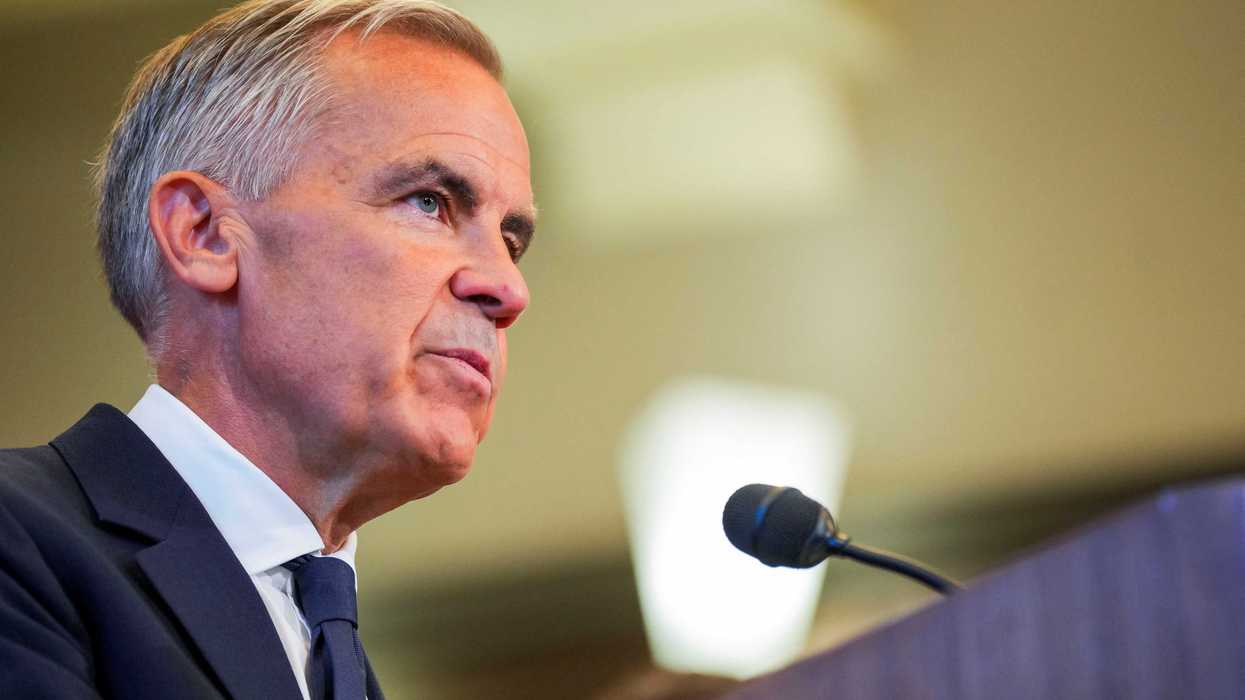
REUTERS/Chris Tanouye
Canada’s Prime Minister Mark Carney speaks with the news media after he suspended trade negotiations with the United States, in Ottawa, Ontario, Canada August 22, 2026.

Canada’s Prime Minister Mark Carney speaks with the news media after he suspended trade negotiations with the United States, in Ottawa, Ontario, Canada August 22, 2026.
President Donald Trump’s escalating trade war with Canada is creating headaches for Republicans ahead of November’s midterms as high prices remain a top concern among voters.
Responding to Trump’s increased tariffs, Canadian officials have said they’re deliberately targeting goods from states where there are close elections. And GOP candidates in Kansas, Maine and Ohio among others have been forced to balance supporting Trump with defending local manufacturers.
Trump has repeatedly targeted Canada, traditionally a close American ally, since returning to the White House last year. But his August move to impose 50% tariffs on billions of dollars of Canadian imports has heightened tensions, pushing Canada to retaliate with its own tariffs on hundreds of American-made products that went into effect Tuesday.
Nearly $28 billion in U.S. exports to Canada now carry up to 50% tariffs, a dollar-for-dollar match on Trump’s taxes on Canadian goods imposed last month, according to Canadian officials.
Trump has long argued that Canada is taking advantage of the United States because of a longstanding trade deficit — meaning more Canadian products are imported here than American products are exported to Canada.
“They don’t pay for anything, and they want to be treated like a state, but they’re not a state,” Trump said last month after trade talks fell apart.
The fallout could affect consumers and businesses across the country, but Canada targeted many of its tariffs to inflict political pain just ahead of the crucial U.S. midterm elections that will determine control of Congress.
The trade standoff has put Republican candidates in a tough position with an electorate already fed up with high prices and underscores ongoing concerns about how federal trade policy will affect American business and state economies.
On Labor Day, Trump threatened to halt sales of the Canadian airplane manufacturer Bombardier, saying its planes weren’t good enough and the company was treating America as a “piggybank.”
That became immediate political fodder in Kansas, home to Bombardier’s U.S. headquarters and competitive races for governor and U.S. Senate this year. The company employs more than 1,000 people in Wichita, the state’s most populous city that calls itself the “Air Capital of the World” with a local economy dominated by aerospace and aviation manufacturing.
The state’s senior Republican U.S. Sen. Jerry Moran immediately defended Bombardier, as did Ty Masterson, the Republican nominee for governor and current state Senate presidentBut the issue has put pressure on the state’s junior Sen. Roger Marshall, a close Trump ally running for reelection in a competitive race.
“We cannot allow this chaotic economic policy to continue to hurt Kansans; they deserve so much better. As your Senator, I will always stand up for Kansas workers,” the Democratic nominee in the race, Adam Hamilton, wrote on X Monday.
On Tuesday, Marshall said he would fight to keep Bombardier’s jobs in Kansas, posting on social media, “I’ve already taken that concern inside the Oval Office.” Marshall said he agreed with Trump’s aim of bringing more manufacturing jobs, particularly in Bombardier’s case because the company sells half its products in the United States.
Tariffs on Canadian and American goods are poised to especially hurt Northern and Midwestern states, according to an analysis from Oxford Economics. It identified North Dakota, Montana, Michigan, Illinois and Vermont as the states most likely to be affected because they trade the most with Canada.
Minnesota State Auditor Julie Blaha, a Democrat, said the trade feud is just the latest federal move to push up costs for businesses, consumers and local governments. Her office oversees some $56 billion in local government spending through financial integrity audits and budget analyses. She said Minnesota cities and townships have had no choice but to raise property taxes as they encounter rising prices.
“It’s just one wave after another. And it’s piling up,” she said. “All these rising costs are just coming home to roost, and they’re hitting Main Street.”
Minnesota shares a 547-mile border with Canada. Blaha said the state’s crucial agricultural industry is especially threatened as businesses constantly send products back and forth for processing. She highlighted General Mills, the maker of well known cereals, including Cheerios. The firm buys Canadian grain that is processed in Minneapolis before being distributed to domestic cereal plants and sold across the U.S. and Canada.
Grain is not on Canada’s list of targeted products for retaliatory tariffs, but the country did enact new tariffs on agricultural equipment, dairy and other food products.
“These tariffs have a bigger impact than just one just one hit on a price,” she said.
Canada’s retaliatory tariffs were aimed at pressuring the White House by targeting certain states and industries.
“We’re being wise and strategic to put political pressure,” Canada’s Industry Minister Mélanie Joly said last week.
Canadian data show countermeasures will hit Ohio harder than any other state, the Canadian Broadcasting Corporation reported. Ohio is home to one of the most competitive Senate races this cycle as Republican Sen. Jon Husted defends his seat from former Democratic Sen. Sherrod Brown.
Husted has largely defended Trump’s tariffs in the Senate. In an August interview with MS Now, he acknowledged the president’s decision-making was not in line with how he would negotiate, but declined to second guess Trump’s stance on Canada.
“It depends on how it ends,” the senator said. “If we get a good deal, both Canada and America can come out of this well, but it’s going to require both sides.”
Canada is Ohio’s biggest export market, sending $17.5 billion in goods across the border — roughly a third of the state’s total exports. More than half of the state’s exports to Canada come from the equipment and machinery and the transportation industries. Ohio is a leading producer of automobiles, an industry deeply affected by tariffs because of interconnected supply chains that span American, Canadian and Mexican factories.
Trump’s tariff “decision is going to make it very difficult for folks in the automobile supply chain to be able to succeed in Ohio,” Rob Moore, principal at public policy firm Scioto Analysis, told the Ohio Capital Journal.
While Canada’s countermeasures were politically targeted, they will sweep across the country, affecting solidly conservative and liberal states.
Connecticut State Treasuer Erick Russell, a Democrat, said the trade war will especially hurt New England states that trade more with Canada. He said the tariffs could raise prices of everything from electricity to consumer goods.
Though tariffs will hit businesses and consumers first, Russell said they will eventually put more strain on local and state government budgets.
And the president’s on-and-off-again history with imposing and rescinding tariffs injects more uncertainty for both business and government, he said.
“Where things are right now, there isn’t any certainty or clarity around where this is ultimately going to land,” he said. “What is consistent through all of this is that consumers in Connecticut and all across the country are going to continue to pay for this tariff war.”
The trade standoff could further hurt New England’s tourism industry that depends on steady Canadian traffic.
In New Hampshire, Maine and Vermont, tourism is big business year-round as travelers flock to beaches in the summer, leaf peeping in the autumn and skiing in the winter. Those businesses have suffered a drop in Canadian visitors amid Trump’s ongoing aggression with the country.
Steve Wright, general manager of Jay Peak Resort in Vermont’s Green Mountains, recently assured Canadians that they were welcome to the resort that sits just a few miles from the border and a roughly two-hour drive from Montreal.
“The border may feel different right now,” Wright wrote online. “We do not. You are our neighbors. You are our friends. You are part of this place.”
Vermont Republican Gov. Phil Scott recently characterized the president’s executive order to rename Lake Ontario to Lake America as “petty and disappointing.” Scott, who is favored in polls to win reelection in November, said the trade war harms communities on both sides of the border.
“Further escalating tensions does nothing to help American or Canadian families and businesses,” he added.
In neighboring Maine, U.S. Sen. Susan Collins has criticized the tariffs and urged the administration to resolve its dispute with Canada. A Republican in a competitive race for reelection, Collins grew up just 20 miles from the Canadian border.
Troy Jackson, her Democratic opponent, has blamed Collins for not stopping Trump’s trade policies.
Last week, Collins told reporters that the White House viewed tariffs in a macro sense without appreciating how damaging they are to border states such as Maine. Collins said Trump’s tariffs were already hurting local governments that rely on Canada for imported salt to treat roads in winter and could further hurt the state’s crucial lumber and blueberry industries.
While Maine’s important lobster industry was spared retaliatory tariffs, Canada did impose 50% tariffs on wood products and agricultural products.
“Canada is not China. It is not an adversarial nation,” Collins said. “It is our closest ally, our neighbor, our friend. And our economy is so intertwined with Canada that I am very worried about what the impact will be.”

