
The Supreme Court may have handed MAGA a win —despite ruling against them
(REUTERS)
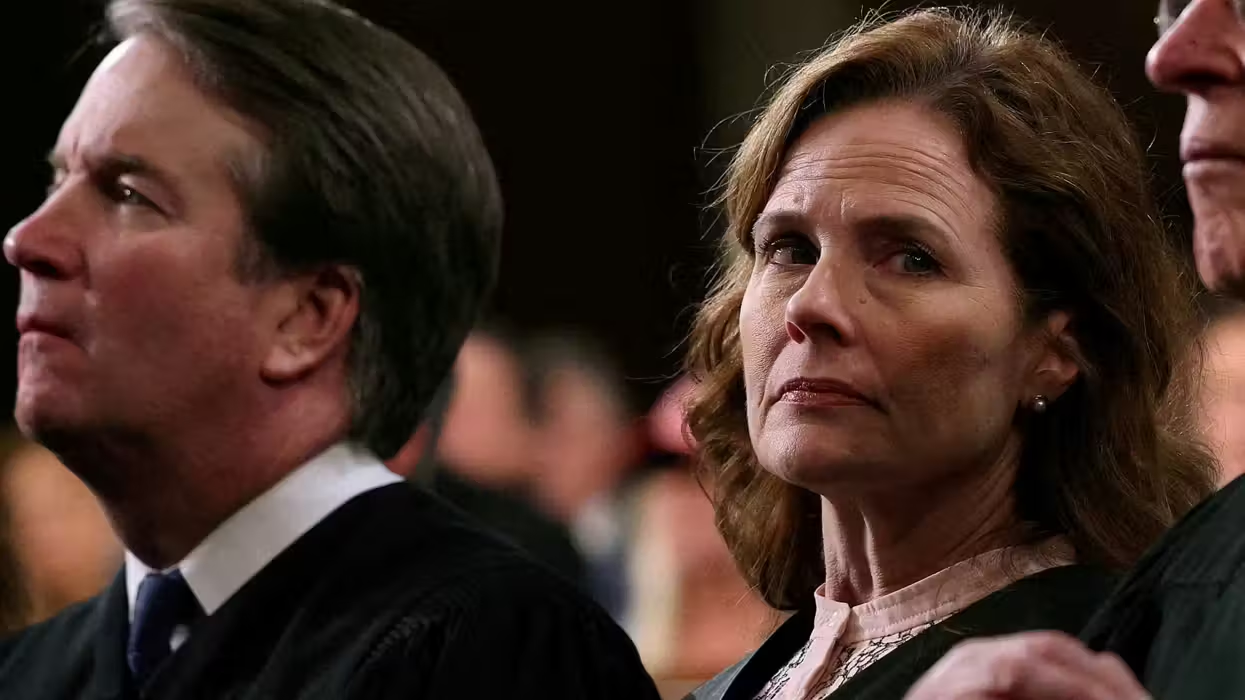
Justice Brett Kavanaugh and Justice Amy Coney Barrett, listen as US President Donald Trump addresses a joint session of Congress

Justice Brett Kavanaugh and Justice Amy Coney Barrett, listen as US President Donald Trump addresses a joint session of Congress
The Supreme Court has done its best to cater to President Donald Trump's wishes, from using a technicality to allow him to build the White House ballroom to overturning longstanding precedents so he can reshape the executive branch at will. Now a new report reveals that, even on an occasion when the Supreme Court seemed to rein in the president and his party, it may have still done their bidding — albeit indirectly.
Describing how Justice Brett Kavanaugh (who Trump appointed) recently rejected out-of-hand a Trump supporter's attempt to gerrymander away a Democratic seat in Missouri, Vox's Ian Millhiser wrote on Wednesday that "one possible explanation for Kavanaugh’s unexplained order ruling against Hoskins is that Kavanaugh did not believe that Hoskins had any business asking the Court to fix a problem that he created. Courts often rule against litigants who have “unclean hands,” meaning that they contributed to the problem they want the court to fix."
He added, "But, if that’s the case, then it’s still possible that Republicans could prevail in Onder, because the plaintiffs in that case did not personally create the problems that the GOP now complains about."
The reference to Onder exists because, even though Kavanaugh rejected Missouri's attempt to make it easier for House Republicans to retain control of that chamber of Congress, he did so without citing his reasoning. As such, a separate federal judge in Missouri is trying to allow Republicans to create chaos in the state by driving through that loophole.
"The Court didn’t just reject the GOP’s request, it did so in the most dismissive way possible," Millhiser explained. "The Court’s order was exactly six words long — 'Application (26A304) denied by Justice Kavanaugh' — and it notably was only attributed to one justice, Brett Kavanaugh. The Court’s procedures sometimes allow a single justice to dispose of a case, but the justices rarely invoke this process unless they view the matter as so one-sided that there’s no need to formally involve their colleagues. This case is known as Hoskins v. von Glahn."
Millhiser continued, "But then, just minutes after the ruling, Judge Stephen Clark, a federal district judge in Missouri, ordered the state to use the GOP-friendly maps after all. Though Clark’s case involves different parties — the lead plaintiff in Clark’s case is a Republican member of Congress, not Hoskins — the legal issues in both cases are virtually identical. And Clark’s opinion even acknowledges that, shortly before he ruled, Kavanaugh denied Republicans the very same victory that Clark wants to give them. Clark’s case, which is currently on appeal to the US Court of Appeals for the Eighth Circuit, is known as Onder v. Missouri."
Because of these two conflicting orders, and Kavanaugh's lack of clarity, Missouri officials who support Trump could still gerrymander away a Democratic seat. Moreover, they can create chaos during the election itself.
"It’s a terrible time, in other words, to be an election official," Millhiser wrote. "State election administrators should expect to spend the next two months buffeted by competing court orders, uncertain rules, and new policies that cannot possibly be legal. They should expect both Trump administration officials and state and federal judges to bombard them with commands that a ballot must be altered, or voters must be denied their right to vote — only to have those commands contradicted by new court orders that may themselves be tossed out on appeal. For now, for example, it’s unclear which maps Missouri is supposed to use in the upcoming midterms. And the final result in this case will likely turn on why Kavanaugh issued such a dismissive order in the Hoskins case."
This is not the only Supreme Court ruling that sided with Trump in practice, if not literally, and in the process has sown chaos in the American electoral process. As Quinnipiac University law professor John J. Martin wrote for The Conversation in August after the Supreme Court allowed Trump to continue his mail-in voting suppression based on a technicality, "election officials need to know how they’re supposed to manage their elections, and they need to know this months in advance. They want to know: Are we actually able to implement mail voting, or absentee voting, the way that we’ve always done it? Or is this executive order going to completely throw a monkey wrench into the process, and now we have to rethink everything, and we have to wait until we receive a list from the U.S. Postal Service confirming that the voters that we believe are entitled to these ballots are, in fact, entitled to these ballots?"
Martin concluded, "And voters might be fearful that if they try to vote by mail it won’t be counted. That could discourage people from voting through a process that has made it easier and more straightforward to vote for certain segments of the population – and really everyone."

