
Ticking time bomb: The real reason everything is about to cost more
REUTERS/Evelyn Hockstein
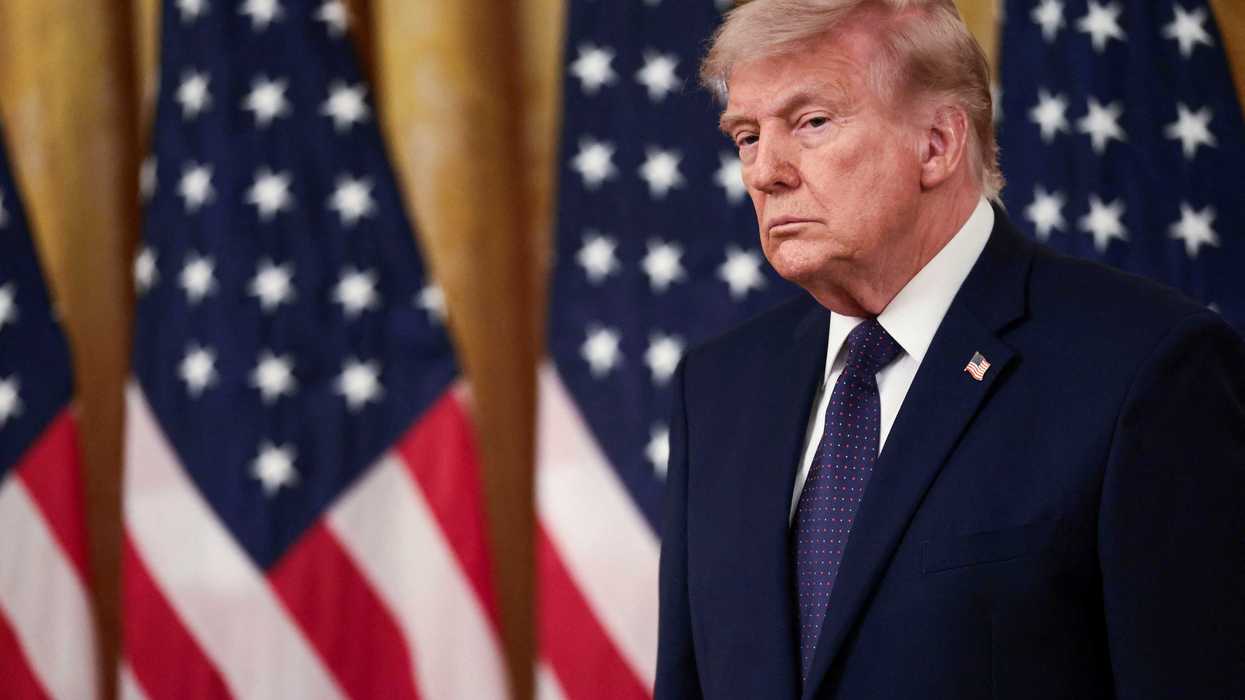
U.S. President Donald Trump in the White House in Washington, D.C., U.S., May 22, 2026.

U.S. President Donald Trump in the White House in Washington, D.C., U.S., May 22, 2026.
We speak to Richard Wolff, a prominent Marxist economist, about the economic fallout from the war on Iran, which recently reached the six-month mark. “Because it’s only been going on for a few months, the impact on the prices we pay is about to unload itself,” says Wolff.
The U.S. national debt, which recently topped $40 trillion, is “one of the many signs of an economy and of an empire that is now in decline,” says Wolff. “There is an enormous increase in defense spending, or now war spending, that is scheduled, and no comparable increase in revenue.”
Wolff also discusses how a global selloff of U.S. government bonds means increasing borrowing costs for everyday consumers.
This is a rush transcript. Copy may not be in its final form.ANJALI KAMAT: As the U.S.-Iran war intensifies again and the Strait of Hormuz remains largely closed, we begin today’s show looking at the economic fallout from the war, which began with the U.S. and Israeli attack on Iran just over six months ago.
On Monday, a critical meeting of finance ministers and central bankers from G20 nations wrapped up in Asheville, North Carolina. The New York Times reports that representatives from Europe and Canada repeatedly criticized moves by the Trump administration that have impacted their economies. Germany’s vice chancellor said the war in Iran and Trump’s tariff policy are leading to global economic instability.
This all comes as the U.S. national debt has topped $40 trillion, and borrowing costs for governments and consumers are on the rise due to a global selloff in government bonds.
AMY GOODMAN: To help make sense of this moment, we’re joined by Richard Wolff, professor of economics emeritus at the University of Massachusetts Amherst, visiting professor at The New School, co-founder of the journal Rethinking Marxism and author of many books, most recently, Understanding Capitalism. Richard Wolff is also the founder of Democracy at Work.
Welcome back to Democracy Now! It’s great to have you with us, Professor Wolff. Can you make sense of this moment as the U.S. passes the $40 trillion debt mark?
RICHARD WOLFF: Well, it’s one of the many signs of an economy and of an empire that is now in decline. And that has to be faced, even though it is difficult for any population to face that it might be at such a moment. We are borrowing beyond all words, the United States the most indebted country in the world. The People’s Republic of China is the number two creditor of the United States, which tells you a lot about who’s rising and who’s falling.
It is now the case, for example, that we will be spending a trillion dollars of the federal budget just to pay the interest on that $40 trillion debt. And what that means to every American citizen and every American business, you’re paying taxes that are going to Washington not to pay for roads or highways or schools or medical care, just being collected by the government and given over to the wealthy companies and individuals and foreign countries who have lent that money. Had the government taxed, had the government functioned differently, we wouldn’t be in this debt. That’s not a manna from heaven; that is a political choice.
There’s one example that I learned about a couple days ago that I want to give you just to show you the ramifications of this war. The price of a ship going through the Panama Canal has gone up by 100 times compared to February of this year, before the war began, to now.
AMY GOODMAN: Panama Canal.
RICHARD WOLFF: Panama Canal. And what’s going on is that since the Strait of Hormuz is closed — not open as President Trump says, closed — one of the things that’s happening is a crisis for shipping companies that would normally use the Strait of Hormuz. So, what are the shipping companies doing? You know, this doesn’t take a genius to understand. They’re looking for other routes. And one of them is to use the Panama Canal. So, suddenly, ships are showing up at the Panama Canal in much greater numbers, and they’re desperate. They have to make their travel plans work. So, the authorities in Panama have said, “Well, this is a wonderful opportunity.” And to give you an example, the average price of a ship going through in February was $55,000, the fee; the latest number, $5+ million. That’s a hundred times larger.
And why is that important for everybody, beside the obvious? It’s going to be inflationary for us. All the goods that are going through there that end up being consumer goods will have to be priced at a higher price to cover the higher cost. That’s a direct outcome. If you hadn’t made war on Iran, the Strait of Hormuz would have been open as it was before the war. So, this is right on the government of the United States. Their decision led to this burden. And because it’s only been going on for a few months, the impact on the prices we pay is about to unload itself. It’s just as dramatic, for example, as the crazy price of jet fuel, of diesel fuel, because that’s also wrapped up in this story.
ANJALI KAMAT: And, Professor Wolff, what is important for people to understand about the bond market? I mean, we keep seeing these headlines about bond selloffs, higher bond yields, lower bond prices. What does this actually mean? And what is important for people to understand in how this all relates back to the Iran war?
RICHARD WOLFF: The basic law of bonds is this: When the government borrows money, it gives you a piece of paper, or an electronic version, saying, “We owe you a million dollars,” if you’ve lent the government a million dollars, “and we will pay you an interest rate, so-and-so many dollars twice a year between now and the time we pay you back.” So, that’s what the deal is. Well, you can buy and sell that IOU. It’s negotiable. And so, there’s a huge market around the world where people and businesses and governments can buy and sell these, what they’re called, Treasury securities. If the price goes down, you still get the same interest payment, so that means that the percentage goes up. So, the price of the bond goes down, the interest goes up. That’s the way it works.
Now, here comes the punchline: If you keep borrowing like there’s no end in the world, which is the United States’ behavior — by the way, not just Mr. Trump, although he has violated every commitment he made about getting rid of the national debt — it’s gotten larger; solving the problem — he’s made the problem worse. But to be fair, Mr. Biden did his share of this also. This has been a joint project of both parties. They are afraid to tax, so they substitute by borrowing. But what people need to understand is they borrow from the rich. Who else can lend to the government? You have to be either a rich company, a rich government or a rich individual.
And so, what’s going on is we’re collecting interest — that’s the job — from all of us, our taxes, which are then delivered to the rich people who’ve lent to the government. Instead of taxing the rich, which would have gotten you the money, the government could have spent it, end of story, what you’ve done is borrowed that same money from the rich. The reason the government can borrow from the rich is because it didn’t tax them. It’s the same money, only it’s going to the government as a loan rather than a tax payment. For a rich person, this is a no-brainer. Which would you rather have: pay a tax, say goodbye to the money, or make it a loan, which gets paid back and pays you interest while you wait?
ANJALI KAMAT: And as this interest rate goes up to these people who the government is borrowing from, what does that mean for everyday people, people who are trying to take out mortgages? And how does the government plan to continue paying for this war in Iran as mortgage costs go up, as the cost of borrowing for regular people goes up?
RICHARD WOLFF: Let me answer the second and then the first. What the government is planning, according to Mr. Trump, is a bigger budget deficit in the year coming up than we already have this year. There is an enormous increase in defense spending, or now war spending, that is scheduled, and no comparable increase in revenue. Therefore, we’re going to get a trillion-plus dollar deficit again, as we have had now for several years. So, the problem isn’t going away; it’s getting worse.
And now to your first part. Banks in this country — let’s take a very simple example — they have a lot of money they want to lend. One place they can lend it to is to human beings who want to buy a home, who borrow a mortgage, we call that. But that’s usually a loan for 15, 20, 30 years. Well, the government borrows for 15, 20 or 30 years. And a bank is, therefore, always comparing: Where do I make more money? If the government is deeply in debt, and therefore has to pay higher interest rates, the banks are going to move their money away from the mortgage market, make it harder for people to borrow, because they want to put that money to the government. And the simple reason? The government is less dangerous as a borrower than an individual family which could have a problem. So, you’re going to squeeze the mortgage market — that’s going to hurt everybody thinking about borrowing to buy a home — while they fund a government that is increasingly going into debt. It doesn’t take any foresight to understand this is not sustainable. This is the behavior of a government which, to parrot Louis XVI, if I’ve got that right, who was famous for saying, ”Après moi, le déluge,” “After me comes the catastrophe.” We’re watching that play out, only it’s us this time.
AMY GOODMAN: Let me ask you about a New York Times piece today headlined “Allies Grumble That U.S. Is Hindering Global Economic Growth.” Trump has eviscerated regulatory barriers for businesses, including the booming artificial intelligence industry, leaned into fossil fuel production. European leaders remain more cautious on AI and other deregulation, more committed to a transition to renewable energy sources like wind and solar power. So, if you can talk about the price of oil and what this means for this country and around the world?
RICHARD WOLFF: Yes, the crisis is played out because the Europeans, largely because of pressure from below of the mass of the Europeans, they’re not letting the climate issue go. They’re saying — and by the way, over the last two or three summers, as we all know, the temperatures of Europe have been record-breaking and deadly for large numbers of their people, so this is an urgently viewed problem. They’re demanding long-term solutions. And those include not relying on oil and fossil fuels. Those include conservation. Those include all kinds of measures that are being made more difficult by everything Mr. Trump is doing.
AMY GOODMAN: In fact, the climate crisis is affecting shipping with a historic drought in Panama that’s severely limiting water flows through the canal.
RICHARD WOLFF: That’s right. And that’s one of the reasons they’re charging more money, because — you know, it is a crazy quilt. This war is not only being lost by the United States, if you’re going to be honest, but the reality is, it is a moment in which a relatively poor, relatively smaller country is confronting the big elephant in the room, the hegemon, the power country.
And the whole world is watching this, and the whole world is wondering: “We have developed a dependence on the United States” — because of the role we played in the world the last 70 years, coming out of World War II, and all the other advanced industrial countries were destroyed. We emerged. Thanks to the Atlantic and Pacific Oceans, we could survive. We inherited the great colonial empires. We became the sole one. That’s why we were so rich. That’s why we had this explosion in which we fancied ourselves the great American exception.
We weren’t the exception. We were under exceptional circumstances, which everyone should have understood would never last. But instead of preparing for that, instead of having a plan to deal with the inevitable disappearance of those conditions, we imagined they would last forever. And now we have a government that is actually trying to roll back the inevitable movement of history. We’re not going to make America great again, because the conditions for doing that aren’t here. And all the bombast and all the verbiage doesn’t change that. And the reality is being shown to us in Iran by the ability of this country, this little country, to push back effectively.
ANJALI KAMAT: Professor Wolff, you talk about the U.S. as an empire in decline. You also talked about the coming deluge. Where do you see the U.S. economy heading?
RICHARD WOLFF: At this point, we’re at what’s called a knife edge. If those interest rates go up, that we were just talking about, that’s a marker for recession. If interest rates go up, people can’t afford to buy that car and make the monthly payments, or the house. And the inflation means we can’t buy as much as we — we’re crunching this economy down. And the irony is, Mr. Trump seems determined to go in that direction, even as the midterm elections are saying to the American people, “Here is a chance. Think about what you’re going to do when you vote,” given what we’ve just been talking about.
AMY GOODMAN: What does Trump gain from this, from his approach? Is it simply personal wealth?
RICHARD WOLFF: No. If I may be allowed, I’m married to a psychotherapist, and so I get tutored from her all the time. This is a psychological problem. It really is. It’s denial. He is the theatrical embodiment of “we’re tough, and we’re powerful.”
As you put it in your show — right? — a few moments ago, this behavior of killing those people in the boats in the Caribbean, this violation of every law, of every tradition — you know, here in America, we arrest people for the drug trade, which is what’s claimed about them, and we — but we give them a lawyer, and we give them a chance to confront evidence, and we give them a chance to face a judge. And if they’re found guilty, we give them a prison sentence. It’s not a capital crime in the United States. What are we doing killing people without any legal recourse? What kind of behavior is being them? This is macho. This is the kind of behavior that we ought to be ashamed of. But it is a — it is part of a denial: “We are — look what we can do.” It’s very tragic. But in the history of the decline of empire, I hate to say it, but it is not unusual that the people caught up in that decline have a very hard time facing it.

