

The four words that explain why Trump finally blinked
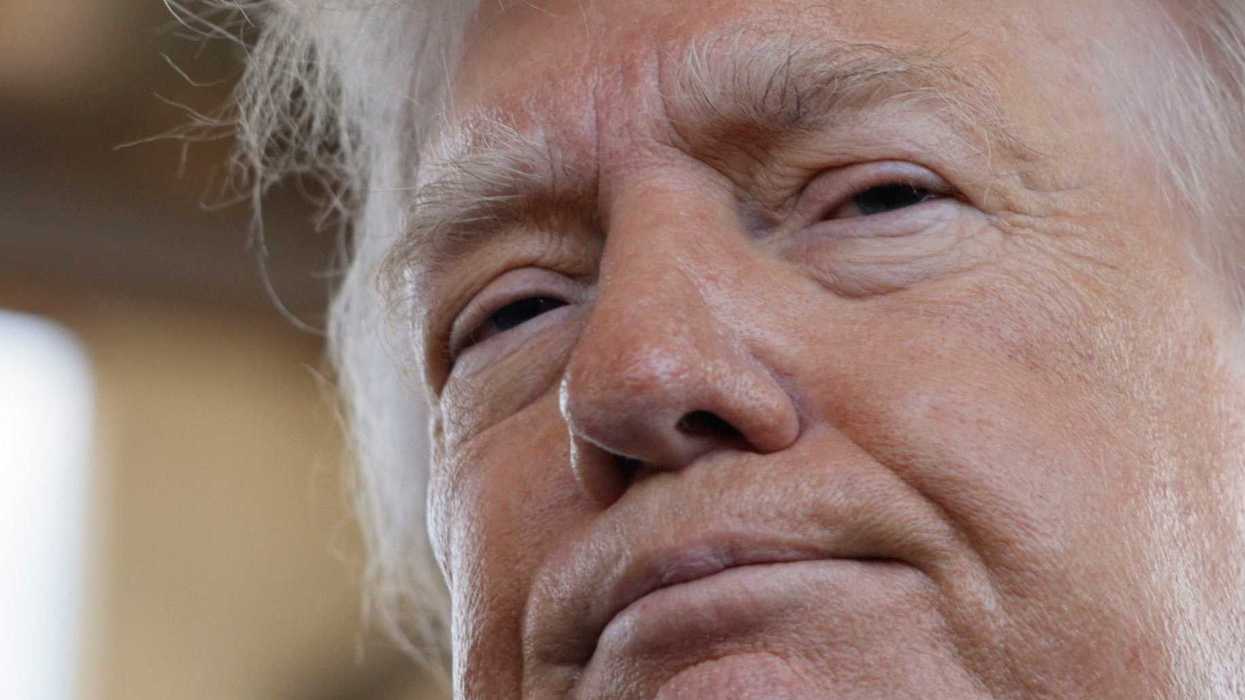
US President Donald Trump speaks on the day the final steel beam goes into the ballroom, at the White House in Washington, DC, US, November 4, 2026.
President Donald Trump repeatedly threatened to steal the 2026 midterm elections if he could not win them legitimately. From declaring a national emergency and seizing ballot boxes to filing frivolous lawsuits and intimidating voters with law enforcement, Trump had no shortage of tricks up his sleeve to thwart the democratic process, much as he tried to do after he lost the 2020 presidential election.
Yet at the time of this writing, Democrats have won the Senate (with at least 52 seats out of 51 needed) and the House of Representatives (with at least 230 seats out of 218 needed). Instead of attempting a coup as he did after losing in 2020, Trump immediately conceded, with administration insiders even admitting that the Iran War has been such an economic and military disaster that it likely is to blame for the GOP's losses.
To better understand why Trump quit on his fascist takeover threats, I reached out to historian Dr. Federico Finchelstein, author of The Wannabe Fascists (2024), From Fascism to Populism in History and A Brief History of Fascist Lies. In 2024, Trump's then-press secretary Karoline Leavitt referred to both of us as "disgusting" for comparing Trump' to Nazi leader Adolf Hitler. Flash forward two years, and now both Finchelstein and I are contemplating why Trump has not succeeded in his coup attempts like Hitler did.
The following interview has been lightly edited for clarity, context and length.
Why Trump didn't pull a fascist coup on Election Night.
Matthew Rozsa: President Trump has made it clear that he plans on meddling in the 2026 midterm elections unless Republicans retain both houses of Congress. Yet last night, he almost immediately conceded once it became clear that the Senate and House had gone overwhelmingly Democratic. As a student of fascism and attempted fascist takeovers, what happened? Why did Trump blink, or perhaps decide that the fight wasn’t able to be fought?
Federico Finchelstein: Well, to me, it’s clear that Trump has a kind of fascist project for the nation, an authoritarian, dictatorial project. I call him a wannabe fascist. And given the fact that he’s not a full fascist, but rather a kind of person that would like to be in an authoritarian situation, he’s all the time stopped by countervailing forces. And to put it in terms of a short phrase that has been used, and rightly so, in my opinion: it was too big to rig. I mean, Trump is known as a cheater. He said that he was not going to abide by the normal rules or even procedures. But it was too big. And I think this shows what history also shows, which is that fascism can be resisted. Fascist projects or dictatorial projects can be stopped when people actually participate in the democratic process.
I mean, democracy needs to be defended, and it was defended yesterday. So I think this is not over. Even in the sinking ship, Trump might adopt a kind of Hitler bunker mentality. And in this perilous moment, or this perilous mode, I think Trump is equally dangerous. So I don’t think this is a major, major victory on the side of democracy. This goes, in my view, beyond the Democratic Party or the specific politics. And I think this is not over, and even if he conceded, and although you might also see mixed messages, or signals, in the coming days, I think he can do a lot of damage still.
So I think we need to be happy, but also very aware that this democracy continues to be in need of defense, and one will hope that more separation of power and more active participation in politics will provide more barriers to Trump’s attempts to destroy democracy from within.
Matthew Rozsa: When you talk about the need for increased vigilance, you raise an interesting strategic question. Democrats are torn between two factions: those who want to aggressively impeach Trump and other corrupt administration officials, and those who think that doing this would seem vindictive and would not accomplish anything for Americans who need economic aid. I want to know, from your point of view, which camp you agree with.
Federico Finchelstein: Well, Matt, I think you’re asking a key question, and I’m not a policy person. So my point is, as a historian, I will say this: in democracies that were under attack, it was important to make clear to those, I would say, enemies of democracy that their actions will not go unpunished. This is a hard-learned lesson, because I think of what happened in Brazil. As you know, Bolsonaro imitated Trump one year later, doing exactly a kind of failed coup d’état. As Trump had done on January 6th, Bolsonaro did, but the Brazilian justice system acted differently. Bolsonaro was prosecuted for attempting against democracy and could not be a candidate, and as you know, he chose his son, and the son lost.
So Trump was allowed to run, and there were a lot of questions as to why the Department of Justice under the Biden administration was not as proactive as its Brazilian counterparts. And that kind of background goes back to your question, which is that I don’t think these are mutually exclusive situations. I think Democratic representatives were elected in order to defend our democracy, and that includes, of course, trying to make life better for Americans, because one should not detach something that was quite unified. I mean, two elements of Trumpism were quite unified: attacks against democratic institutions and, of course, an attempt to benefit those at the really, really high end of American wealth.
So this kind of increase in the gap between the top and the bottom, in terms of economic inequality, is also related to the increase in authoritarianism at the political level.
How to hold Trump accountable.
Matthew Rozsa: In other words, it sounds like what you’re saying is we need to address income inequality and address justice inequality, and income inequality is caused by policies which concentrate wealth in the hands of the few. Justice inequality is exacerbated by corrupt political figures being left unaccountable because of concerns about political propriety. To address something that you said earlier, that it was mysterious why President Biden did not pursue Trump more aggressively, it isn’t actually mysterious at all. He and Attorney General Garland were confident that the American people would never return him to power, and also did not want to seem petty and political. So although they did pursue those prosecutions, they tried to not rush them, I suppose would be the way they put it. My question to you, therefore, is what do you think the American people can do at this point to ensure that Democrats seize this moment in history and try to achieve both of those things at the same time?
Federico Finchelstein: Well, I think the message was clear from a majority of American voters that they saw problems with Trump’s authoritarianism, the lack of justice, those issues about inequity and corruption, as well as income inequality and the higher cost of living. So I think these policies cannot be one-dimensional, in the sense that elected representatives, in order to do what they were elected for, would have to address them both, at many levels. But the two are connected. I think it’s part of the same, two sides of the same coin, let’s say: increasing authoritarianism, the lack of justice, as you also put it, with the higher cost of living and income inequality. Not to mention foreign wars that nobody wanted, and many other problems that Trump had either created or increased at both the national and international level.
Matthew Rozsa: I’m curious if you would agree with me, as a historian of fascism: it sounds like one of the key reasons this fascist project became untenable in America is that America has a decentralized form of government. The founding fathers, in their wisdom, wrote into the Constitution of the United States that federal elections would be held by the states, and as a result, President Trump, despite repeatedly trying to gain access to voter rolls so he could conduct purges, was blocked. He was blocked dozens of times by courts all over the country, including by Republican judges that he appointed, because they kept saying that the text is indisputable. Therefore, could you argue that America’s decentralized form of government is what made this, to refer to your own language, too big to rig?
Federico Finchelstein: I think that’s part of the answer, of course. The other parts are that Trump is not a fully committed individual. He is very weak in the translation of his desires into action, and he is also very unstable. So my point is, of course you are right, but one wonders to what extent Trump’s own inability and instability, and I would say even idiocy, also presented problems towards the achievement of those aims. I think—
Matthew Rozsa: I have to interrupt you here, because if Trump had been able to access those voter rolls, if he had been able to do so even once by force, it would have set a precedent that would have allowed him to do so everywhere by force. And at that point, who is to say that he wouldn’t have been able to purge thousands of people from the rolls in key states and, if not prevent last night’s blue wave, at least reduce its negative impact on him?
Federico Finchelstein: Yes. And imagine if there was a difference of one. So my point is, for example, in the Senate race, the overall results were so big. I mean, the different possible strategies, including possible illegalities and forms of cheating, could have been expanded. And you’re raising an important point regarding one of the dimensions that probably stopped Trump from doing so. But as you know, there were attempts to circumvent legality, for example, in Alaska or other places, and the judiciary also proved itself autonomous this time. And this is not obvious. It doesn’t happen all the time, as you know.

