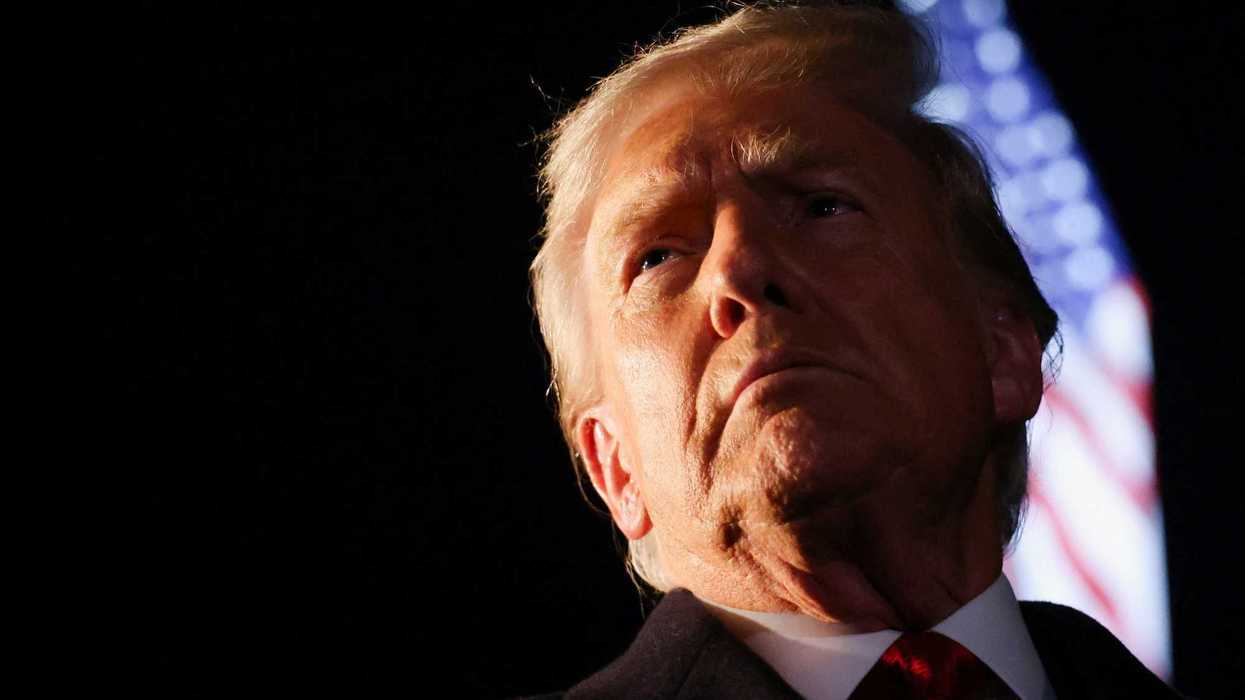
Donald Trump may think the midterms are all about him, but historian Heather Cox Richardson argues the moment runs much deeper.
“This moment is far bigger than Trump,” she wrote in Monday’s Letters from an American.
Richardson argues that a pattern is at work in Trump’s second term that has been repeated throughout American history: a handful of wealthy men rigging the system to pocket the wealth produced by ordinary folk. At certain junctures, a majority of voters see what is being done and put up a fight.
She takes Trump’s closing argument as evidence of how adrift he is. On Monday at the Lincoln Memorial Reflecting Pool, before what she described as a very small crowd, he spent the first 16 minutes or so discussing the pool, blaming vandals for its troubles rather than poor workmanship. From there, he went on to what Richardson described as exaggerated claims and his pet construction projects in Washington, including a golf course and a triumphal arch.
As for the Republicans, they are bracing for heavy losses. Richardson cited a Politico report in which GOP insiders were privately blaming Trump. She pointed to his trade wars, the war with Iran, corruption, his ties to Vladimir Putin and his attacks on immigrants as reasons for his unpopularity. “We all know who the problem is,” a Republican strategist told the outlet.
Richardson traces the cycle back to the country’s founding. After 1854, Americans from a range of political parties united against the power of Southern enslavers, eventually putting in place a government that broadened voting rights and access to land. In her account, the crash of 1893 helped fuel the backlash against the robber barons and the rise of the Progressives; the concentration of wealth in the 1920s was followed by the crash of 1929 and, later, the New Deal.
Then in 1981, the pendulum swung with Ronald Reagan. Richardson argues that tax cuts and deregulation helped move money upward, citing a Time article on an estimated $50 trillion shift in income toward the richest Americans over several decades beginning in 1975.
She also refers to the Guardian’s account of Elon Musk’s spending of at least $446 million on the midterms and to voters making long journeys to reach the polls. And the Supreme Court, she notes, rebuffed the administration’s emergency request Monday night to set aside some 20,000 California ballots.
Early voting and polls suggesting a Democratic wave are only indications, Richardson cautions. The results will depend on the count after the polls close.
In her view, the way the government has been openly exploited in Trump’s second term appears to have made it plain to most Americans that Republican policies since 1981 benefit only a few. They seem to be uniting once more to build a government that works for all. If her reading of history holds, the force Trump has riled up could outlast him.