
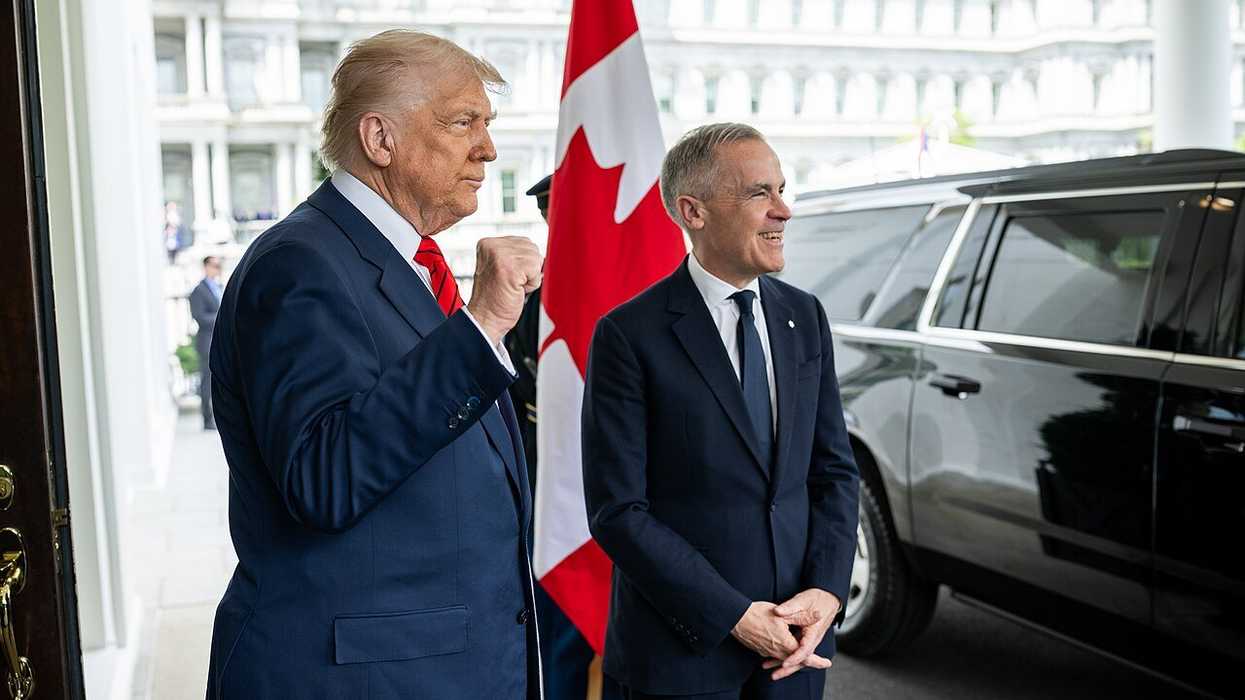


President Donald Trump's trade wars are not a theoretical exercise. As even his staunchest supporters are starting to understand, they cause long-term harm to the American economy, whether directed against longtime allies like Canada or those with whom we have had periodic tensions, such as China or nations in the Middle East.
Canada, of course, receives special attention because Americans are not used to having an antagonistic relationship with them. Speaking to AlterNet in August, President Bill Clinton's top economic adviser Dr. Robert J. Shapiro pointed out that "just this week, Trump announced 50 percent tariffs on our largest trading partner, Canada, which will further increase inflation." Explaining in September how Canadian Prime Minister Mark Carney has gotten the advantage over Trump, Dr. Richard D. Wolff — a professor emeritus of economics at the University of Massachusetts Amherst – pointed out that "our government is busy strong-arming people around the world in every way that it can, militarily, economically, politically, and discovering time after time to their amazement, if you take them seriously, that the folks are going to resist. And that's what's going to happen."
For this interview I spoke with Dr. Ed Gresser, a trade expert at the Progressive Policy Institute, who also authored one of my favorite books on the subject, “Freedom from Want: American Liberalism and the Global Economy." He connected Trump's trade war against Canada with those against China and various Middle Eastern countries, and thereby shed light on the long-term consequences for the American people.
This interview has been lightly edited for length, clarity and context.
ROZSA: What specifically triggered this trade dispute with Canada, and how does it differ historically from previous US-Canada bilateral trade friction?
GRESSER: Well, in terms of what specifically triggered it, I guess it sort of started in the transition period, that Trump personally began threatening Canada and Mexico with quite high tariffs — in contravention of the US-Mexico-Canada agreement that actually the first Trump administration had worked out. It was not clear why, and I think it is still not clear why they're doing this.
At the beginning of February 2025, they made a claim that Canada was not doing enough to stop fentanyl trafficking along the US-Canadian border and announced a 20% tariff, I believe, on Canadian goods. That was not true. There is very little fentanyl trafficking on the northern border, and it may — based on seizure data, there may well be more going north and coming south. Canada, unusually among other countries — I back up and say, then the administration, I think in March, imposed very — kind of enlarged the existing so-called national security tariffs on steel and aluminum, for the first time applied these tariffs to Canadian and Mexican steel and aluminum. Canada is our main source of aluminum, it's quite a large industry there.
The Canadian government retaliated with its own set of tariffs, and I think that is sort of what is really the animating thing for the Trump administration and for Trump personally — that only, in its year and a half of trying to impose tariffs on everyone, only China and Canada have really retaliated with their own tariffs on American things. And China has sort of wrestled the administration to a draw more or less. Canada's smaller, more dependent on the United States, and it may be that the administration generally feels they need to retaliate — they need to treat this very seriously, to avoid the potential that other countries might adopt Canada's approach and get back when the administration kind of hits them. I think they would be quite alarmed about that, and so they want to kind of make an example.
And probably Trump personally is — and he seems to have some real animus against Canada for reasons I don't understand. And that goes well beyond tariffs, although tariffs are kind of the main policy thing, but he's always sort of belittling Canada and calling it the 51st state and things like that. And it's just very — there must be — there seems to be something really personal involved in this, which I don't feel I have any insight into. It's just, it's weird. (laughs)
ROZSA: I think much of what Trump does can be accurately described with the adjective weird.
GRESSER: Yeah. Mm-hmm. It seems that Canada is particularly weird.
ROZSA: I agree — because if I may speak off the cuff, say what you will about his animus toward China, but China actually has behaved aggressively toward the United States, at least economically. It is not entirely unjustified. But am I correct in saying that this cannot be accurately said of Canada?
GRESSER: Yeah, I would say you are correct in that. The US-Canada trade relationship is very large. There are some kind of long-term irritant points in it — many, many generations of trade negotiators have been very frustrated with Canadian dairy policy, and some of them are frustrated with cultural exception issues. But these are very specific things in a very large relationship that's generally very good for both sides. And most relationships have particular touchpoints — whether something's really dug into a national policy and the other country doesn't like it, and they have their own complaints about us as well. And we often have tariffs on Canadian lumber based on a complaint which is — not crazy, but not really unshakable — about subsidization of logging in Canada.So there's all those sorts of things. There are issues that the US government has tried to work out with Canada and hasn't been able to do it, and those are things the Trump administration is bringing up as a kind of rationale for all this. But they're, in a world of a trillion-dollar trade relationship, they're pretty small. And the harm done alone by the aluminum tariff alone to the US economy is way bigger than anything else — to say nothing of the Trump administration really doing its best to no longer have a friendly relationship with our permanent neighbor.
ROZSA: Well, I want to refer to your book, "Freedom From Want," and I know you'll forgive me for this unsolicited plug, but to the readers who will see this interview — "Freedom From Want: American Liberalism and the Global Economy" by Edward Gresser is a masterpiece. And if you want to understand trade policy, I recommend that you read it. Now that I've embarrassed you, I would like to ask about this quote from page 95: "The agreement which brought China into the World Trade Organization, conducted by President Bill Clinton's second US trade representative, Charlene Barshefsky, in 1999 and implemented in 2001, was the last genuinely big change in the global trading system."
Looking back a quarter century later, would you say that is still true?
GRESSER: No, I wouldn't say that's true at all. There's been a number of things to point to, but the Trump administration's attempt to return the US to a kind of high tariff isolationist policy is a very big change.
ROZSA: Would you say that the hope for bilateral and amicable trade relations between America and China has been permanently disrupted by Trump's actions?
GRESSER: With China? Well, permanent is a long time, I suppose. Chinese history, 3,000 years or so — there's been a lot of ups and downs over that period of time. I think in the relationships we have with Canada and Mexico and the European Union and a number of our other major trading partners, and with developing countries and low-income countries, the main cause for stress and problems right now is the Trump administration's policy, and reversing things the Trump administration has done, or replacing them with something better, would help settle these problems.
With China, there's a lot of, as you say, complaints about Chinese behavior. I think a lot of countries view China as mercantilist, and pouring lots and lots of money into industries where they're already quite large and squeezing out others. Eight years ago, when the first Trump administration published this kind of — they call it a Section 301 report — about Chinese government intellectual property extraction and forced technology transfer — and you can argue about whether the response was the correct one, but the diagnosis was not wrong. Those were kind of big problems. And underlying that was a larger policy China had introduced in 2015 called Made in China 2025, which set aims for market share, both within the Chinese market and globally, for a series of industries. And that was something a lot of Americans, both in government and in business and labor and in academia, found pretty threatening, and not something the US government should just kind of accept.
So there are, in that relationship, a lot of quite legitimate complaints about Chinese policy behavior, and they're not uniquely — they're not unique to Americans. There's a lot of concern in other countries as well.
ROZSA: I appreciate you being so thorough. I am now going to cite your book just one more time. It is one of my favorites, so I have to restrain myself. But at the end of the chapter about the Middle East, on page 197, you say: "The Muslim world needs no aid program on the scale of the Marshall Plan" — which for my readers was implemented by President Harry Truman to reconstruct Europe after World War II — "Instead, it needs a Western policy suited to a region with lots of cash, but little industry, few jobs, and too much oil. Though some help for Pakistan's schools and Egypt's roads and ports would be welcome, the region's real need is to attract investment, create jobs, and restore a sense of hope to the public. And for this, trade is far more effective than aid."
Now, would you say that President Trump's invasion of Iran and overall belligerent posture toward the Middle East works with or against the goals that you described in that sentence?
GRESSER: I would say against. I don't think the administration has ever explained what it's trying to achieve with this war. It has definitely raised a lot of — that part of the world is has endemic and high tensions, and they were already quite high before, and now they are considerably worse. The Iranian government appears to be kind of emboldened, and feels with some justification that they have faced Trump down. And the administration is kind of, I think, seems like they're kind of continuing what they've been doing in the hopes that something will change, rather than explaining — here's what we're going to achieve — in a way that, actually, I would say the Bush administration did try to explain: here's what we're trying to achieve and here's how we're going to do it. And that didn't go well.
And this is a significantly worse situation, where there's no US public support for this. There's no congressional authorization. And, you know, who knows where this will end.
ROZSA: What industries or sectors on each side of the US-Canada border are absorbing the most damage? I'm returning to US-Canada relations, but if you want to describe the Middle East or China, I'm open to that as well.
GRESSER: That's okay. In terms of US and Canada, the Canadian industries that have been most heavily targeted by Trump administration tariffs would probably be the metals industry, and potentially very much the automotive industry. Those are quite large parts of Canada's industrial economy. In the case of aluminum and automotive particularly, they're very integrated with American industry, and things that make Canadian aluminum harder to buy and more expensive are immediately bad for American aircraft manufacturers, and for appliance makers, and for automakers — and likewise, tariffs on auto parts and so forth.
So that would be one set. If this escalates, then the US auto industry — at least the Michigan-based and Midwest-based part of it — would be very vulnerable. Canada's the biggest foreign buyer of American-made cars. And the production lines are so intermeshed between Ontario and Michigan that the damage of tariffs will kind of be multiplied many fold. US dairy industry is going to be hit pretty hard by Canadian tariffs.
So those would be kind of the biggest ones, I think. One thing I was kind of watching last couple weeks was in aviation, and Trump said he was in some way going to try to ban Bombardier aircraft from being sold in the United States. This is a Canadian maker of small jets, often corporate jets and things. And as it turned out, and the administration probably didn't know, a lot of the Bombardier parts are made in the United States, in Kansas and in Texas. So they would suffer pretty badly if that actually happened.
I would say basically up to now, the level of anger and kind of a sense of stress is a lot higher than the actual coverage of the tariffs. Like what the Trump administration did in July, and Canada did in response in August, is about $20 billion of trade going from one country to the other. And that's about 5% of US-Canada trade. So it really doesn't — it affects particular industries, but it probably doesn't do systemic damage to either economy. But it's quite possible it would escalate. Trump has sort of threatened tariffs on Canadian cars and things, which would be a very large thing. So the question of how much actual economic harm is still open. It depends on whether there's a de-escalation or whether it continues to get worse.
But the damage to kind of the sense of common destiny, and trust and confidence within North America, is probably very high by now, and not easy to repair.
ROZSA: What actually happens in terms of who pays the costs of these tariffs — Canada, Middle East, and China — whether it's companies, consumers, or workers? How does this play out in practice? And I know that is a very broad question, but candidly, it is the single question I get asked the most as a journalist, so I feel the need to pass it on to you.
GRESSER: All right. Well, they are actually getting a kind of experiment done in this, and I think the economists will be learning from this experience — how does an experiment like this work out in practice? Typically, economic modeling suggests that consumers bear the end cost of tariffs. So, if you're asking who pays — within, in most cases, a business pays. So if you're buying a car that suddenly has a 20% tariff on it — the dealership that gets it from Europe, let's say it's a 15% tariff, which is what the Trump administration has done so far. The dealership will pay at 15% to Customs and Border Protection, and that is part of the price that they've paid for the car, and they have to make some amount of profit on the car to pay their employees and keep the shop running.So that eventually comes onto consumers. And that's sort of the theory of how this works. And what we're seeing in the actual, kind of, running through this — companies do have some options and alternatives. They have to pay this money, and the mechanical thing to do is just tack it onto the price you're charging to your customer. But especially for large companies, they have some ability to save elsewhere. So they can hire fewer people. And that is one of the things we've seen over the past year and a half — the rate of job creation's gone down. So, in that sense, companies are nervous about customers' reactions to price increases, so they try, at least for a while, to avoid it by saving money elsewhere.
Some companies in retail are large enough that they can put the cost on consumers, but in variable ways — so they figure out which types of products are most — what will customers be most willing to accept price increases on, and which will they be least willing? And they can raise the price of the first type of good more, and the second type of good less. What does not happen is that foreigners pay tariffs. This is a cost that's put on the US economy in one way or another. And I guess if you had asked me a year and a half ago, I would've probably guessed there'd be more price impact, and I wouldn't have really predicted the labor impact.
ROZSA: Is there a realistic off-ramp here in terms of Trump's trade wars with Canada and China, as well as his unsatisfactory policies in the Middle East? Or does the trajectory point toward escalation?
GRESSER: There's numerous off-ramps. One off-ramp is in the courts. The courts have so far been ruling against the administration on these issues. The way the Trump administration has done this is not the constitutionally appropriate way. The Constitution says Congress shall have power to lay and collect taxes, duties, imposts, and excises, and is also responsible for regulating commerce with foreign nations. So all the previous presidents who wanted higher tariff rates, whether it was Herbert Hoover or William McKinley, or — what was his name — Benjamin Harrison, people of that sort, would always ask Congress to pass a tariff bill. And Congress would either do that or not. And that is how the Constitution says, if you want to raise tariffs, that's how it ought to be done. The Trump administration has tried to do this by finding kind of old trade laws that are kind of disused, dating from 1930 to 1974, and trying to use them in various ways to impose a general tariff increase.
And courts, when these have been challenged so far, courts have been saying no, you can't do that. That's a congressional power. The law is for a particular thing — it's meant to be used in that particular way, and you can't use it in a different way. Second off-ramp is that Congress could reclaim its own powers and pass a bill saying we are not going to let presidents set tariff rates by decree anymore. The third off-ramp would be, perhaps, Republicans do very poorly in this election, attributed to, at least in part, tariff increases, and force the Trump administration to back off. And the last one — Trump would change his mind, hypothetically — or ultimately the American people, I think, have thought a lot about this tariff policy in a way that hasn't happened for quite a long time, and they don't like it.
And so there's a presidential election in two years plus a couple of months, and we'll see what the candidates say about this, and what they want to do with whatever legacy Trump has left them.
ROZSA: Is there anything you want to say that I haven't broached with my questions so far?
GRESSER: Not really. I mean, it — I am sort of struck by the degree of interest the American public has taken in this, and their generally quite negative reaction to it. I think if you'd asked people what they think about tariff policy two years ago, or 10 years ago, they wouldn't feel very confident about it. They might have kind of a feel — a general feeling one way or another — but it wasn't very strongly held. I think the public has been sort of forced to think a lot more systematically about this, and the feelings against tariffs are much stronger than they would've been in the past.
ROZSA: If I may use an analogy, I often think of Trump's protectionism in the same way that I would imagine a hot tub. A lot of people think, "Wow, I would love to take a dip in a hot tub." And if the hot tub's water is a reasonable temperature, they'll enjoy the plunge. But if it's 300 degrees, suddenly people will think a different way about plunging into a hot tub. Does that make sense?
GRESSER: I would — yeah, I mean, I don't know whether I like that one. There's, typically in the past, the way tariffs have worked is like they're done for very particular industries who become very attached to them, but they've been small enough that the public wouldn't really have noticed them. It wouldn't be like — the first Trump administration introduced steel tariffs, and the public kind of liked that — I think it was more like the public just thought, this is, I don't really understand this, it's kind of a specific industry. Maybe they have kind of a bad feeling about it, or a good feeling about it, but it wasn't something they really — or even felt very strongly about. So, like most people, if they're in a good-temperature hot tub, they kind of enjoy it. So I'd have to think about the analogy that I would make, but, you know — to each its own.
Report typos and corrections to:
feedback@alternet.org.

#story_page_sidebar
MOST POPULAR
{{ post.roar_specific_data.api_data.analytics }}
MOST POPULAR
ContactAdvertise with AlterNetPrivacy PolicyWriter GuidelinesPress InformationAbout AlterNetMeet the AlterNet StaffDebug Logs
@2026 - AlterNet Media Inc. All Rights Reserved. - "Poynter" fonts provided by fontsempire.com.