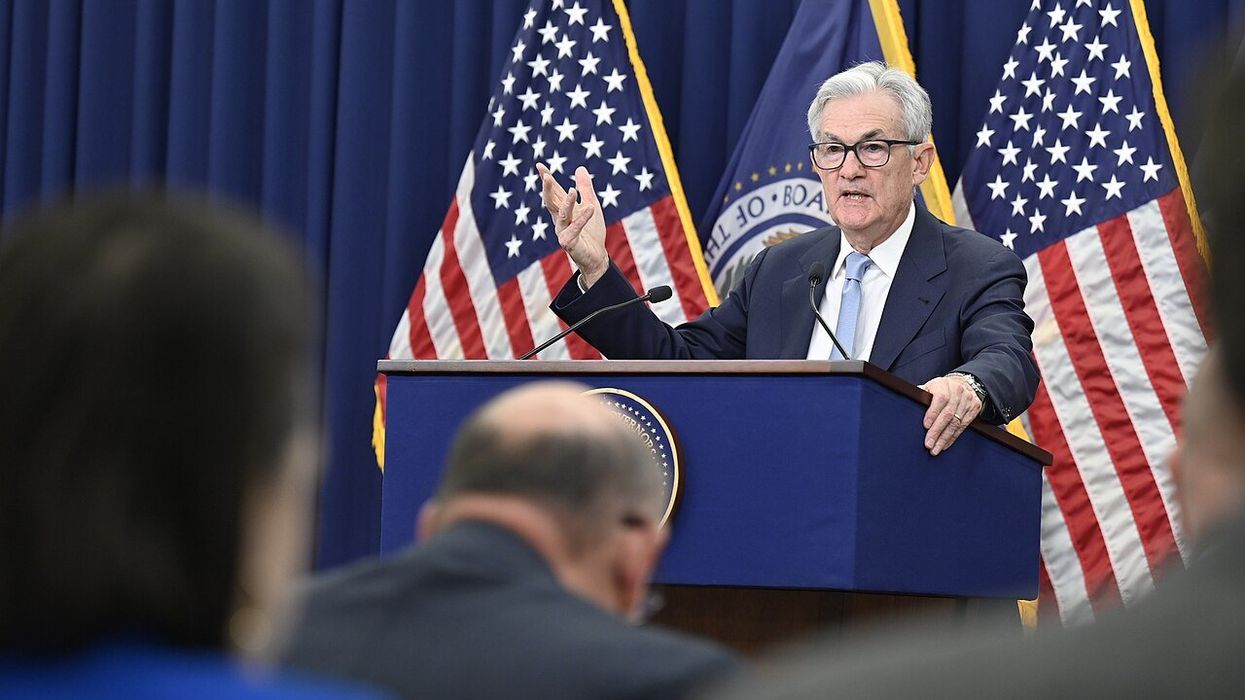
Federal Reserve Chairman Jerome Powell successfully defeated President Donald Trump last week with the aid of a U.S. senator, but that doesn't mean the fight is over.
Powell has faced an unprecedented pressure campaign to oust him from the Federal Reserve through a politically motivated Justice Department investigation. Sen. Thom Tillis (R-N.C.) is forcing Trump to back down if he wants to clear the path for Kevin Warsh's confirmation. If the investigation remains, Tillis has vowed to block Warsh's confirmation, leaving Powell in office in the interim.
The New Yorker's "Financial Page" by John Cassidy said on Monday that there's more than one "win" the White House can aim for over the Powell matter. First, they can always bring charges again after they succeed in appointing Warsh. Second, Warsh's track record raises serious doubts about his independence and whether he will cave into Trump's demands to reduce interest rates.
Thus far, Powell has been unwilling to reduce those rates, saying the goal is to get inflation back down to 2 percent. Inflation increased to 3.3 percent in March 2026, up from 2.4 percent in February. It is the highest it has been since May 2024, NBC News reported. It is likely attributed to Trump's war in the Middle East.
This week, the Federal Reserve Board of Governors will meet to decide whether to raise or lower interest rates. It is expected to be the final meeting presided over by Powell, who is slated to finish his term in May.
"Powell deserves a lot of credit," said Cassidy. "At the start of this year, when [Washington, D.C. district attorney Jeanine] Pirro launched the investigation into cost overruns, which targeted him personally, he could have kept his head down and hoped it went away. Instead, he publicly denounced the effort to intimidate him and his colleagues[.]"
“Public service sometimes requires standing firm in the face of threats," Powell said at the time.
Cassidy attacked Pirro, saying that Powell’s stand “put to shame the heads of law firms, universities and public companies who have caved to the White House.”
In his Monday newsletter, he doubled down, saying that Powell stood in opposition to Trump and was backed by members of Congress and the courts. Tillis, for example, already said he wasn't running for reelection. So, he had the rare option to stand up to Trump, preventing the president from using "his normal bullying tactic — threatening to endorse an opponent."
“There is abundant evidence that the subpoenas’ dominant (if not sole) purpose is to harass and pressure Powell either to yield to the president or to resign and make way for a Fed Chair who will,” a judge wrote in March after Pirro attempted to subpoena the Fed. “On the other side of the scale, the government has offered no evidence whatsoever that Powell committed any crime other than displeasing the president.”
Cassidy makes the case that the Fed has remained safe due to "Powell's leadership and Tillis' presence," along with the failures of the D.C. district attorney.
Warsh, at the very least, served as governor from 2006 to 2011. While Warsh told Fox Business he agreed with the president that interest rates should be lower, that doesn't put off some experts.
“I have every expectation he’s gonna take the job really seriously. He cares about the Fed,” said economist Austan Goolsbee, who served in the Obama administration to the Financial Times.
Cassidy noted, "It’s not always clear whether Warsh is expressing his own views or positioning himself politically." He said that it also appears that his opinion on matters changes depending on who the president is. Under Obama, he advocated keeping interest rates higher, and unemployment was nearing 10 percent after the 2008 economic crash. But when unemployment was at just 3.9 percent under Trump in 2018, Warsh still agreed that interest rates shouldn't be too low for too long.
"There are complex economic issues, with legitimate arguments on both sides. But the biggest question about Warsh relates to something simpler: his spine. During last week’s hearing, he repeatedly pledged to be independent, but he wouldn’t say whether Trump lost the 2020 election; he wouldn’t comment on the President’s blatantly political effort to fire Lisa Cook; and he refused to identify a single element of Trump’s economic agenda that he disagreed with. Hostage videos have contained more convincing displays of independence," wrote Cassidy.
All of Trump's interventions spark concern for Cassidy, in large part because the Fed is supposed to remain independent from political pressure. Warsh, seen as more compliant, recently drew Trump's praise but also pressure to slash interest rates immediately, signaling potential White House meddling.
Optimists argue the Fed's collegial structure would resist pressure, but public dissent via votes and statements could spark damaging market turmoil, Cassidy closed. For decades, global investors have relied on the Fed as a stable anchor amid U.S. political chaos; any whiff of politicization risks catastrophic fallout. Wall Street bets Warsh can withstand Trump while preserving credibility, but his evasive congressional testimony fuels skepticism.