

Top psychiatrist: One simple question proves Donald Trump is ‘deranged’
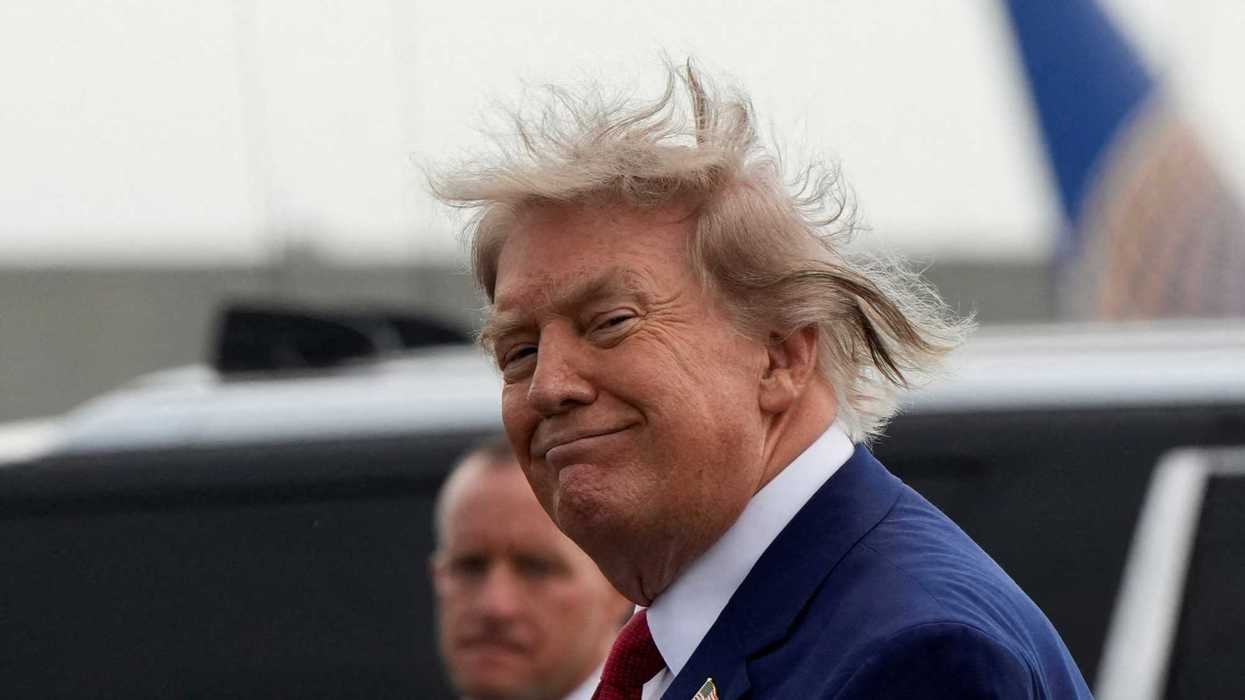
President Donald Trump often appears to be insane — not figuratively, but literally — and yet the mainstream media insists on sanewashing him.
"Sanewashing" is the practice of making irrational and psychologically unhealthy behavior appear lucid, even normal. In Trump's case, journalists seem quite timid about describing his obsession with putting his name on the Kennedy Center, building a White House ballroom and picking unprovoked fights with Canada, Denmark and Iran as indicative of poor mental health. By contrast, when President Joe Biden put in a stumbling and incoherent performance during his 2024 debate, a massive clamor arose for him to drop out of the race... one that ultimately succeeded.
Why the double standard? Indeed, how can the sanewashing be called out for what it is? How do we know for sure that Trump is insane?
To understand these questions, AlterNet spoke with Dr. David Reiss, a psychiatrist who contributed to the book “The Dangerous Case of Donald Trump: 27 Psychiatrists and Mental Health Experts Assess a President."
This interview has been lightly edited for clarity, context and length.
Breaking the silence on 'sanewashing'
ROZSA: I feel that the press tends to sanewash President Trump.
REISS: Slightly.
ROZSA: I feel like you're using "slightly" sarcastically.
REISS: Definitely. (Reiss laughs)
ROZSA: Well, I'd like you to elaborate on why you agree.
The family dinner test
REISS: Yeah. This might be a little different from what I've said before, in that at this point diagnosis isn't that important — is it this, is it that, is it dementia, is it meds he's taking, is it another illness. It really isn't relevant. What's relevant is one simple question: if you were sitting at a family dinner and someone acted and talked like him, how long would it take you to get them to an emergency room?
The press is treating it as if this is just him. No, this is a very disturbed — in a vernacular, deranged — person. He says things that don't make sense, goes on for two hours. This is not normal behavior, not productive behavior, and obviously a lot of it is lies. So the diagnosis really isn't relevant. What's relevant is: if this was a friend, if this was a relative, would you say this person needs help if they're not getting it — and if they are getting it, they should see a different doctor because it's not being treated effectively.
That's not what the press is saying. The press is acting like this is just his style, or making bizarre excuses, or ignoring it.
ROZSA: Now, you contributed to a book about President Trump being unfit for office. Just now you said things are a little different in terms of your analysis than they were then. Why has your analysis changed?
REISS: It's not that my analysis changed, in that what we warned about ten years ago still holds true, and the possible diagnoses still hold true. But he's been in the public eye for four years and then two more years. There's more everyday evidence, as you say, that's being ignored by the press. So is he worse? Well, yeah, he seems worse — but is that stress? We don't know why. It doesn't matter why. What matters is whether this is a functional human being who should have the responsibilities he has. Back then it was: based on his history, he doesn't look like a person who should. Now it's: we have six years of increasing evidence that he isn't doing the job.
ROZSA: I'd like to discuss some of the excuses people have made for him. The New York Times referred to his verbal style as "the weave," and the hosts of the Flagrant podcast, Andrew Schulz and Akaash Singh, reinforced that narrative. You hear people describe him as playing four-dimensional chess whenever he does something seemingly irrational, like threatening Canada or Greenland.
REISS: It doesn't hold. Yes, some people are more concrete, some a little more loose — there's a spectrum. But this is so many standard deviations from normal that calling it "a weave" doesn't make sense. To say this is his strategy — he hasn't learned that it isn't working. But it's way beyond that, because you see it even in statements that have nothing to do with anything of importance, where there's no strategy involved. Even yesterday, I saw — I didn't take a deep dive — that he again made the statement that most people don't know "dumb" has a B in it. Doesn't he realize that just makes him look stupid? That's ridiculous, and it has nothing to do with Canada, Israel, or Russia. It's just — even if it was a joke the first time, common sense says you don't make the same joke that's going over badly 200 times.
ROZSA: I agree with you there, but I'd say there's a difference between him not knowing how to spell "dumb" — after all, [Vice President] Dan Quayle didn't know how to spell "potato" — and him engaging in irrational behavior that is destructive. To use a couple of examples: he is obsessed with putting his name on the Kennedy Center. He is obsessed with building a White House ballroom. He picks fights with allies like Canada and Denmark because of his own narcissism. These actions have destructive consequences.
REISS: Exactly. The point I was trying to make is that even in the non-destructive examples you see the same pattern, so it isn't strategy. That's why I used that example — you're right, those things are dangerous. Whether he spells it correctly or not isn't dangerous. But even in those simple things that carry no weight, he's just as crazy — the pattern is the same.This brings me to what I consider the most important question: what are the worst-case scenarios we've seen, based on his displayed behavior, in terms of potential policy fallout?
That's not really my area of expertise, to know exactly where things will go, but basically what you said — he's going to keep damaging international relationships. With whom, or who's next, will depend on what his emotions are that day. He'll keep aggrandizing himself, whether it's gold, the Kennedy Center — it's all crazy. If it was one thing, okay, but this is everything, and it will keep going. The more frustrated he gets, the more he ups the ante. So what's next, I can't predict. But if there aren't some reins put on it, it's going to keep going, and it will get stronger, because when he gets frustrated, he ups the ante.
ROZSA: Why the double standard in how he's been treated versus how President Biden was treated?
REISS: I wish I knew.
ROZSA: Do you feel the warning signs with Trump are greater than, lesser than, or equal to those that existed with Biden?
REISS: Much greater. With Biden, who I personally met — and that was back in '19 — there were some signs that toward the end he wasn't functioning, that his age was showing. But he was never that disorganized, and he had people around him who were containing it. If there was some, anything worse, it didn't affect policy, because there were good people around him. Whereas this guy intentionally picks people who are even worse than he is, so there are no guardrails, no one holding it in. I'm not equating the two — I think they're different. Were there some issues with Biden? Probably. But there were people around him containing it.
ROZSA: What do you think the cameras aren't showing us, based on what we have seen?
REISS: Not much, because we've seen about everything. I think we're not seeing the tantrums — you hear things about, the other day he threw a tantrum at someone — I don't think we're seeing the angry explosiveness that it's said he displays. But otherwise, we're seeing it. It's just not being talked about in the right way.
ROZSA: This goes back to my first question about sanewashing and how the press seems to normalize Trump's behavior. I want to be clear — I'm not talking about corruption, I'm not talking about far-right policies. While I oppose those things, they don't make a person literally insane. Benjamin Netanyahu in Israel is corrupt and far-right, but he isn't literally insane.
REISS: He may act like a war criminal and all that, but he's not insane. He's not actually detached from reality.
ROZSA: He's just a genocidal maniac. Trump is also a genocidal maniac, but I think he may be detached from reality as well.
REISS: Exactly.
ROZSA: The question is, why does the media and the general public seem to give him a pass?
REISS: I think the general public is more and more onto it. Of course, those watching only one side of the media don't necessarily do a deep dive to see it, and they're not thinking about it. But as for why the media does it — I think some are being paid off, some are scared of what he'll do to them if they don't comply. The overall question is why isn't everybody getting together and saying: we all have our own reasons to give in if we're alone, but together we don't have to. Why isn't that happening? I'm at a loss.
ROZSA: May I share my theory?
REISS: Yeah.
ROZSA: My theory is that fear is the primary motivation. There are two aspects of the fear. There's the partisan fear, from Republicans and other Trump supporters who've hitched their cart to this wagon, and fear that if the wagon goes off the cliff, they'll go off with it. And then there's the fear of the general public of being attacked by that same group of Trump supporters for pointing out that the emperor has no clothes — or, more precisely, has no brain. (Reiss laughs) Do you think my theory has merit, and if so, what is the antidote to this fear?
REISS: Absolutely. I think — and this is basically repeating what you said — it is fear, but it's not monolithic in terms of exactly what the fear is in any individual. That's what keeps them split up and not joining together. One person may be fearful for this reason, another for that reason, instead of saying "we're both fearful, ridiculously — let's come together." They stay in their own corners defending their fear. Does it make sense why it's lasted so long? That's what I can't answer, because it seems so obvious. But I think you're right — it's fear, just not the same fear in each group or person.

