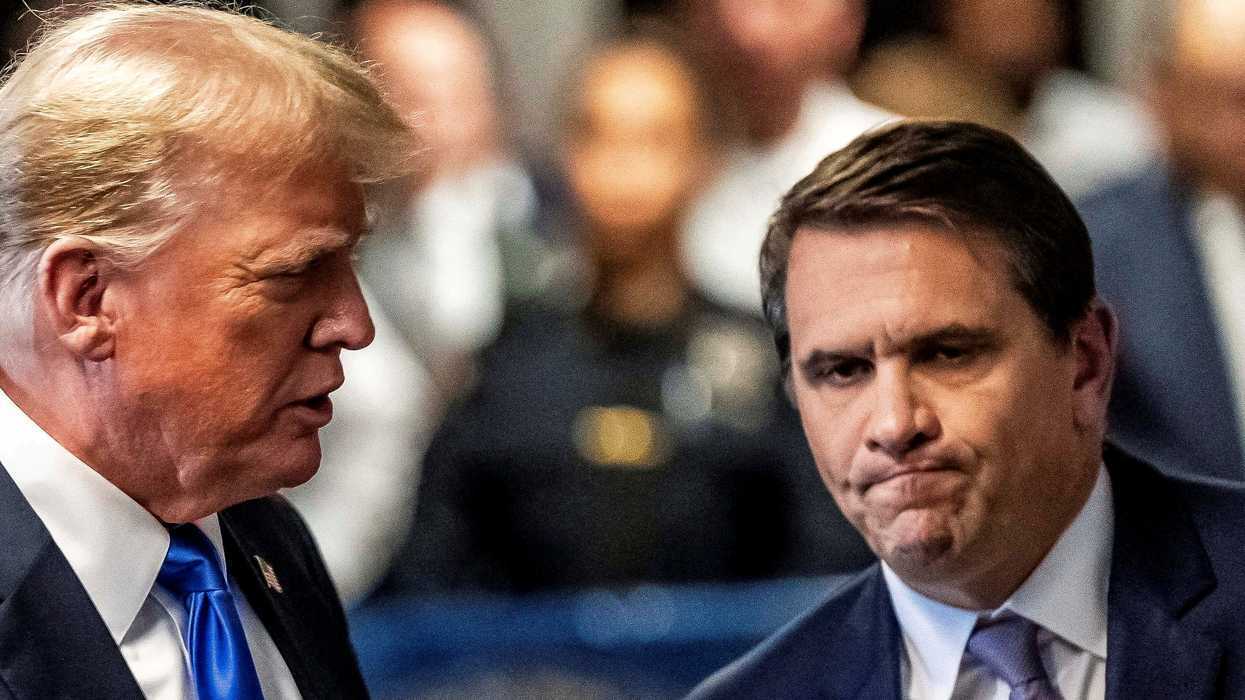
President Donald Trump is no stranger to setbacks in court, but his recent setback was notable in that it involved a judge blatantly telling him that his officials were not "privileged" in being allowed to avoid answering the judicial branch's questions.
"U.S. District Judge April Perry held a hearing that addressed the DOJ’s last-minute request Sunday that she not directly question the frontline career government prosecutors who worked on the case," reported The Washington Sun's Jose Pagliery on Monday. "Instead, the DOJ urged her to ask narrowly focused questions of the Trump-appointed political head of that office, U.S. Attorney Andrew Boutros."
As Pagliery described the courtroom proceedings, "the judge wants answers. The DOJ is playing defense."
He added, "Henrique Carneiro, a counsel to the associate AG, wrote that ''here is plainly no need for anyone but the U.S. Attorney to provide information.' But he also made clear the government would fight the judge on appeal if she didn’t agree, arguing that she should essentially just let it go and allow the government to sort this out on its own."
Meanwhile the presiding judge "rejected the government’s request to label much of the information 'privileged' and therefore inaccessible to the judge — and the American public, according to two people in the courtroom."
One Democratic politician quickly attempted to make hay out of the situation.
"Former Democratic congressional candidate Kat Abughazaleh, who was among those charged, told The Washington Sun after the hearing that it 'should be in the government’s interest to be as transparent as possible to prove it did no wrong,'" Pagliery reported. "'At this point, I’m wondering what could be so horrible in these communications that the DOJ would go to such lengths to hide them."
Overall, the Trump administration took the view that it infringed upon the official responsibilities and prerogatives of government officials to expect them to answer a judge's questions. This argument is consistent with the tone the government has used in other filings in which they have attempted to shield its own employees from inquiries from the bench.
"The United States moves for a protective order to circumscribe the scope of testimony at the hearing currently scheduled for December 2, 2026, so as to preserve all applicable governmental privileges and to ensure that any questioning is limited to the purported misstatements the Court has identified as relevant to its inquiry," the government wrote in its earlier filing to Judge Perry.