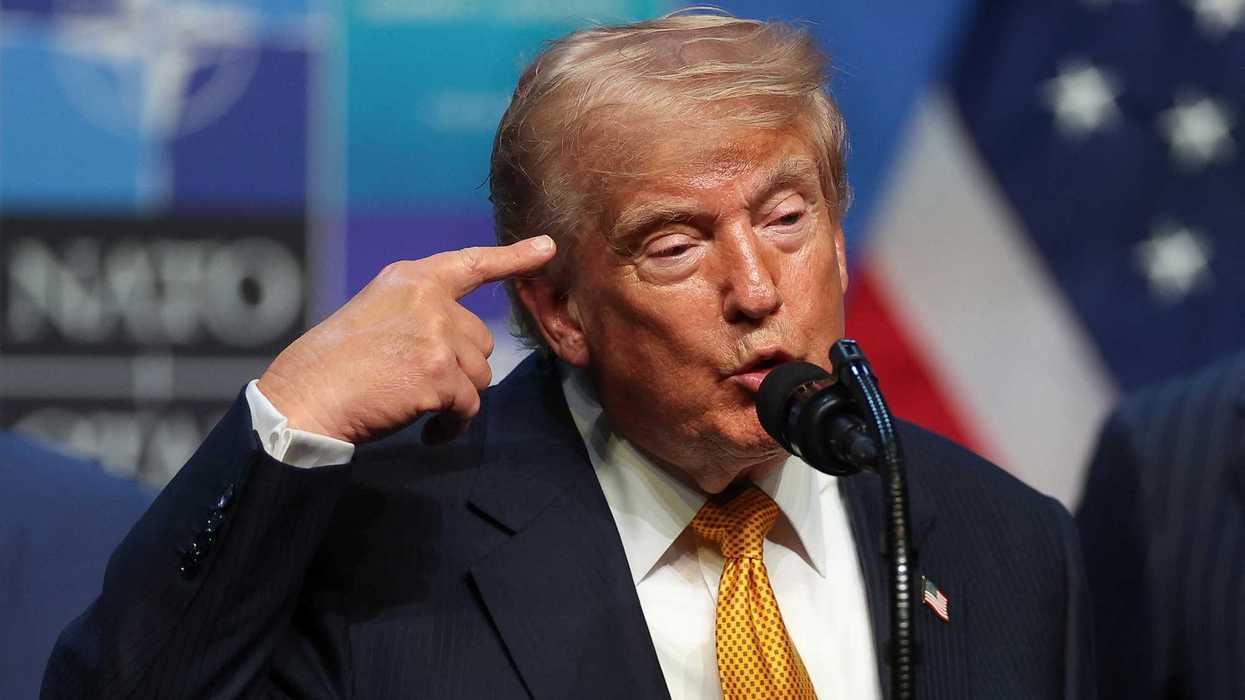
Over the course of his political career, President Donald Trump has displayed a “psychological pattern” that makes it clear he is afflicted with some form of “neurodegenerative disorder.” This is according to neuroscientist Frank George, who on Friday revealed the specific disorder he believes is motivating Trump, and argued that the United States must become more willing to identify such conditions in its public figures.
George asserts that U.S. institutions are limited by “blind spots” that restrict their ability to recognize and call out certain psychological patterns. He raises the example of the press, noting that while “nobody objects” when journalists suggest patterns to issues like corruption, fraud, or discrimination, “when the pattern involves personality and behavior, many news organizations are way more hesitant to frame it that way. Instead, they treat each disturbing outburst as a fresh controversy rather than asking whether the controversies themselves reflect an enduring psychological pattern.” According to George, it’s the pattern — not each individual action — that should get the headlines.
He says that this problem stems largely from “the Goldwater Rule.” Established by the American Psychiatric Association in 1973, it bans psychiatrists from diagnosing and offering professional opinions about public figures without examining them personally. According to George, while the rule makes theoretical sense, reducing the possibility that psychiatry could be used as a political weapon, “Psychiatrists became so worried about saying too much that the public was left hearing almost nothing at all. Ironically, the profession dedicated to recognizing behavioral patterns became remarkably reluctant to talk about one unfolding in front of hundreds of millions of eyewitnesses.”
In Trump’s case, argues George, we’ve observed his behavior for decades, and certain patterns have become clear. According to George, “You don’t have to diagnose someone to notice that they’ve never admitted they lost an election. You don’t need a $500 office visit to recognize chronic grandiosity, projection, or an inability to tolerate criticism. You don’t need to diagnose someone to notice that they have never admitted making a mistake. Ever. Millions of people can observe those things. That’s called...Observation.”
Lately, he notes, there has been “growing interest in Trump showing progressing signs of dementia, notably FTD,” as well as “Malignant Narcissism.” He suggests that this increasing willingness to admit such possibilities stems from a recent reframing of how the public discusses Trump’s behavior.
“For years, many people heard: ‘Trump has a personality disorder.’ That sounded like politics,” George explains. “But when they heard: ‘Trump may have a neurodegenerative disorder,’ that sounded like medicine. Once the conversation moved into a medical frame, people became more open to asking broader questions about the brain, behavior, and judgment. Some then revisited personality explanations they had previously dismissed.”
“Somewhere along the way,” writes George, “we decided there was a moral difference between saying, ‘His hippocampus is deteriorating,’ and ‘His capacity for empathy appears profoundly impaired.’ Both are observations about brain function. One feels clinical. The other feels personal. One is saying the car needs work. The other is saying the driver needs work.”
In the end, George argues that less important than Trump’s Malignant Narcissism may be Americans’ reluctance to admit to it. As he concludes, “We didn’t lack evidence. We didn’t even lack the vocabulary. What we lacked was the institutional and societal courage to put the two together. And when a society can’t comfortably describe a recurring pattern...That pattern gets a very long head start.”