
This is your brain on MAGAspeak — according to science
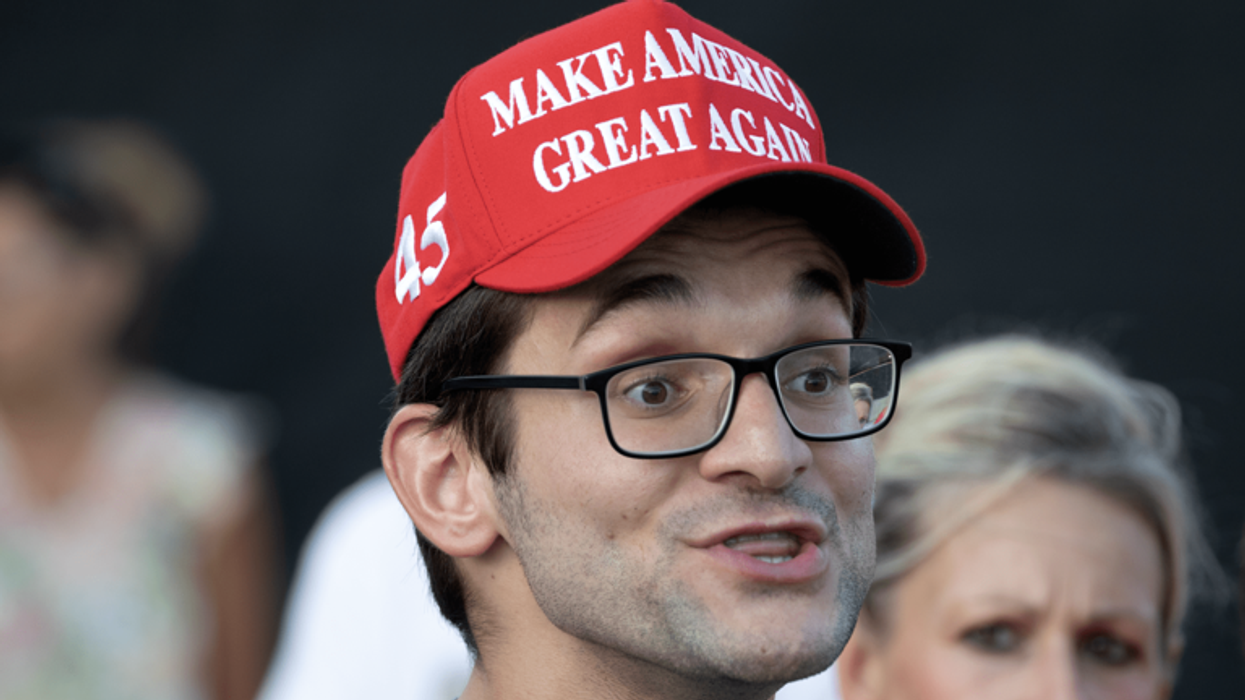
A supporter of President Donald Trump in Milwaukee, Wisconsin on August 23, 2023 (Image: Shutterstock)
Trump supporter in a MAGA hat
June 30, 2026 | 03:09PM ETTrump
A recent study in the scientific journal Current Psychology confirms what many opponents of President Donald Trump long suspected — namely, that demagogic rhetoric such as that promulgated by the Republican president destroys popular faith in democracy.
A group of Dutch, Italian and Spanish researchers determined that “exposure to demagogic discourse increased value threat and reduced political tolerance independent of ideological-matching,” according to a June study in the journal Current Psychology. This means that, when demagogic leaders like Trump went mainstream in those societies, they made it easier for their supporters to rationalize being intolerant of those who disagree with them. At the same time, this conclusion was not without its qualifications.
“Yet, in the U.S., effects on tolerance were moderated by satisfaction with democracy,” the authors wrote. “Ultimately, our research validates warnings about the dangers of demagogic political discourses at a psychological level.”
In their abstract, the authors explained that “rather than mere words, demagogic discourse elicits perceived threat in people that goes against democratic plurality. One can only imagine what, for example, sustained exposure to such discourse across an electoral campaign or a presidential term can do. The first experimental evidence we hereby present on the noxious effects of demagogic discourse compels us to take a more in-depth look at how potentially dangerous words are in this context. Alongside the growth of this kind of discourse, there is also a wave of euphemization by those who use it and those who support them, arguing that, even when foul, words are just words. We have provided some first evidence that this is a crude downplay of the implications of political speech, and that demagogic political discourse contributes to setting the table for potentially antidemocratic confrontation.”
The researchers experimented in three batches on groups of roughly 300 participants, the first collection in Spain and the last two in the United States. In all of the experiments, the researchers asked participants to expose themselves to news articles, political speeches and other forms of polemical rhetoric that to ascertain how such exposure altered their ability to empathize with those who hold differing views. They found that, on a consistent basis, individuals who sincerely internalized those beliefs became less compassionate to anyone who did not share their political views.
“First of all, this seems like a very honest study,” Dr. Henry Abraham, psychiatrist and former professor at Tufts University, told AlterNet. “They don't make wild claims, but they do have statistically meaningful findings, which is why it got published in the first place. And, if I understand the study correctly, it does seem like demagogic language does shape the attitudes of individuals hearing it. And those attitudes shift in a definitely less tolerant direction.”
When it comes to the broader implications for society, Dr. Abraham opined that “these folks are social psychologists, and so they're used to looking at many different variables and seeing how they hang together. This study, by my reading of it, doesn't quite do that. It doesn't look at many possible explanations, like how they drew their sample, whether or not membership in the sample reflected a lot of noise in the form of preexisting political ideas and sensitivities to the questions that were differently distributed between the different groups. That's kind of important.”
He added, “I don't really see in this, in my reading of it, whether people were assigned to their groups randomly or non-randomly. If it was random, that's a real plus. If it was non-random, that would be a source of bias, which could ultimately give you these kinds of results without having great long-term validity. So I hate to be a pain in the — academically — but, you know, this is a complex finding. It seems to be reasonably, thoughtfully done, and it has meaning beyond itself in our greater understanding of how people think. That's saying a lot.”
Previous studies have unpacked how the polarizing rhetoric espoused by Trump on the right and analogous radicals on the left influence widespread perceptions about politics. In April, Futurism analyzed three research papers from the scientific publication Journal of Social and Political Psychology revealed that Trump supporters have been conditioned to reject objective facts when that information contradicts the values with which they have been inculcated by Trump’s political movement.
“While each study is highly complex in their own right, together they reinforce the finding that denial of factual information — Trump’s seedy misdeeds, basically — is a direct response to anxiety caused by cognitive dissonance,” Futurism explained.
Research into the psychology of Trump supporters is a rich field, such as a June study which discovered that right-wingers tend to interpret smiling as an act of dominance more than anti-Trumpers and a May study which revealed that Trump supporters tend to be willing to accept personal hardships as long as they believe that marginalized groups such as Black people, the LGBTQ community and other minorities suffer more than themselves.

