
'I would rather die': Inside the politics of spite driving Trump voters
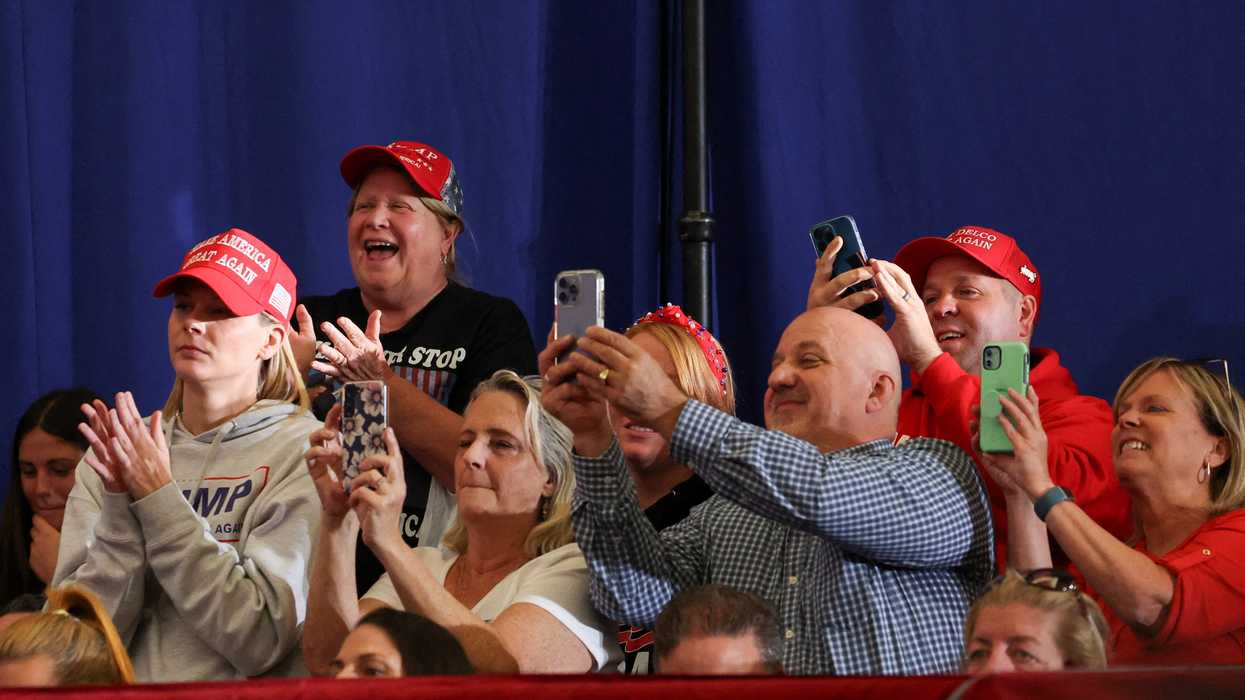

President Donald Trump’s supporters actively oppose democracy, according to a recent ethnographic study, and actively want to make things worse for people they dislike.
“As a wise man once said: They are who we thought they were,” wrote The Bulwark’s Jonathan V. Last on Thursday about a May study sponsored by the Johns Hopkins Agora Institute that studied Trump voters in Michigan, South Carolina and Wyoming. “I want to go deep on this question because the people in the study describe a remarkable consistency about why they dislike democracy. It’s not that they’re misled, or mistaken. They have a coherent worldview. It’s just not very nice.”
Reviewing how 14 out of 21 study participants immediately reacted negatively to the idea of democracy, Last observed that the participants perceived themselves as “a minority under threat from a tyrannical majority” who “believe that there is a cultural schism in America, with good, God-fearing people like themselves on one side and the wicked majority on the other. They detest this imaginary majority and fear that ‘democracy’ would allow that majority to gain political power.”
Last quoted a number of study participants who bluntly stated that they feared democracy would mean people they dislike — generally defined as racially diverse liberals who do not subscribe to the ideals of white conservative Christians — would exist with full rights. To rationalize this, they define democracy as a form of mob rule, ignoring that the Constitution created institutions like the Senate and the Electoral College for the precise purpose of preventing mob rule.
“Sarah put this directly, ‘I don’t value democracy, because we wouldn’t be heard. Wyoming’s the smallest state on the map, right? If we were a democracy, then we wouldn’t have a voice,’” Last quoted from the study. “Kyle (mid 20s, WY), a delivery driver, extends the logic: ‘Every single small town would be outvoted by every single city. We wouldn’t be able to feed people cows. We’d all be eating seaweed.’ Patricia (50s, SC) offered up a common conservative metaphor: ‘[Democracy is] two wolves and one sheep deciding who’s for dinner. I hate that word [democracy]. I mostly hate it when people who think they are educated about our style of government use it to say, ‘Save our democracy.’ No, there's no democracy here. Praise God. If there were then California and New York would make all of our electoral choices.’ Steve (60s, WY) describes it directly: ‘Democracy rules . . . is mob rules, okay?’”
Last added that these voters “very explicitly do not want majority rule. They want minority rule.” The study found that they viewed Democrats as immoral because of issues like supporting racial diversity, backing LGBTQ rights, believing in feminism and opposing the imposition of Christianity on society. They also feel frustrated by what they perceive as young people overwhelmingly turning away from these values.
“I’m not sure how Democrats win over a voter who’s motivated not by unemployment, or the the Iranian nuclear program, or the price of eggs—but is rather lashing out because they’re angry that their children rejected their political views,” Last wrote.
He added, “We are firmly out of the realm of policy here. Or reality, even. So long as there is a trans activist in San Francisco posting on BlueSky, these people will be aggrieved. Even if their preferred political party holds the presidency, controls Congress, and has an openly corrupt majority in the Supreme Court. Domination of the political system is not enough; they want the people who disgust them to disappear.”
This means that “if ‘democracy’ produces anything they dislike, then they are ready to be done with democracy.” A hypothetical “Cletus” supports Trump regardless of economics because “he’s mad that the brown girl at Starbucks with the nose ring and the pronouns on her apron exists. And even if she doesn’t work at his local Starbucks, he’s sure that she’s out there, somewhere. He doesn’t like it and he thinks that he should be able to rule over her, even if there are more of her and her ilk than there are of him.”
The recent study treads the same ground as the landmark 2019 book “Dying of Whiteness,” written by psychiatrist Jonathan Metzl, who in the Boston Review published an anecdote about a conservative named Trevor who had to quit his job as a cab driver because he was dying of hepatitis C. Despite the fact that his state of Tennessee denied him access to health care that could have saved him, Trevor was staunch in his opposition to the Obamacare exchanges that could have provided him with help in the form of the polymerase inhibitors, a lifesaving liver transplant or other treatment options.
“Even on death’s doorstep, Trevor was not angry,” Metzl wrote. “In fact, he staunchly supported the stance promoted by his elected officials. ‘Ain’t no way I would ever support Obamacare or sign up for it,’ he told me. ‘I would rather die.’ When I asked him why he felt this way even as he faced severe illness, he explained: ‘We don’t need any more government in our lives. And in any case, no way I want my tax dollars paying for Mexicans or welfare queens.’”
Despite opposing social programs as “welfare” when given to other people, Trump supporters nevertheless do hope for this assistance for themselves. On Thursday Trump announced a possible $17.3 billion relief package for farmers who have been overwhelmingly hurt economically by Trump’s policies of mass deportation, raising tariffs and declaring a war against Iran. These rural voters still back Trump by massive margins, even though they connect his policies to their economic distress, and polls show they hope to make up the difference in their economic relief through bailout packages.
When a different conservative commentator, The Bulwark’s Tim Miller, described this as a form of “welfare,” economist Ed Gresser — Vice President and Director for Trade and Global Markets at the Progressive Policy Institute — pushed back to AlterNet against the idea that helping farmers should be opposed as “welfare.”
“Tariffs have been quite bad for farmers in two ways,” Gresser said. “One is that they have led to reactions against American products overseas, sometimes by governments and sometimes by public opinion. In a typical year, American agriculture exports about $180 billion worth of stuff that typically makes up about one-fifth of US farm income. So it's quite a lot: half the exports go to, or at least historically went to, China, Canada, and Mexico.”
Gresser added that Trump’s tariffs have hurt farmers in each of those markets.
“The exports to China have shriveled up because the Chinese retaliated very hard and hit back again directly against American farmers,” Gresser said. “Mexico has kind of held up. Canada is off, not so much because the government of Canada has taken any particular steps but because Canadians have looked for American goods so as not to buy them.”
“The tariff program has badly screwed over American farmers,” Gresser added, and because "farmers are definitely in trouble,” he concluded that “the idea that the US government would respond to that in the abstract is not a terrible one in my opinion.”

