
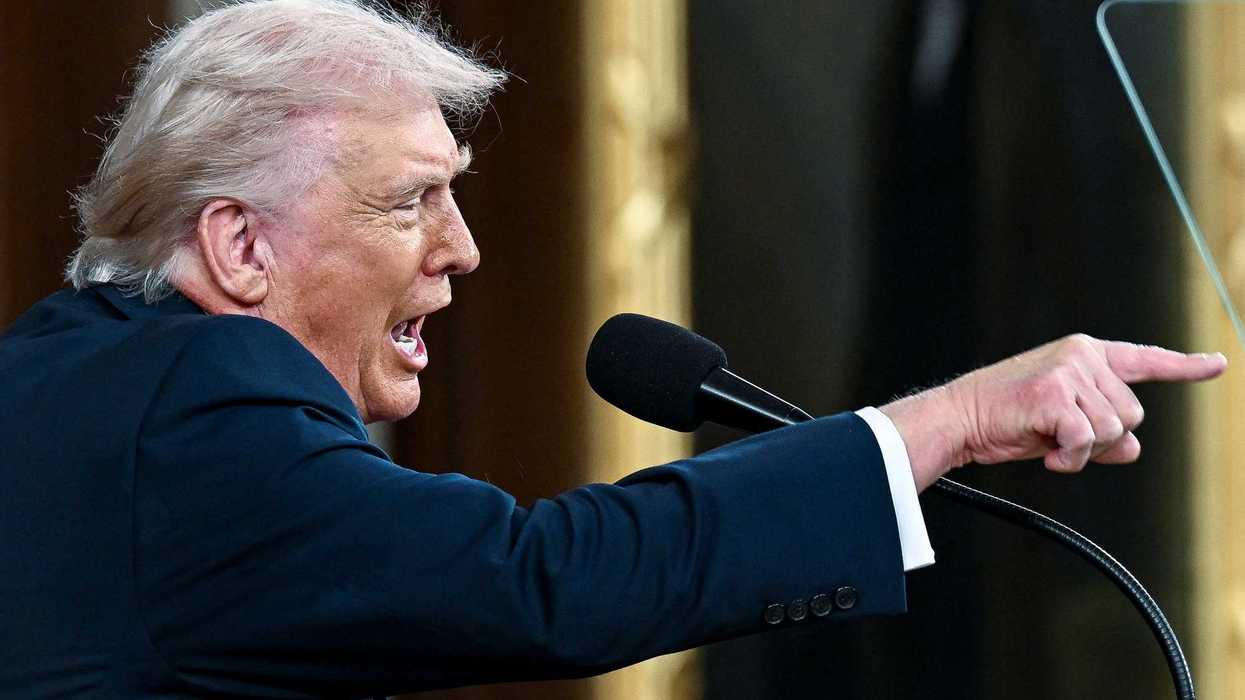


New York Times reporters Maggie Haberman and Jonathan Swan spoke at The Atlantic Festival Thursday, where the former detailed her predictions about President Donald Trump's presidency if Democrats take over one or both houses of Congress.
In a discussion about pardons and members of the administration breaking laws, court rulings, or orders, Haberman said that one thing that Steven Miller learned is that if the president declares an emergency, he can do whatever he wants. That combined with "an utterly compliant House GOP and slightly less so but fairly compliant Republican Senate" is how Trump has accomplished what he has.
Aside from the "emergency powers" efforts, another option is for Congress to hand over its power.
"And so, not to get too hyper local here, but there are many ways in which this government reminds me of like 1970s New York," Haberman said. "And the reason I say that is that that is Donald Trump's, you know, sort of, model of executive power."
She said that he's known for talking about the former Brooklyn Democratic Party boss, Meade Esposito, from the 1960s and 1970s. It's similar to his compliments for Xi Jinping, who he said "rules with an iron fist." That has become a kind of model for Trump.
"His own political lieutenants use it about how they have maintained control over Congress," said Haberman. "And one of the reasons that corruption was so rampant in the 60s and 70s in machine politics in New York City is because the party bosses controlled anybody who would investigate. They picked the judges. They picked the DAs."
"So, if you have control of anybody who might investigate you or raise questions, it isn't just about saying yes. It's about every check in society that we are used to. That creates an entirely different form of government," she explained.
Atlantic staff writer Tim Alberta acknowledged that those involved in news and politics have become "a bit desensitized" after two years of watching it. However, "if we saw it unfolding elsewhere in the world, I think we would have a term for it. We would certainly be describing it more colorfully than we in the American press are accustomed to describing our own government."
But unlike in other countries, there's a time limit on Trump, Alberta said, calling the president a "lame duck." It prompted him to wonder how Trump is handling something like that and whether he'll be willing to stand down so JD Vance can step up.
Swan said that in their recent book they describe a scene in which Rupert Murdoch comes to the White House and has dinner with Vance and Marco Rubio along with a few other typical far-right appointees. In the event, Trump begins a conversation asking about Vance and Rubio for 2028, which Swan called "a beauty pageant, essentially."
Trump knows full well that Murdoch can't stand Vance and worked to stop Trump from appointing Vance. Murdoch said, "JD has the potential to be great." When asked about Rubio, Murdoch said: "Marco is brilliant."
"And it's this savage moment," Swan said. "It just foretells what the next two years are going to be like."
So, the way he's grappling with being a "lame duck," Swan said, is that he's simply refusing to be one. So, the idea that it will be a smooth path to a 2028 nomination and candidacy, "is contradicted by every piece of evidence we have about the way Trump behaves."
Haberman predicted, "This is not going to look like any kind of congressional flip that we’ve seen before in a lame-duck presidency, in terms of oversight."
She said that Trump believes he's immune from any federal prosecution and he's "talked about pardons very openly."
Trump knows that he is immune from federal prosecution. Um, he has talked about pardons very openly. We spoke to a number of people during the reporting of the book who are counting on their pardons. So, I expect that will be sweeping. We've never seen a government just not respond to subpoenas in Congress across the board."
At the same time, a contempt referral goes to Trump's government for prosecution.
- YouTube www.youtube.com
Report typos and corrections to:
feedback@alternet.org.

#story_page_sidebar
MOST POPULAR
{{ post.roar_specific_data.api_data.analytics }}
MOST POPULAR
ContactAdvertise with AlterNetPrivacy PolicyWriter GuidelinesPress InformationAbout AlterNetMeet the AlterNet StaffDebug Logs
@2026 - AlterNet Media Inc. All Rights Reserved. - "Poynter" fonts provided by fontsempire.com.