
An irate Trump fan complained to the manager that I'm a liberal journalist
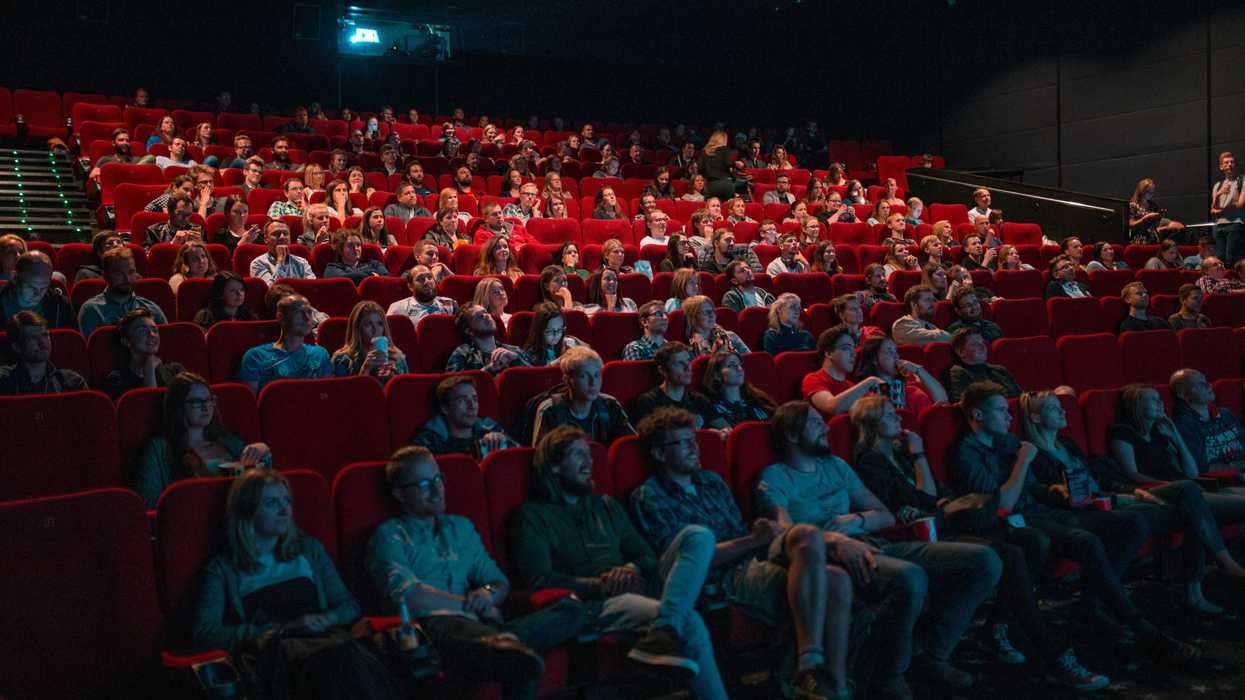

After reviewing "The Brink of War" for AlterNet, I decided to see it in theaters with a regular audience to get a firsthand sense of how the American public is reacting to this MAGA-coded movie.
Before the night was over, I had been repeatedly accosted by an angry Trumper named Mona who spent much of the evening trying to disrupt my reporting. Indeed, I later learned Mona went to the manager to say that "there is a liberal journalist" — her exact words about me, per what I was told — and demand I be thrown out of the theater, falsely claiming that I was bothering people and being disruptive. The manager, who was friendly and seemed weary the whole way through, assured me she had not seriously considered obliging Mona.
The anti-Trumpers who liked a pro-Reagan movie
But before I get to Mona, let me discuss the main takeaway from the audience who saw "The Brink of War." The theater only had about a dozen-and-a-half or so patrons, a testament to the fact that "Spider-Man: Brand New Day" and "The Odyssey" are much bigger draws than a serious drama about the 1986 Reykjavik Summit. Only moviegoers with a very specific type of taste will go out of their way to see Jeff Daniels play President Ronald Reagan and J. K. Simmons play Secretary of State George Shultz as they attempt to negotiate Cold War geopolitics with General Secretary Mikhail Gorbachev (Jared Harris). Because the heroes of this story are Republicans and the film was released by the right-leaning Angel Studios, I assumed the sparse audience that did attend would be quite Trumpy.
Not so. Of the 10 people who I asked to speak with me, two politely declined after saying they were conservatives, but six others appeared quite enthusiastic. (Mona and her husband belong in a category of their own, as you'll soon see.) All of them admired Reagan... and yet all of them were also openly critical of Trump.
"I decided to see it because I actually lived through it," an intellectual middle-aged woman named Colleen told me. She was joined by her twenty-something son, Jake. "I had just graduated from college when this meeting took place, so I'm very familiar with the sentiment around it." She praised Reagan as "humble and a good negotiator," adding that "he may not have been great at everything, but we can be grateful he was such a good negotiator that nobody pushed the button." When I told her that I spoke with one of Reagan's foreign policy officials from the summit, Jack Matlock, and he disputed the movie's claim that Reagan emphasized human rights, Colleen expressed disappointment.
"I think it should be depicted the way it actually happened," Colleen said. "Framing him as petitioning for human rights is a little inaccurate — I noticed the same kind of issue with 'Young Washington,' where some things weren't quite right either. I just think historical films should be as accurate as possible, so people don't come away with a false impression."
Despite her admiration for Reagan, Colleen made it clear she is far from being a Trump supporter.
"What do they call it — word salad?" Colleen told AlterNet. "I think Trump is great at word salad, and not what a lot of people expected. Many who voted for him are disappointed, and I worry about the future for my children more now than I did before. So, no — not a Trump fan," adding that compared to other presidents "this one terrifies me."
Jake, who admitted he was "just along for the ride" for "The Brink of War" because his mom invited him, added that "she's told me nothing but good things about 'Young Washington,' and now that we're seeing 'The Brink of War,' I have high expectations for this one too. I heard 'Young Washington' was really good, and I'm expecting this to be too." Like Colleen, Jake said that he is "not a big Trump fan myself either" and that he'd "probably agree with everything my mother just said."
Unfortunately I was not able to ask Colleen and Jake for their post-film takes, but the same is not true for Jeremiah and Joshua. Apparently it was the trailer for "The Brink of War" that inspired them to come out and see this in theaters, which pleasantly surprised me since while Josh appeared to be in his thirties, Jeremiah was either a teenager or a very young-looking twenty-something himself.
"I saw the trailer yesterday and thought, 'Wow, this comes out tomorrow' — it looks great," Jeremiah told AlterNet. "I'm really interested in that period of history, and I think we don't have enough movies covering the Cold War. I hope it does well."
After the film, Jeremiah gushed to AlterNet that he "thought it was fantastic — a truly American movie, both in story and ideology. It expands on the greatness of the American ideal while also acknowledging its flaws. It's not a screed about how terrible communism is and how great capitalism is — it makes you feel for both sides and realize our nation isn't perfect."
He added, "I also think it shows how far our country has drifted today: whether you're a Democrat or a Republican, whether you thought Reagan was a good guy or not, we no longer have people willing to sit down and talk. We have people like Trump who won't respect our adversaries, who won't come to the table. I thought it was fantastic, and I think it sends a real message about how America should be today — a great story. As for the filmmaking itself, the acting is great across the board — you're on the edge of your seat. And you know a film has done its job when it can spend most of its runtime in one room and still be this compelling."
Joshua seconded Jeremiah's sentiments, offering praise for Jeff Daniels' depiction of Reagan and Jared Harris' characterization of Gorbachev.
I also tried to speak to a different pair, Dwayne and Christina, although my efforts were repeatedly hindered by Mona. My recording of that interview picks up Mona interrupting me twice, with me replying by saying "I'm now interviewing them" on one occasion and "Ma'am, I'm not speaking with you" on the other, after she says she is reading my review. It does not pick up her husband whispering "stop, please stop" during her second interruption, her stating "I just Googled you" (also amidst that second interruption) and her scrolling through her extremely bright phone while muttering "no" over and over again after her "Googled you" proclamation. All of this distracted me during my chat with Dwayne and Christina, making it difficult for me to conduct a proper interview. Nevertheless I gathered that the middle aged couple saw "The Brink of War" because they remembered the Reykjavik Summit from when they were teenagers, that they like me admired President Jimmy Carter and that they agreed with Carter's dislike of Trump. After the motion picture had ended, both of them praised it, describing it as "an insight into things we might not have covered in high school history" that they would highly recommend.
But it was hard to pay attention even then, as Mona had made a point of stopping and recording me with her phone.
So what triggered Mona?
How a Trump supporter becomes a bully
Let me back up.
It started when I approached Mona, shortly before I spoke with Colleen and Dwayne. Mona noticed my shirt, which has a screenshot of my 2018 interview with Carter. The interview began with her describing how she had lived through Carter's presidency, although I quickly pivoted to asking why she chose to see "The Brink of War." She replied that she is both a subscriber to Angel Studios and a fan of its recent film, "Young Washington," which she and her husband "loved."
"We've also been watching several of their other productions at home," Mona told AlterNet. "We're interested in this topic, and since Reagan is one of our favorite presidents, it's interesting to see their take on it." I then quoted Jack Matlock, who served as Reagan's special assistant and senior director for European and Soviet Affairs during the summit.
"It was great working for him," I read to Mona, quoting Matlock's observations about working for Reagan. "I was called to the National Security Council with the task of developing and negotiating a strategy for the Soviet Union. Although he had been rhetorically very critical of communism, at the same time he was very worried about nuclear weapons and the possibility of nuclear war. He wanted a strategy for negotiation, so I was brought onto the NSC and tried to develop what became a four-part agenda."
It was at this point that Mona's tone developed an aggressive edge. She asked why I chose "that particular person," and when I explained that he was the only one available (most of the other principals are either dead or long stopped speaking to journalists), she shot back that "the very beginning of your quote was interesting because he said that he didn't necessarily — he worked for Reagan, but he didn't necessarily agree with his policy." When I explained that Matlock hadn't said that at all, and that I hadn't either, she wanted to know if Matlock was a Republican. Upon hearing that he had in fact pursued a diplomatic career under presidents from both parties for more than three decades, ending with the President George H. W. Bush's administration, she replied with contempt that "if he was a career civil servant, that puts him in a whole different stratosphere."
"How so?" I asked. "Can you elaborate?"
She shot back, "It's a branch of government most people aren't aware of. The people empowered to maintain continuity of government in a catastrophe are given certain privileges that most people don't have."
I asked her for her sources. She vaguely replied, "Much of my reading, and my own observations online." At that point the trailers started and I suggested we wrap up the interview, which I did by reading a Carter quote I included in my review for "The Brink of War."
"I think that under Trump the government is worse than it has been before," Carter told me in 2018, which I repeated to Mona. "This is the first time I remember when the truth is ignored, allies are deliberately aggravated, China, Europe, Mexico and Canada are hurt economically and have to hurt us in response, Americans see the future worse than the present, and immigrants are treated cruelly.”
Mona clearly did not like Carter's point-of-view, especially after I added that he is my favorite president. That was when things turned outright hostile.
"You know what — let's cut this off right now," Mona told AlterNet. "If I gave you my exact thoughts, it would be too confrontational, so I'm going to stop here." She then told me, "I do not want this published. I'm not giving you permission to use this. Do you understand?"
"I do," I explained, "but you realize you never said this was off the record." She said she wished for it all to be off the record, perhaps not realizing that the term only applies to material said after the phrase is uttered, not retroactively to what is said beforehand. As such I merely confirmed that I understood what she was saying. Because I had already chosen to close with the Carter analysis, I assumed that Mona would not be on my radar again after that.
I was wrong.
What we must do
Despite my interviewing four other people after her (including the two she repeatedly interrupted), my interactions with Mona continued after our own interview ended. More than once my girlfriend and I felt uncomfortable as we sensed a person standing on the walkway right behind us and staring at us while we watched the movie; on one occasion we heard that same person stomping off. Because Mona was seated several rows behind us, this made us both feel uncomfortable. Soon thereafter I noticed a security guard in the auditorium and — both to make sure Mona didn't bother us any further and because I intuited his presence was connected to Mona — I took the initiative to reach out to him. He brought the manager and she informed me that Mona had complained about my presence, saying I was bothering people (not true; I only interviewed people before the movie started and after it ended, and the only one who complained was Mona, as six of the other eight seemed happy to talk to me and I immediately moved on when two said they didn't wish to do so). She described me as a "liberal journalist" and insisted I be removed from the theater for bothering people, even though I only spoke to them during the commercials and as they were leaving the theater... and she alone expressed dissatisfaction with my presence at any point. Either way, the manager said she would never have acceded to her demand given the lack of any probable cause.
I asked the security guard to stay to make sure she didn't continue to bother me or my girlfriend, which mostly worked. However, as I interviewed two of the moviegoers outside of the auditorium following the screening, she pulled out her phone and briefly recorded me without my consent. (I recorded people to do these interviews strictly for transcription purposes, and always after both requesting and receiving an affirmation.)
As I contemplate these events, I feel like they are a microcosm of a much more sinister problem. We live in an America where open-mindedness often runs in only one direction. A half-dozen people who oppose the current Republican president were nevertheless willing to watch a motion picture that sympathetically depicted one of his GOP predecessors. Yet this MAGA supporter felt justified being hostile to me, interrupting me and the other people I interviewed and recording me without permission. She made these decisions for no other reason than my occupation and my admiration for a mainstream Democratic president.
Is it really a stretch to say that she did this because Trump has normalized the idea of vilifying "liberal journalists" like me?
He has referred to journalists as "enemy of the people" and "fake news" and described left-wingers as "radicals" and "vermin." He will harass reporters through frivolous defamation lawsuits and baseless subpoenas, while using his power as president to launch politically-motivated investigations into Democratic politicians, liberal activists, protesters and anyone else who stands up to him. He regularly makes unfounded allegations of election fraud against Democrats to spread the disinformation that his political opponents can never win elections except by cheating. Perhaps most notably, he and thousands of his supporters attempted a coup after Joe Biden defeated Trump in the 2020 presidential election. When they were rightfully prosecuted and incarcerated for their crimes, he pardoned the lot of them and is trying to give them taxpayer money through a $1.8 billion slush fund.
For all of Reagan's faults, he (a) never encouraged his supporters to hate journalists (criticize, yes, but not hate) and (b) always respected the democratic process, even when its outcome disappointed him. He believed firmly in the right to a free press and the right to free speech, points that are made in "The Brink of War." Similarly, for all of the faults with left, we have not mainstreamed the idea that violence is okay against our opponents. Despite Trump supporters' attempts to claim otherwise, we by and large deplored the murder of Charlie Kirk. When Trump won his elections in 2016 and 2024, Democrats peacefully relinquished power, something Trumpers refuse to do. On the occasions when a Democrat is revealed to be violent or predatory, like Senate nominee Graham Platner in Maine, Gov. Andrew Cuomo in New York or Rep. Eric Swalwell in California, we stand firm in demanding that they step down because we regard such behavior as unacceptable, something Trumpers refuse to do for the alleged domestic and child abuser Rep. Max Miller (R-OH) – or, of course, for Trump himself.
MAGA Republicans follow a very different standard when it comes to dealing with different political opinions. Because Trump has made it seem okay, and even chic, to harass journalists and liberals, Mona managed to watch a movie glorifying Reagan's open-mindedness while disrespecting his legacy by emulating Trump's intolerance. I had no idea if she was armed with a gun, a knife or pepper spray and couldn't be certain that she might not assault me as I exited the building, with the hope that Trump would later pardon her, as he often does for his violent supporters. Since she recorded me without my permission long after our encounter, I couldn't know what further plans she might have for me or what she wanted to do after capturing my likeness on her iPhone. Perhaps this was paranoia, but I've experienced MAGA violence before, having been given a concussion in 2022 by a local politician at a Trump event which I'd been invited to cover — and, like this occasion, the precipitating event for that one was simply them identifying me as a liberal journalist.
Unlike that occasion, this time a loved one was with me. That is why I asked the security guard to stick around after the show; I could take no chances with my safety and that of others.
This brings me to my advice to everyone who opposes Trump right now. We do not live in a typical political environment. Trump, very much by design, has created a culture in which his supporters can fully indulge their collective political id. They want those who don't share their far right views to be scared, to stay silent, to experience harsh consequences for daring to not toe the MAGA line. In response to this, we must perform a delicate balancing act. On the one hand, we should not lower our voices even one decibel. No matter how hard they push the idea that opposing the MAGA movement is verboten, we must make it emphatically clear that we will never accept a world in which they can speak and act as they please without pushback. MAGA politics are toxic, and we must prevail in detoxing the American body politic that they have contaminated with their poisonous policies and ideas.
Yet we also have to stay safe. The days of Reagan Republicanism, which encouraged conservatives to disagree without being disagreeable, are over. Trump Republicanism is as violent as it is vile, and we cannot afford to be cavalier about our physical and psychological well-being in this new climate.
What we can do, and must do, is stand staunchly behind the principle that when they act like this, they are 100 percent in the wrong for doing so. No exceptions. No equivocations. No caveats. We must return to a culture where respect rather than disrespect is the norm in the American political process. Mona's actions would have been universally regarded as weird and boorish in the pre-Trump times. If we do not rapidly return to a culture in which that is perceived as being the case, our democracy will not survive.

