
This conservative studio just accidentally made a movie slapping down Trump
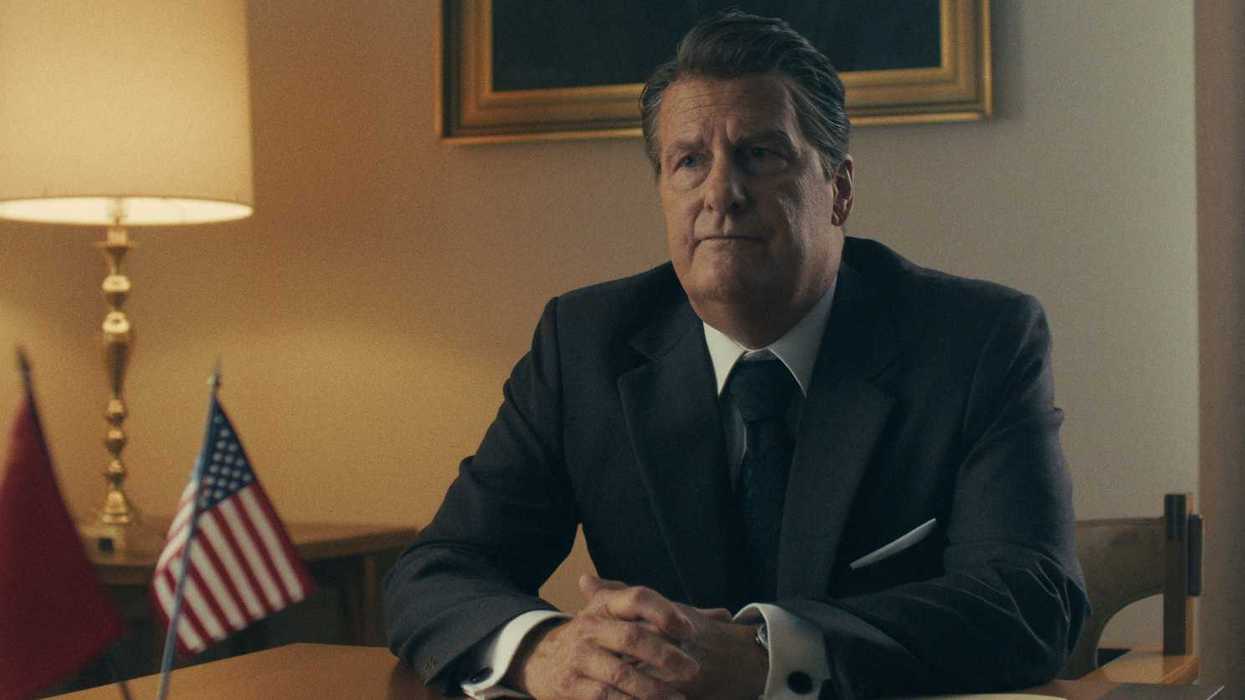
Courtesy of Angel Studios
Jeff Daniels as Ronald Reagan

Jeff Daniels as Ronald Reagan
Given that Angel Studios has a well-known conservative bent, I highly doubt that the filmmakers behind "The Brink of War" intended to make a movie that implicitly criticizes President Donald Trump. Nevertheless, merely by juxtaposing President Ronald Reagan's behavior during the famous Reykjavík Summit in 1986 with Trump's own transactional, belligerent and bullying approach to foreign policy, "The Brink of War" serves as a scathing critique.
It shows, if nothing else, how the Republican Party has evolved between the 1980s and the 2020s — and does so through a cinematic work of art that can best be described as beautiful, intelligent, moving... and flawed.
Analyzing "The Brink of War" as entertainment
From a strictly artistic standpoint, there is much to admire in "The Brink of War." It was filmed on location in Höfði, the actual location of the Reykjavík Summit and a reputed haunted house (locals claim to have seen the ghost of a young woman, stuck there after dying by either suicide or drowning). The on-set photography was performed by Pete Souza, a real-life White House photographer who actually photographed the summit captured in the movie. Much of the dialogue between Reagan and his counterpart, General Secretary Mikhail Gorbachev, is authentic, as writer-director Michael Russell Gunn went out of his way to incorporate publicly-available transcripts from the event.
Importantly, everyone in the main cast manages to not so much impersonate their historical counterparts as embody their essential qualities through subtle performance techniques. The story centers around Reagan (Jeff Daniels), Gorbachev (Jared Harris), Secretary of State George Shultz (J. K. Simmons), First Lady Nancy Reagan (Hope Davis) and Spouse of the General Secretary Raisa Gorbacheva (Branka Katić). There is little narrative fat to bloat the running time or confuse audiences about the thrust of the plot. The Reykjavík Summit, which was held on October 11-12, 1986, involved Reagan and Gorbachev trying desperately to implement arms control at a time when the Cold War was dangerously heating up. The movie focuses on that issue, and all of the crucial geopolitical tensions surrounding it, with eagle-eyed clarity.
The result is a motion picture that is entertaining for anyone who enjoys history or politics. The cinematography is somber, saturated and moody, much like many of the protagonists. The directing and writing is brisk and confident, trusting audiences to be smart enough to be as riveted by ideological and strategic debates as they would by violence in an action flick or sex in a romance story. Despite the Reykjavík Summit eventually covering a wide range of issues, Gunn is adept at addressing all of them without feeling overwhelmed by any, something that could have easily happened in the hands of a lesser filmmaker. Finally, Gunn's passion for the material — which I witnessed firsthand when interviewing him — is evident in every frame here.
This is not to say that it's perfect. Liberal audiences will likely groan at its oft-hagiographic depiction of Reagan (who was far from perfect) and clear bias toward conservatism. Unlike "Young Washington," another Angel Studios film, "The Brink of War" is not comfortable showing Reagan's warts alongside his strengths. There are also a handful of moments, most notably at the beginning, when the score was so loud I had trouble hearing the dialogue. Even without that technical issue, in general I found the score to be intrusive, as if it was ordering me what to think or feel rather than allowing the film's directing, writing and acting to let me reach my own conclusions.
Yet these quibbles, though meaningful, are ultimately minor. For anyone seeking quality entertainment meant for thoughtful grown ups, "The Brink of War" is an excellent choice.
Analyzing "The Brink of War" as history
After watching "The Brink of War," I spoke with Jack Matlock, who served as Reagan's special assistant and senior director for European and Soviet affairs during the summit. In addition to writing an excellent book on his experiences working for Reagan as he interacted with Gorbachev, "Reagan and Gorbachev: How the Cold War Ended," Matlock was kind enough to illustrate for me what it was really like working for Reagan — not just Reagan the statesman, but Reagan the surprisingly chill boss.
"It was great working for him," Matlock told AlterNet about Reagan's relationship with employees as an employer. "I was called to the National Security Council with the task of developing and negotiating a strategy for the Soviet Union. Although he had been rhetorically very critical of communism, at the same time he was very worried about nuclear weapons and the possibility of nuclear war. He wanted a strategy for negotiation, so I was brought onto the NSC and tried to develop what became a four-part agenda. I've described that in detail. When we finally had an agreement for him to meet with Gorbachev, I was asked to develop a program so that he would better understand the various issues. I organized what was, in effect, a college course — we jokingly called it 'Soviet Union 101.' We produced over twenty papers; I wrote three or four of them, and I had the others written by specialists in the CIA and the State Department's intelligence bureau."
Characterizing Reagan as someone who was kind and supportive to those who worked for him, as well as engaged with the substance of issues, Matlock described how he had to set an agenda of topics and then asked agencies to select their most knowledgeable analysts to write classified papers about them. Reagan could call the authors directly with questions if he chose, and consistently showed a deep level of engagement with policy substance that belied his contemporary image as an "amiable dunce."
"He would give us sometimes two hours a day to discuss these issues — almost incredible," Matlock recalled. "I would say that, of everyone I've dealt with, he was, only half-jokingly, the best student I ever had. He had some ideas that weren't right, but if you corrected him, he would thank you instead of getting angry. Before his first meeting with Gorbachev at the Geneva summit, he wrote a four-and-a-half-page description of what he expected. This was handed to me — typed up by his secretary, with a few corrections in his own handwriting — and I was told: read this, and when we brief him in Geneva, if he's got something wrong, straighten him out. That was the attitude of that administration. I haven't found that attitude in any other administration I worked for."
Matlock then described a scene from Reykjavík that doesn't appear in "The Brink of War" but, frankly, should.
"When we got there, we actually did a rehearsal," Matlock told AlterNet. "I played Gorbachev, speaking Russian, and our interpreter would interpret. I used things I had observed of Gorbachev on television — he had visited London and Paris before we met him and had appeared on TV — so I knew what his arguments would be on issues like the Strategic Defense Initiative and others."
He continued, "In any event, the main thing people need to understand about Reagan is that he genuinely wanted peace. He wanted to end the nuclear arms race. When Gorbachev later proposed the abolition of nuclear weapons, almost no one in the government thought that was a good idea except George Shultz. At that point, Reagan told us: 'Although this proposal isn't completely acceptable, we're not going to knock it — because if he's serious about eliminating nuclear weapons, we've got to meet him halfway.'"
In addition to omitting the rehearsal scene, "The Brink of War" botches the history of the summit in another critical sense — namely, by conveying the ideas that (a) Reagan prioritized humanitarian issues and (b) Reagan believed emphasizing civil liberties could ultimately lead to the downfall of the Soviet Union.
When Matlock heard this was part of the movie's message, he emphatically said that it is "absolutely not true."
"He said in a statement — which I've quoted in my book, and which he wrote without any prompting — I'm paraphrasing now: 'I think we're much too public about human rights. We can hammer at them in public, but it will not help the victims; in fact, it could hurt them. We have got to deal with this privately,'" Matlock told AlterNet. "And he stopped the public rhetoric after that. As for bringing down the Soviet Union — he did not aspire to break up the Soviet Union, and neither did his successor [President George H. W. Bush]. His view was: communism is a bad system, but if that's what they want, that's their business. Our policy, as it was under the first Bush, was that the three Baltic countries should regain their independence, because we had never recognized that they were part of the Soviet Union — but we were not trying to break up the Soviet Union otherwise. One reason was that we didn't want to see a proliferation of nuclear weapons, and at that point there were nuclear weapons in many of the republics. So the idea that human rights was a strategy to bring down the Soviet Union gets it exactly backwards."
When I shared Matlock's criticism with Gunn, he gently pushed back against it.
"Well, that was something Secretary Shultz told me about in our first conversation — that he felt there were two leaps at Reykjavik," Gunn told AlterNet. "The first was a leap of faith on Gorbachev's side, to be willing to reach out and engage one-on-one with Reagan. There were a lot of hardliners in the Soviet Union who thought Reagan was dangerous, but Gorbachev sensed something in him he could work with — that was the leap of faith. On Reagan's side, it was a leap of imagination. Shultz told me that even he didn't fully believe the Soviet Union could end. So it was that leap of imagination I was trying to capture with Reagan."
Gunn concluded, "When I read the transcripts and the material about the refuseniks and human rights and those kinds of issues, I was really thinking about it through the lens of how Reagan would have worked with Gorbachev to get that message through. That's really how the script came to deal with it."
Analyzing "The Brink of War" in the Age of Trump
At this point I must disclose something personal: I've always felt hostile to Reagan in part because he rose to power by winning the 1980 election against my favorite American commander-in-chief, President Jimmy Carter.
I've previously explained why I believe the outcome of the 1980 contest was one of history's greatest tragedies. Under Carter, Americans had a president who did prioritize human rights in foreign policy and was similarly ahead of the curve on issues like environmental protection, supporting racial equality, backing women's rights, implementing ethics reforms (and being ethical himself), helping disabled people, achieving landmark geopolitical negotiations (particularly in the Middle East and Panama) and fighting inflation. When Reagan replaced him, America took major steps backward on every one of those issues, and for the most part we have never fully recovered; just as bad, Reagan's pro-business and anti-labor attitudes created the pervasive income inequality that trickled down from America to the rest of the world.
For all of these reasons, I am no fan of Reagan, to put it mildly. Yet as "The Brink of War" powerfully shows, Reagan was still an exponentially better president than Trump. Everything wrong with Reagan is far worse with Trump; everything good about Reagan is lacking in Trump. Or, as Carter himself told me when I interviewed him for Salon in 2018, “I think that under Trump the government is worse than it has been before."
Albeit probably without intending to, "The Brink of War" displays how this is the case. Reagan is shown to care deeply about respecting American alliances, from our relations with weaker Asian nations like Japan to supporting our involvement in NATO. Trump, by contrast, is deliberately blowing up America's multilateral relationships due to a mix of isolationist tendencies and a desire to personally financially profit from foreign policymaking. At various points in the film, Reagan expresses sympathy for immigrants and for persecuted peoples like the Soviet refuseniks; Trump, on the other hand, is infamously and chillingly indifferent to human rights. Whereas Reagan paid close attention to his expert advisers and tried to intimately familiarize himself with topics important to his job, Trump has a notoriously short attention span and has botched major policy areas — from his COVID-19 response to his war against Iran — because he is proud of his own ignorance.
Even as personalities, Trump falls short of Reagan's standard in every measurable way. In contrast to the friendly and loyal boss shown in "The Brink of War" and described in real life by countless former employees, Trump is widely despised by those who used to work for him — not just obscure names but including his own first term vice president (Mike Pence), attorneys general (Jeff Sessions and Bill Barr), Secretary of Defense (James Mattis), Secretary of State (Rex Tillerson), chief of staff (John Kelly) and countless others — and is happy to throw his subordinates under the bus to save his own skin. (One can never imagine Reagan doing what Trump recently did and use his own staffers, as well as many journalists, as decoys for a potential assassin.) Reagan was a loving and faithful husband to Nancy, while it's an open secret that Trump and Melania are at best extremely chilly and distant toward each other. Finally, while Reagan was respected even by critics for his humility and willingness to be corrected, Trump demands sycophants who praise him at every turn and spare him all criticism — and, most importantly, was literally willing to destroy American democracy rather than admit he lost the 2020 presidential election.
While I was not given time to ask Gunn about the full gamut of differences between Reagan and Trump, I did ask for his impressions by quoting part of my 2018 interview with Carter. Reagan's predecessor described Trump by telling me, "This is the first time I remember when the truth is ignored, allies are deliberately aggravated, China, Europe, Mexico and Canada are hurt economically and have to hurt us in response, Americans see the future worse than the present, and immigrants are treated cruelly." From there I asked Gunn, "Do you feel your film's message is relevant at a time when President Trump is ignoring human rights, both in this country and abroad, trying to pull America out of NATO, and abandoning longtime Asian allies like Taiwan?"
His response was telling and shows how "The Brink of War," despite showing how one right-wing president was far superior to another, was made by people as uncomfortable with this reality as the millions of people who still back Trump with cult-like devotion.
"Well, I think it's a very different world now," Gunn told AlterNet. "When Carter and Reagan were in office, it was a bipolar world — a world between two superpowers. We now live in a multipolar world, with the rise of China and the low-intensity conflicts that have emerged around the globe, in Myanmar, in Ukraine, and elsewhere. I think we're living in a much more complicated world." He then pivoted to a point about "The Brink of War" on which liberal and non-MAGA conservatives can most certainly agree.
"But if your question is really about what we can take away from the Reagan-Gorbachev era, I think it's that engaging with an adversary is always the first step toward peace," Gunn explained. "That's the takeaway I had while researching and working on this project, and it's what I hope audiences take away when they see it."
The bottom line
I hope they see this too. Like Gunn, I hope audiences walk away with that impression because Americans do indeed need to adopt more human rights-focused and more engagement-oriented approach to foreign policy. Art is a powerful medium for communicating ideas — after all, Reagan was familiar to Americans as a star of Western movies before becoming California governor and president, while Trump spent a decade as host of the reality TV show "The Apprentice" before his successful 2016 presidential campaign — and when it comes to its core ideas, "The Brink of War" will be entirely salutary if it transmits them en masse effectively.
Unlike Gunn, however, I also hope people will watch "The Brink of War" and appreciate the extent of the decline in American conservatism. Whereas Trump and his supporters clearly want to destroy America's two-party system (how else to describe characterizing all elections won by Democrats as illegitimate?), I don't want to live in a country where only one party is allowed to succeed. We need a robust two-party system, with Republicans of integrity working alongside Democrats of integrity. For all of Reagan's myriad shortcomings, he appreciated that too — and, by dint of his leadership style, embodied those ideals.
This is why, at the end of the day, Angel Studios' Reagan movie is also secretly a warning about Trump.

