
Trump’s document shredding boosted by DOJ memo about records: veteran reporter
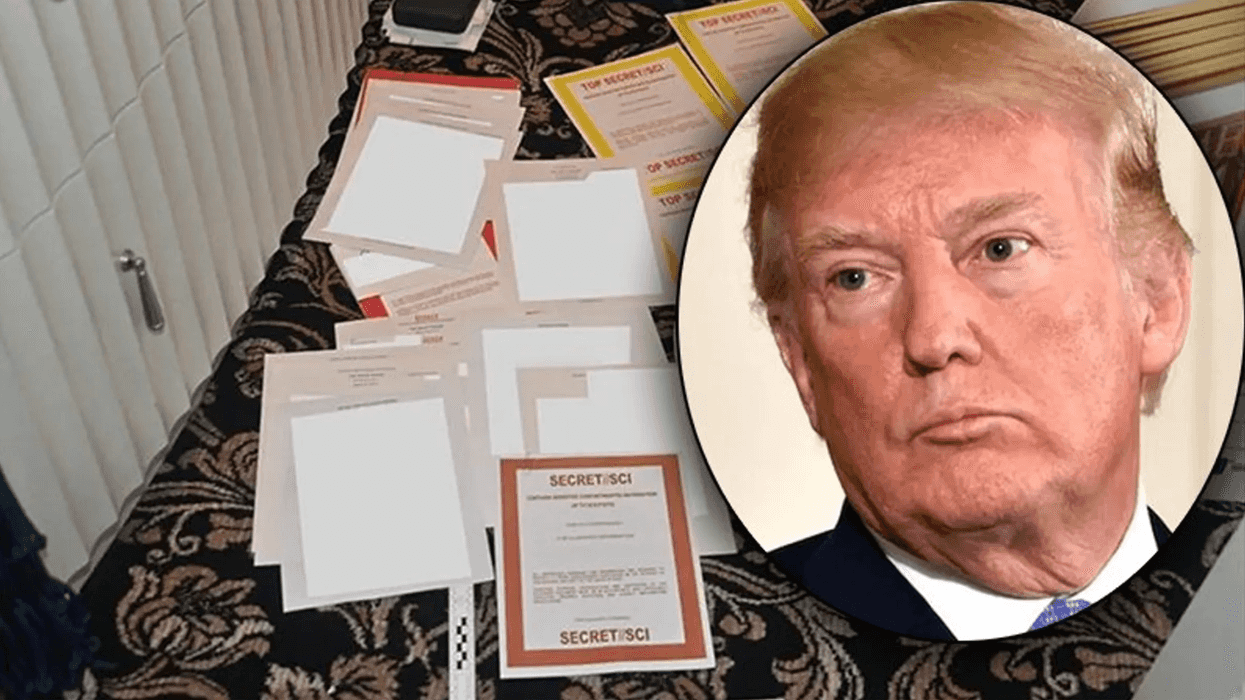
Donald Trump and documents found at Mar-a-Lago (Photo: FBI and Shutterstock)
Donald Trump and documents found at Mar-a-Lago (Photo: FBI and Shutterstock)

Donald Trump and documents found at Mar-a-Lago (Photo: FBI and Shutterstock)
President Donald Trump is trying to gut the Presidential Records Act (PRA), declaring the post-Watergate law unconstitutional and claiming his stolen documents from the first term are his personal property to shred, flush, or hide at will.
On Wednesday afternoon, the Justice Department issued a radical legal opinion that defies decades of precedent and threatens to erase the paper trail of the Trump administration's most damaging decisions. Courts are racing to intervene, but the fight exposes Trump's theft of classified documents and his long-standing document destruction habit.
Writing for the New Yorker, longtime columnist Ruth Marcus recalled a former senior Trump official told the Washington Post that they were forced to tape documents back together to comply with the records laws.
“He didn’t want a record of anything,” the staffer said. “He never stopped ripping things up."
There were even reports by the New York Times that broadcast photos of documents found in toilets in the White House.
Maggie Haberman, in her 2022 book, “Confidence Man,” said of Trump, in his first term, that he “would periodically throw print paper into the toilet, which would clog the pipes and require engineers to clear them; staff sometimes found clumped-up paper themselves, with his handwriting on it, and recalled it happening on some foreign trips.”
Trump would frequently complain about the plumbing, claiming that low-flow toilets required him to flush "ten times — fifteen times."
When Trump left the White House in 2021, he took dozens of boxes of documents, which included classified information. For more than a year, the National Archives and the FBI tried to work with Trump to get the boxes back to ensure they were properly archived. Most would then be returned to Trump for the presidential library. Trump refused to turn them over, maintaining "they're mine." Ultimately, the FBI was forced to get a search warrant to take the documents. It resulted in Trump's indictment, which was initially killed by Trump-appointed Judge Aileen Cannon.
"In his second term, Trump seems determined to operationalize that 'mine, mine, mine' world view," wrote Marcus. "His White House counsel, David Warrington, asked the Justice Department’s Office of Legal Counsel to review the constitutionality of the Presidential Records Act of 1978, which requires that Presidents’ records be preserved while they are in office and transferred to the National Archives once their terms are up."
"The O.L.C.’s opinion, released last month, declared that the law is unconstitutional — that 'Congress cannot preserve presidential records merely for the sake of posterity' and that, in addition, the law infringes on 'the constitutional independence and autonomy of the Executive.' Therefore, the opinion concluded, 'the President need not further comply with its dictates,'" Marcus continued.
In the wake of the DOJ's decision, two lawsuits have already been filed. One of those came from the American Historical Association, which said in its court filing, "This case is about the preservation of records that document our nation’s history, and whether the American people are able to access and learn from that history."
While Trump's judge may have killed the document theft case while he is in office, the DOJ just reignited it.
Former National Archives general counsel Gary Stern explained that the law has never been challenged in court. "No one ever suggested that the law was unconstitutional," said Stern.
But even in the case of Trump's theft, the president has never made the case to a court that the law should be ignored. His DOJ merely decided they would ignore it.
"This President and succeeding Presidents, if they chose to, could simply ignore the Presidential Records Act, not do anything consistent with their Presidential Records Act, and it would never be subject to judicial review," said Judge John Bates, a George W. Bush appointee, to the Trump administration's lawyer.
“On the one hand, you’re arguing that the guidance that you’re following is substantially equivalent to the Presidential Records Act,” the judge told the administration. “And on the other hand, you’re arguing that following the Presidential Records Act would be extremely burdensome to the Presidency. I don’t see how those fit together.”
The most concerning piece of the story is that there's no indication that the entirety of the Trump government isn't simply shredding documents on a daily basis.
Lawyer Daniel Jacobson, representing the American Historical Association, told Judge Bates, “This is not some academic exercise where they’re still going to act exactly in accord with the P.R.A., and they just wanted to make it clear they think this law is unconstitutional. They issued a new policy right after for a reason.”
Executive director Chioma Chukwu, who oversees the government watchdog group American Oversight, said, "The White House does not get to decide what is preserved, what’s hidden, what’s destroyed, because the law is very clear that these records belong to the American people, not to any one President."

