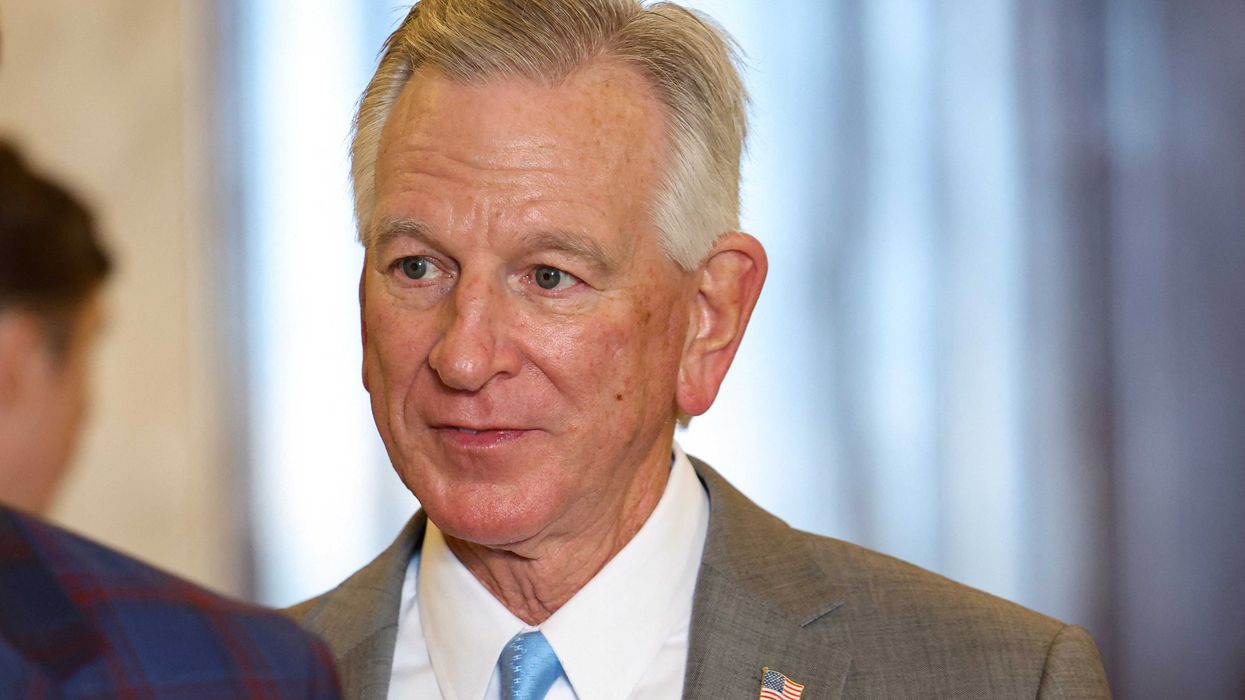
Sen. Tommy Tuberville (R-Al.) appeared in the Alabama Supreme Court this week to defend himself against allegations that he wasn't a resident of Alabama in time to serve as governor.
Those challenging Tuberville filed a 23-page brief to the top court in response to Tuberville's attorney and the state's GOP, reported the Alabama Recorder.
The issue has been a problematic one for Tuberville, who faced allegations that he was a resident of Florida. That evidence includes a "2023 Florida driver’s license, and homestead exemption in Auburn that Tuberville said he has been on since 2018 but was not added to until mid-2024." He was previously the head football coach at Auburn University. He then coached at Cincinnati from 2013 to 2016. He said he purchased the Auburn home in Oct. 2018 during a closed-door hearing, The Birmingham News reported in June.
Alabama requires that a candidate for governor be an Alabama resident for 7 years to qualify for office.
Tuberville's team is accused of attempting to avoid an “obvious and very inconvenient truth.”
“Raising every conceivable procedural and legal roadblock they can muster, Tuberville and his political allies ask this Court to simply look the other way while he thumbs his nose at an Alabama constitutional requirement that has existed since this state was founded more than 200 years ago,” Thursday's brief said.
Tuberville has argued that while he may have a home in Florida, it's not his permanent residence.
“Alabama has long held that it is up to the judiciary – undisputably a co-equal branch of our government – to uphold and enforce the provisions of the Constitution when threatened by unscrupulous politicians and others more concerned with their own power than the rights enshrined in our most sacred laws,” the brief went on.
“The statutory language is expressly limited to ‘any proceeding for ascertaining the legality, conduct, or results of any election’ or ‘any injunction, process, or order from any judge or court, whereby the results of any election are sought to be inquired into, questioned, or affected, or whereby any certificate of election is sought to be inquired into or questioned,’” the brief continued. “Appellants challenge only Tuberville’s constitutional eligibility to now serve as the certified nominee — which presumes that the results of the primary are valid and correct.”
One of Tuberville's arguments is that the courts have no role in deciding whether or not he meets the legal requirements. The plaintiffs are using a legal proceeding called “quo warranto,” the report explained. It is the process by which someone asks, “By what authority does this person hold — or claim the right to hold — this public office?”
In June, Tuberville's campaign released new documents to prove his residency, but it inadvertently exposed him to two potential charges. To prove he was an Alabama resident, his team recently produced seven years of tax documentation and property tax records. Still, there are questions as to how Tuberville can prove he was a resident of Alabama.
First, Alabama Reporter journalist Josh Moon asked why it took so long for Tuberville's staff to produce documentation in his defense.
The second question was whether Tuberville's voting records showed that he committed voter fraud.
Tuberville included his 2018 tax filings in the records, which aren't required, since he only has to prove seven years of residency, not eight. The problem is that Tuberville voted in Florida in Nov. 2018 while claiming to be a resident of Alabama, AL.com reported.
"According to records from the Walton County, Florida, registrar’s office, Tuberville registered to vote in Florida on May 24, 2017, and voted by mail in the 2018 general election," Moon reported. "The earliest he could have received a mail-in ballot was October 2, 2018, according to the Division of Elections at the Florida Department of State."
The legal argument is a complicated one because Tuberville hasn't been elected to office yet. So it's challenging to say whether he could take office if he were elected.
The brief addresses that by arguing, "Alabama voters deserve to know whether Tuberville is constitutionally ineligible before they go to the polls in November."