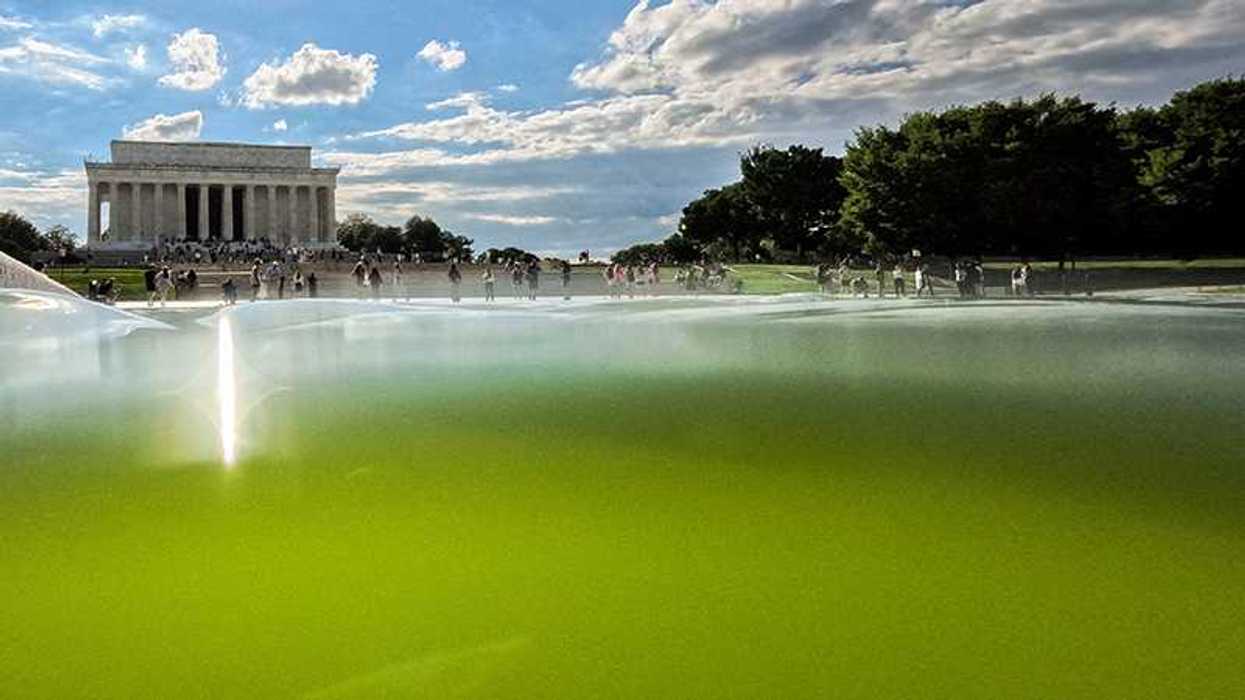
Until recently, Atlantic Industrial Coatings was handling the waterproofing and repainting of the Lincoln Memorial Reflecting Pool. Now, a new company is taking over with a $2.7 million contract to address the algae issue, local NBC Washington reports.
President Donald Trump's Reflecting Pool disaster has become a kind of "Money Pit" satire of Washington, D.C. over the past year. The goal was to add a liner to the pool in "American Flag Blue" to eliminate the algae problems that have existed since the pool was built.
Trump initially said that the liner would cost about $1.8 million. He later described the estimate as roughly $1.5 million to $2 million, but the project’s cost ultimately rose to more than $14 million. After the pool was finished and the liner began to peel, the White House gave an additional $2 million to fix it. The cost now exceeds $16 million, according to contract records. Green Water Solutions was hired to run its nanobubble technology to clean the pool ahead of the July 4 holiday. Once they were finished, however, their equipment was removed.
The new contract will mean an additional $2.7 million to address the algae problem for a second time, government spending data shows.
“I read about it in the New York Times, and I said you know what, I can fix this problem,” said Richard Rosen, the founder and CEO of American Ag Energy, Inc. told NBC Washington.
He said that his company was one of five that were bidding on the contract to fix the algae issue.
“Our goal is to have nothing growing in the water,” Rosen said.
A longtime expert in swimming pools said he knew the culprit behind the Reflecting Pool "vandalism" that caused an ongoing algae bloom. "Swimming Pool Steve" Goodale is a second-generation pool builder with a YouTube channel dedicated to explaining aspects of swimming pools and hot tubs. Speaking to CNN in June, he explained that there's no way to fix the algae problem without using chemicals that can be dangerous to animals that use the pool.
"Well, somebody definitely planted the algae, and it was the very first bird that landed in the water," said Goodale. "You know, in an open-air environment like this, there's no stopping the algae from coming. It's going to be in the water. It's just how are you going to deal with it, knowing that it will be expected."
He suggested a multi-pronged solution: the pool must be drained and the immediate remediation would likely follow.
"It would really come down to a matter of concentration," said Goodale. "And again, we're talking about, you know, 6.5 million gallons of water or more. So, it would take an awful lot of product to get to dangerous levels of contamination here. It's why hydrogen peroxide would be commonly used for an open-air, clear water environment like this, because it is kind of the safer of the options. It's why we don't use something like chlorine, which wouldn't be as safe for the wildlife."
Rosen explained that his team has experts and engineers who have "decades of experience managing water quality in facilities around the world."
He described his team as "conducting a biological and chemistry profile of the Pool, to understand exactly where the water is coming from, what organisms are living in the water, and how the environment around the Pool impacts the water in the pool itself," the report said.
He thinks the problem stems from the water's chemical composition. Before the 2012 renovations, the National Park Service used city water to fill the pool. The new goal was to circulate the water from the Potomac River through a filtration system and into the pool to keep the use of city water to a minimum.
"I think we can do a lot of stuff for much lower cost, because we are going to focus on knowing what we’re doing,” Rosen said.
The report claimed that he's still not "overly confident," however.
“I don’t believe in anything until I actually see it work,” Rosen added.
He also swears there's nothing political about his bid for the contract.
“I don’t want any politics in this at all,” Rosen told NBC Washington. “We don’t have any political motivations here. This is really science and technology and engineering.”