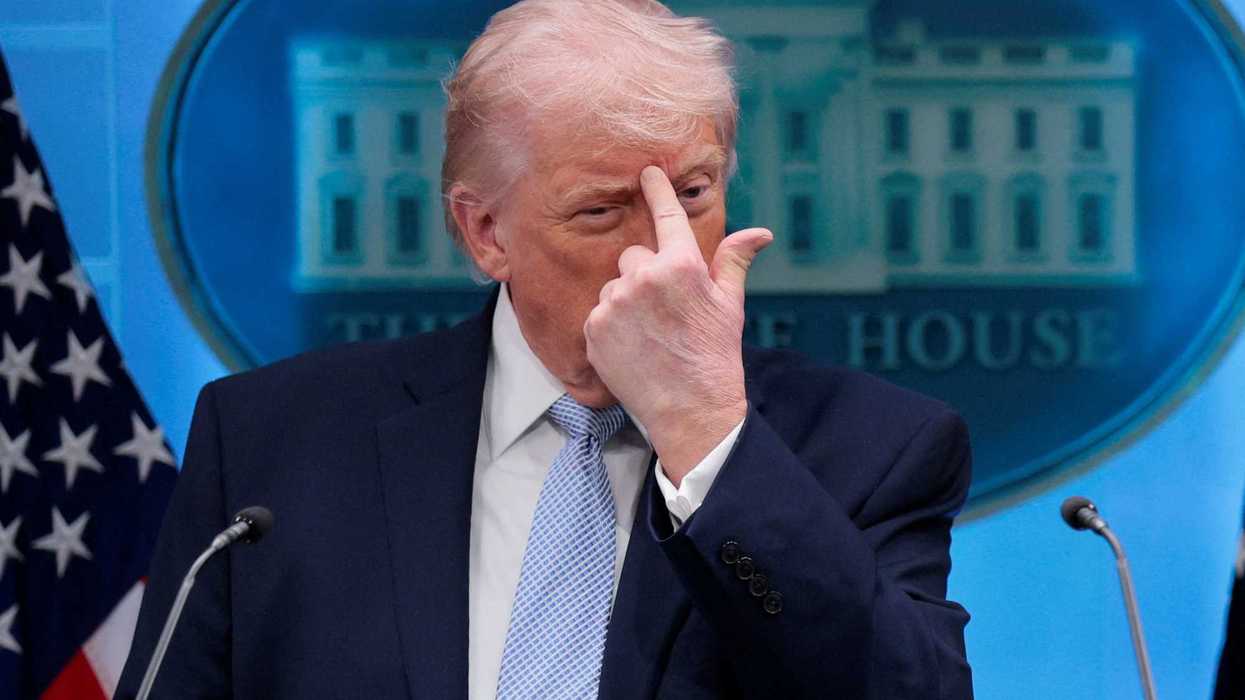
Over the course of President Donald Trump’s second term, the United States and the entire world have been thrust into chaos by the administration’s erratic actions. While many have speculated about what pushed the U.S. to elect its highly disruptive leader, renowned historian Timothy Snyder has a theory: it’s an attempt at “superpower suicide.”
“I’ve been thinking about how best to characterize what the United States is doing to itself on the scale of the world,” said Snyder on his Substack, “and I think ‘superpower suicide’ is probably the best term.”
There are a handful of points that drove him to this conclusion.
“To be a superpower, you have to be a power, and to be a power, you have to be a state,” he explained. “And I think the way we’re being governed now is inconsistent with statehood. The way we’re being governed now — or rather ruled — seems to have to do with the enrichment and the wealth of the president himself and the people immediately around him. It seems to involve the cult of an individual and his eternal power rather than the continuity of institutions that belong to everyone.”
That brought him to matters of succession, or the lack thereof, and the future in general.
“By calling into question past and future elections,” said Snyder, “the President of the United States is undermining…the principle of succession, which is fundamental to being a superpower” — the idea that a country will continue beyond its present leadership. What’s more, Snyder claimed that Trump lacks a coherent ideology to carry forward, saying, “What is the future of this country? I don’t think the people in power are able to give any of that a name. There is no idea of the future. There’s just day-to-day enrichment.” On top of that, the U.S. is “pursuing policies that are inconsistent with there being a future.” He explained that global powers rise and fall based on their energy policy, and Trump’s decision to double down on oil and gas while ceding green energy development to China simultaneously cedes the future to Chinese leadership.
On that note, Snyder argued that “a superpower would be able to deal with its adversaries, and we seem completely unable to do so.” Over the course of the past year, Trump has declared and quickly lost a trade war with China, then a war with Iran, and a consequence of both has been the enrichment of Russia. At the same time, Trump has made it clear that he’s not only uninterested in collaborating with allies, but happy to shred essential alliances.
Finally, Snyder suggested that “a superpower of the future…would be caring about education and science, which is what we’re not doing.” To the contrary, under Trump, the U.S. is decimating its K-12 and university systems. Science has become politicized, while students and researchers from abroad are now looking elsewhere to bring their smarts and expertise.
All of this, concluded Snyder, comes down to an act of "superpower suicide." But he didn’t end on an entirely dire note.
“To make things a little bit more hopeful,” said Snyder, it’s an “attempted suicide, because none of this has to happen. It could all be changed. But that would depend on the choices we make.”