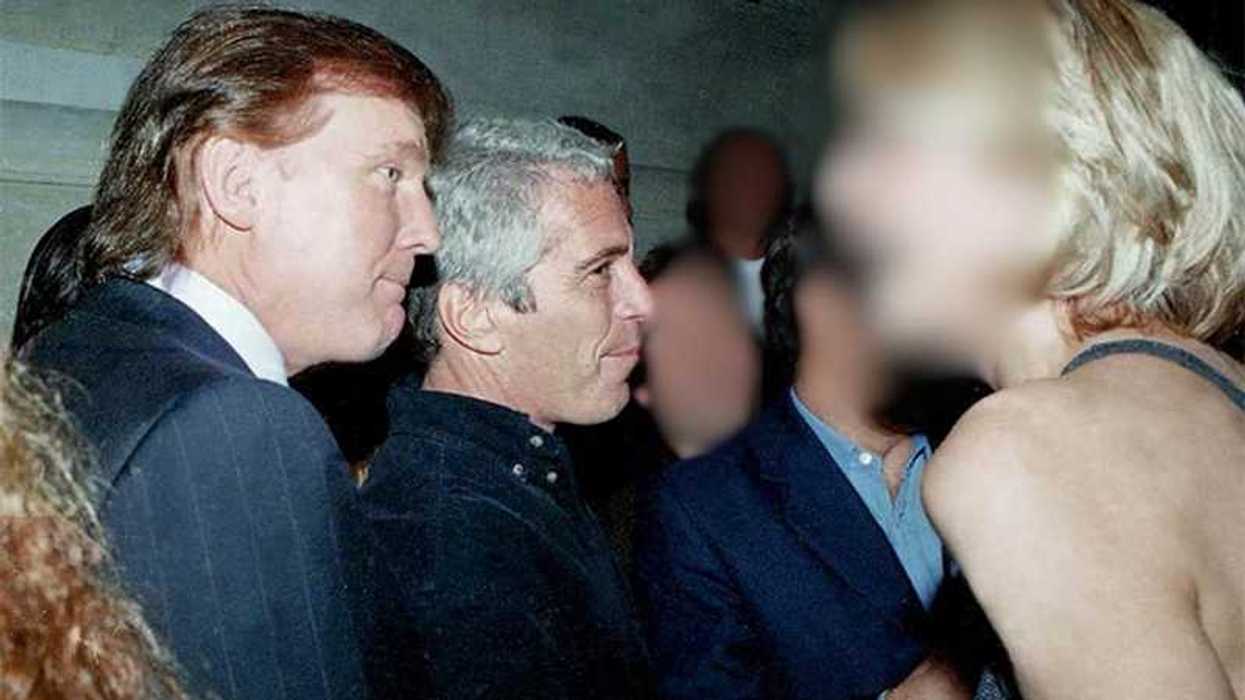
Michael Wolff, one of the biographers of President Donald Trump, teased last week that he would begin telling his long tale of trafficker Jeffrey Epstein and the information he'd gathered over the years. On Monday, those stories began to drop.
He began with the property scheme Trump cooked up in Palm Beach, Florida, after the 1990s had "gutted" Trump's finances and left him relatively broke. This is what the men said was the real falling-out of their relationship.
"Without the forgiveness of his lenders," Trump's bad investments "would have finished him. He had lost his properties, and only the rental of his name kept him in place. This was the nadir of his career. So low that he’d been talked into fronting a reality TV show where he’d play a successful businessman — a venture that other more successful businessmen had turned down. His friend Epstein couldn’t get enough of this, the ignominy of it, and kept telling people Trump was going to be a contestant on Survivor instead — because he barely had survived."
“His only real business was renting his phony-baloney name,” Epstein characterized, Wolff recalled. It was said both marveling at it and being disgusted by it.
Putting his name on something took a different turn, however. Essentially, Trump could also lend his name to an anonymous buyer and artificially inflate public appearances before the anonymous buyer buys it back from you.
"If you bought — or appeared to buy — a property for $10 million, say, and then sold it to the person who had given you the money to buy it in the first place, for $20 million, the actual buyer, paying back himself, would have washed his money," described Wolff.
According to Epstein, Trump thought only a shmuck would refuse something so profitable.
The biographer noted that it was also an easy way for an "influx of shady money — mostly Russian money, much of it probably Putin’s own money" that was using a "rich man's name."
The deal that Epstein and Trump tried to do together was, in Trump's mind, about the money. Whereas Epstein actually wanted the property.
Enter Les Wexner, a former employer of Epstein. The home had nearly 500 feet of ocean-front living and a long history of "society" owners. Wexner ultimately sold it to Abe Grosman, who turned it into a 90,000 square foot "French Regency monstrosity," according to Wolff.
Wexner testified to Democrats on the House Oversight committee in February, where he answered questions about his relationship with Epstein. Before Epstein's death, Wexner was subpoenaed by a grand jury in New York to answer questions. He and eight others were to be questioned by the FBI, News Nation reported in February, about files that allege Wexner was a "co-conspirator."
The men were "not precisely mentor and protégée, although it might have begun that way," Wolff said. "The homoerotic cast of the association — when they were together, they exchanged constant looks and seemed to move in tandem, as though with a need for the other’s say so, and heightened awareness of the other’s physical space — was why the suspicion of a sexual affair has become one explanation for the millions that Epstein reaped from Wexner," Wolff continued.
Wolff thought it was more about an alter ego.
Epstein lived in Wexner's compound in Ohio, and Wexner "sold" Epstein the infamous Manhattan mansion. Wexner had regretted selling the house to Grosman and kept a close eye on it for another opportunity. Once Grosman's fortunes slumped and it became clear he overbuilt the house, the men swooped in. The problem, however, is that the home ended up in bankruptcy proceedings. After small battles, he tried to buy it back.
Epstein loved the idea that he was the biggest landowner in one place or another. He bragged about the mansion in New York, claiming it was the "largest private residence in Manhattan."
That was what Trump wanted when he bought Mar-a-Lago, the largest home in Palm Beach. "If your real estate made you unavoidable and unmissable in it, you had achieved something beyond the value of the property itself. This was straight Gatsby stuff," Wolff said.
It was a lot like a king or a pharaoh building a monument to themself. "You owned the space, and controlled it, and made it into whatever you wanted — you did this. You bent your environment to your absolute will. Even if Epstein liked to pretend that it all had come into being as an afterthought," said Wolff.
Unlike the massive mansion, Trump was being forced to live in a commercial property instead of a home. Wolff described him as being forced to “[kiss] rich old ladies for their membership fees.”
Trump and Epstein walked the grounds of the property together and dreamed about ways to undo Grosman's tacky taste.
"In Epstein’s retelling of this story — still, years later, full of hurt and betrayal — his and Trump’s visit to the house was on a Saturday. The following Monday, Trump went around his back and topped his $36 million bid with an immediate cash offer of $41 million," said Wolff.
In reality, Trump first tried to see whether they could do a deal together. Epstein told Wolff that "Trump identified Dmitry Rybolovlev, the Russian oligarch and fertilizer king (and Putin BFF), as an interested buyer."
“This was basic Donald,” Epstein told Wolff. “Nothing would interfere with an advantage he saw for himself. Primal. Grab and devour the meat. So, it gets to threats. Me: ‘If you f—— me, I’ll f—— you.’ Him: ‘I’ll f—— you back.’ We got there pretty fast. The thing is, Donald really has no scruples.”
Epstein didn't think Trump could make good on the offer, but Deutsche Bank rushed to loan it. Epstein later told Wolff that the bank had "long since stopped lending to Trump." For Wexner and Epstein, the mansion was a beloved space. To Trump, it was nothing more than a quick payday.
Epstein was furious and turned to litigation. "He would expose Donald Trump, who just then was debuting as mogul-manque on The Apprentice, as a fake billionaire and failed businessman," wrote Wolff.
"Indeed, hardly two years later, when Maison de L’Amitié was sold to Rybolovlev for $95 million, without improvements to the property and far outstripping the market, Epstein might appear to be correct in exactly what he saw as Trump’s game — and in all the accusations he was making. (Rybolovlev would tear down Gosman’s 90,000 square feet and start over again.) But that satisfaction was limited," said Wolff.
Then two weeks after Trump closed on the deal, the Florida police were at Epstein's door.