Resend Push Notification

Laughing at Trump's hair is fun — but it's also a trap: NYT columnist

In a thought-provoking guest essay published in The New York Times, veteran columnist Frank Bruni delivers a sharp, analytical critique of the public and media's persistent fixation on Donald Trump’s physical appearance.

Bruni argues that this ongoing, near-obsessive focus on cosmetics and aesthetics serves as a dangerous, counterproductive distraction from the severe institutional, legal, and democratic harm caused throughout Trump’s political career. By constantly reducing a highly consequential and deeply destructive political leader to a mere caricature—characterized by discussions of orange skin makeup, shifting hair colors, and distinct physical mannerisms—society inadvertently trivializes the profound gravity of his actions. This superficial approach ultimately lowers the bar for true political accountability, transforming serious questions of governance into a shallow cultural spectacle.

Bruni highlights how late-night television monologues, political cartoons, and viral social media commentary frequently center their primary critiques on Trump’s physical presentation rather than his policy outcomes. While these superficial jabs and aesthetic jokes offer quick entertainment and momentary emotional relief for his detractors, they construct a misleading, circus-like atmosphere around American politics. This constant focus on appearance crowds out rigorous, substance-driven journalism. Instead of deeply analyzing complex policy implications, landmark judicial appointments, international foreign relations, or the systemic erosion of foundational democratic norms, public discourse becomes saturated with shallow internet memes and playground insults. Bruni notes that this troubling dynamic plays directly into a broader, worrisome cultural shift where political entertainment increasingly supersedes civic responsibility and critical thinking.

Furthermore, the essay emphasizes that treating a prominent political figure like a cartoon villain minimizes the tangible, long-term consequences of his administration's official decisions. When the media and the public spend more collective energy debating a politician's physical signs of aging, posture, or tailoring choices than analyzing their actual legislative rollbacks, executive orders, or rhetoric, the true stakes of democratic governance are entirely lost. This aesthetic focus allows the substantive, everyday impact on citizens' lives to fade into the background.

Bruni strongly urges critics, journalists, and the electorate to move past this counterproductive fixation. He calls for a collective, disciplined refocus on the substantive realities of Trump's political record, urging a return to serious, policy-oriented critique that addresses the fundamental challenges facing the nation's democratic institutions.

Ultimately, Bruni's piece serves as an urgent warning that safeguarding democracy requires citizens to look far past the superficial spectacle, disregard the trivial aesthetic distractions, and directly confront the actual exercise of political power and its enduring institutional legacy.

Trump biographer says he has no idea he just staged his own 'funeral'

President Donald Trump seemed more than pleased with the praise and attention lavished on him during the recent GOP midterm convention, but according to his one-time biographer, he seems to have no idea that he helped stage his own "political funeral" in the process.

While parties typically reserve conventions for presidential election years, at Trump's insistence, the GOP held an unprecedented midterm convention in Dallas this past week, aiming to help bolster their chances as polls continue to show a Democratic wave coming to wipe out their congressional majorities. Many observers, however, argued that the event might make things worse for Republicans, given how much of it was dominated by Trump at a time when voters hold an increasingly toxic view of his leadership.

Michael Wolff is a longtime reporter and author, best known for his extensive coverage of Trump's political career. In the latest episode of his Daily Beast podcast, "Inside Trump's Head," he suggested that the convention actually served as a preview for Trump's potential successors within the Republican Party, with appearances from the likes of Vice President JD Vance, Secretary of State Marco Rubio, Sen. Ted Cruz of Texas and Florida Gov. Ron DeSantis. Vance, in particular, was at one point met with cheers of "JD 48," in reference to him potentially becoming the next president.

Wolff further suggested that Trump might not have been aware of the extent to which the event turned into a funeral of sorts for his time in politics.

“It suddenly gave a platform to the people who are going to be running to replace him,” Wolff explained. “And I wonder if he actually realized that. As we go past the midterms into the final two years of this presidency, the one thing that is going to most bedevil him is the idea that someone in his party would actually want to and believe they can replace him.”

Wolff also noted that "the JD machine is now gearing up” and “getting into position now" to launch his own 2028 campaign, even as polls often show him with historic unpopularity for a vice president. He argued that this dynamic going forward is not going to sit easily with Trump and reiterated his past point that Trump will not go quietly to make things easier for his successor.

“Let me repeat my position because I really think it’s the only context in which you can see this,” Wolff said. “The idea that a Republican might become president and overshadow Donald Trump would be the tragedy of his life. Therefore, it’s not going to happen.”

He added: “The Donald Trump presidency is going to continue, if not in the White House—because I don’t think he’s figured out how to pull that one off—but therefore it will continue in Mar-a-Lago. He will be the president in exile with billions of dollars at his disposal to finance this administration in exile.”

The jig is up: Trump is going to take the money and run

There are amazing sentences in this Post report from this morning about the president not spending hundreds of millions intended to support Republicans in the coming midterms.

They are amazing sentences, because they exist in a mainstream news outlet owned by a billionaire who profits from his patronage of the White House, but also because they never quite land on the truth in plain sight, which is that Donald Trump is stealing the money.

Examples:

  • "Trump has kept most of his super PAC money on the sidelines, causing Republican leaders to conclude it’s too late to fully deploy the cash in the midterms and that he intends to hold on to much of it for his own purposes."
  • "Trump’s political advisers have been assuring anxious allies that MAGA Inc., the president’s super PAC that had more than $400 million on hand as of July 31, will come to the rescue ... But Republicans are increasingly skeptical and suspicious that Trump — who must personally approve the spending — has other ideas."
  • "Some people around Trump have concluded that he has little interest in spending the bulk of his super PAC funds on this year’s midterm races."

"Theories" about what he's planning include:

  • "protecting his political influence in the next presidential race by passing on the money to his chosen successor and saving up for legal fees."
  • "post-presidential travel, events and pet projects, such as his library."

But here's the kicker:

  • "Trump [believes his] ability to rake in massive donations will take a hit after the midterm elections, giving the president an incentive to keep hold of the money."
  • Trump's "super PAC and funds for his inauguration, White House ballroom and Freedom 250 events ... have been inundated with donations from companies looking to get in Trump’s good graces, a dynamic that is likely to change as he becomes a lame duck."

In other words, the president has a feeling the jig is nearly up. As deranged, damaged and demented as he is, a lifetime of scamming tells him the end is near. If the Democrats take the House, and especially if they take the Senate, Trump will face the deadliest kind of exposure imaginable for the following two years. Over that time, the Republicans won't want him anymore. Worse, the rich won't want to "donate" to him or his "projects," that is, they will be less inclined to bribe him. The Post report may be an early indication that the Republicans and their donors are reading the writing on the wall. Trump, now age 80, is a depleted force.

It's time for him to take the money and run.

Of course, no sane person should shed a tear for the Republicans. They knew what they were doing from the day Donald Trump descended his gold-plated escalator more than a decade ago. Their lust for power and desire for control (of women, of minorities, of immigrants, of workers, of religion, of free thought and expression) drove them to his side. While everyone else knows that no one survives a deal with the devil, what makes the Republicans exceptional is their belief that they are the exception. Consequences for me! Disgraceful!

That said, if the only consequences of the next two years are Trump sitting on a pile of bribes and blood money, running down the clock, with some House Republicans looking for work, the party should be grateful. As it stands, the Republicans put a malignant narcissist in charge of the government, with the blessing of legal immunity by a lawless court. They might want to leave the president. They might envision a future without him. But to a malignant narcissist, there is no future. There is no leaving. And if you try, he will make you pay.

Consider what Anthony Scaramucci said some months ago. The White House communications director during Trump's first term told Bloomberg that up to now, Trump has actually constrained his contempt. That will change after the midterms, but especially in the run up to 2028, he said. "His personality is 'you guys were nothing before I got on the stage and I’ve carried you for the last 12 years, and the 2020 election was rigged and everyone knows it, and I should’ve won that election, and I’ve returned to the presidency carrying all the Republicans on my back, and when I leave ... you’re going back to nothing.'"

Milo Yiannopoulos: "I didn't really understand the physical reality of how institutionalized the brutality is in America. The manner in which they arrest you, they put you in manacles, everybody is arrested like an MS 13 gang member.
It was physically degrading. It was… pic.twitter.com/71yM6bmiGl
— Reggie B. (@reggiebblue) September 1, 2026

Scaramucci added that "we try to normalize him, sane-wash him, and put him into a bucket. 'Oh, he’s a Republican, he'll want a Republican to succeed him or he’ll want JD Vance or Marco Rubio.' He doesn’t want those guys to succeed him. Let's say he has a successful remaining two years of his presidency, which seems unlikely, but let's say he did. He wouldn’t want those guys taking any credit for anything that happened in the administration."

What would Trump do? Obviously, no one can say. Something similar to the J6 insurrection is one possibility. However, given the consolidation of Trump's control over the federal government, a more plausible option is doing to select Republicans what the administration did to Milo Yiannopoulos, the British propagandist and fascist who was one of Trumpism's greatest champions before getting on the wrong side of Laura Loomer, a Trump confidante.

ICE arrested him, brutalized him and humiliated him before deporting him. The law didn't protect Yiannopoulos from Trump's secret police any more than the law protected the East Wing from Trump's wrecking ball. Yiannopoulos' experience is a dramatic example of what a bureaucracy run by a vindictive sociopath can do in subtler ways to ensure that his enemies are reduced to nothing. If all he does is take their money, the Republicans will be lucky.

Trump faces backlash as 'clown crew' policy hits a brick wall

After President Donald Trump’s military campaign against Iran failed to achieve any of his stated goals, his strategy shifted to emphasize economic pressure that he hopes will force capitulation. But according to new reporting from Politico, his plan has resulted in little more than mockery from the Iranian regime, and it’s unlikely to achieve anything more.

“Trump is waiting for Iran to cave to his economic pressure,” Politico explains. “Tehran may be willing to wait even longer. Even as Treasury Secretary Scott Bessent promises a level of economic isolation ‘never seen before,’ former Trump administration officials, U.S. ambassadors and other Middle East experts are skeptical that tightening the economic vise will force Iran to relinquish its desire to toll ships passing through the State of Hormuz and make the other concessions Trump is demanding to bring an end to the war.”

“It’s an attrition campaign, and I am sure Treasury tweaks this or that to fill gaps or expand coverage of sanctions,” former ambassador James Jeffrey – who served in the Middle East during three presidential administrations, including Trump’s first term – told Politico. “But, it’s hard to believe [there will be] something decisive after 20 years of U.S. sanctions and Iranian experience of going around them.”

His statement highlights the asymmetry of the stand-off. As Politico explains, “The Trump administration is staring down a consequential midterm election amid an unpopular war that has sent oil prices back up to roughly $90 a barrel and helped push long-term borrowing costs to their highest level in nearly two decades as hope dims that a peace deal is near. Iran’s leaders, meanwhile, see the conflict as existential, giving Tehran reason to absorb the extraordinary economic pain rather than accept terms it believes could imperil the regime — especially as U.S. inflation remains elevated.”

According to Politico, former administration officials warn that Iran has an outsized incentive to muscle through the pain, making the success of Trump’s blockage strategy dubious. “I think the economic pressure would need to hit them in new ways we haven’t seen so far to change the mindset of the regime,” one former Trump administration official told Politico.

What’s more, Iranian leadership has been bluntly dismissive of Trump’s plan, and publicly mocked U.S. efforts to sanction them into submission. Mohammad Bagher Ghalibaf, the speaker of Iran’s parliament, posted, “Americans think squeezing Iran harder will win concessions that were never part of the agreement.” He added, “Bessent and [Defense Secretary Pete] Hegseth are way out of their league. Stop waiting for the clown crew to pull a rabbit out of their hat and clean up the mess you made.”

While the Iranian economy has undoubtedly taken a severe hit, according to Politico, “those who have worked on previous Iran negotiations say that’s far from enough to get the regime to cave, especially after six months of U.S. bombing that has killed, by Tehran’s own measure, more than 3,000 Iranians.” As Ali Vaez, the International Crisis Group’s Iran project director, who helped work to bridge differences between Iran and world powers during negotiations over the 2015 nuclear agreement, explained, “It’s undeniable that there is economic pressure. The question is whether there is a breaking point, and I would say for a regime that is fighting for its life and has never hesitated to transfer economic pain to its population, there is no breaking point.”

GOP strategists 'tearing their hair out' as Trump insiders feed him bad data

President Donald Trump's numbers are so bad that a recent report suggests that his staff are trying to shield him by feeding him positive information about Iran. Meanwhile, a new Fox News poll shows just how much of a drag Trump is on Republicans running for office.

The New Republic's Greg Sargent spoke with Democratic strategist Caitlin Legacki on Friday about some of the U.S. Senate races and where they stand as the midterm election nears.

New Fox News polls show damaging numbers for Republican candidates in several states, Legacki said. One of the things that the survey also examined is where Trump stands in states where Senate candidates are struggling to keep their heads above water.

"In Maine, it’s 39 to 60. That’s 21 points underwater. In Texas, it’s 45 to 54, nine points underwater in Texas. In North Carolina, it’s 40 to 59, 19 points underwater in North Carolina. And in Iowa, it’s 42 to 55, which is 13 points underwater. Trump won three of those states, two by double digits. I don’t know what to make of numbers like this," said Sargent.

Legacki explained that Trump's broken promises are weighing heavily on the minds of voters who may have cast ballots against Democrats in 2024. Sargent wondered if it was Iran or tariffs that were impacting the numbers, but Legacki said it's everything.

"Almost every single thing he’s done has actually increased costs — whether it’s unnecessary tariffs on allies like Canada, or, you know, needlessly bombing Iran and shutting down the Strait of Hormuz, which has caused some of the highest gas prices we’ve seen in decades," she said.

She noted that Iran is probably the most "glaring" issue.

Earlier this week,The Atlantic's Jonathan Lemire reported that Trump is angry, "furiously" telling his staff that Iran is acting in "bad faith." So, his staff has responded by feeding Trump data that supposedly shows that if he waits things out, they're certain to surrender.

Sargent joked, "Sir, sir, absolutely, you’re doing the right thing by doing nothing!"

"So they’re basically telling him right now that doing nothing is a very smart plan, really shrewd on his part. And you can kind of see that manifesting itself in Trump constantly saying things like, 'I’ve got nothing but time.' And it’s like, behind the scenes, Republican Senate strategists must be tearing their hair out," he added.

Legacki agreed and noted that it's a key problem for leaders who surround themselves with "yes-men" unwilling to deliver hard truths. The first Trump administration was filled with advisers who were willing to quit their jobs and make a public statement if Trump went forward with some of his worst instincts.

"In the second administration, it’s all sycophants. And what that means is, like, we know he’s being given bad data," said Legacki. "We know people are using that to push their personal political agendas. And the people that are suffering most are American families, and then the families that are being bombed in Iran and elsewhere, simply because, you know, we kind of have a sucker for a president right now."

It has become a problem for Senators, she said, as Trump is dragging Republican lawmakers down with him.

One example is Sen. Susan Collins (R-Maine). A key argument she must make for reelection is that she's somehow been a "check" on Trump's presidency. But she hasn't been. During Trump's first term, she voted with him 90 percent of the time, Politifact reported. In Trump's second term, it has only increased. As of February, Collins was voting with Trump 96 percent of the time. As of June, that voting record dropped to 95 percent with Trump. The Portland Press Herald reported this week that the new Fox poll shows voters find this problematic.

'There’s a bridge I will sell you': Mary Trump roasts White House logic

President Donald Trump’s niece, psychiatrist Dr. Mary Trump, has previously commented on her uncle’s apparent cognitive decline and mental “downward spiral.” On Wednesday she transferred her analytical lens from the president’s psychological state to how he and his advisers are trying to manipulate the public to ignore America’s problematic economy.

“Last week, we learned that America lost 23,000 jobs in July,” Dr. Trump posted on X on Wednesday. “And it turns out that in May and June, we added 103,000 fewer jobs than had originally been reported. Is that a good thing? Well, to find out, we just need to ask Economic Council director Kevin Hassett.”

Trump played a clip of Hassett saying “over the last couple of years, there were millions of revisions, and the bottom line is that if you look at the overall economy, then things are really, really booming.”

The psychiatrist responded by saying, “Pro tip for future economists to determine whether or not the country is strong — or maybe I should say the degree to which an economy is strong — just look at how many jobs we're losing. Because according to inappropriately smiley person Kevin Hassett, the more jobs we lose, the better it is for us.”

She concluded, “By the way, if you believe that, there's a bridge just down the street I will sell you.”

Speaking exclusively to AlterNet Dr. Karl Widerquist, Professor of Philosophy at Georgetown University–Qatar, expressed shock at Hassett’s assertion.

“I did not understand the logic of the person who was saying that losing jobs is better,” Widerquist told AlterNet. “Now, jobs are not the only measure of economic health. And jobs, quite frankly, are not what the working class most needs. What the working class most needs is better wages. But more hiring indicates greater demand for jobs, which indicates a healthier economy and a greater likelihood that wages are going to go up.”

He concluded that “the more demand there is for jobs, the more likely wages are gonna go up. Less demand for jobs is almost never good for working people. It's usually really not that good for the owners of capital either, because their demand for jobs only goes down overall, usually, when the economy is in a bad situation, which isn't good for anybody.”

Trump himself has made it clear that he does not prioritize fixing the economy, from describing the affordability crisis as a “Democrat hoax” to telling reporters “I don’t think about Americans’ financial situation.”

Carping Trump gets a dose of comeuppance after election shocker

Abdul El-Sayed’s victory in Michigan, declared Thursday morning, seems to have broken the brains of Republicans and the chattering class.

Donald Trump’s pathetic bleats notwithstanding, people voting for progressive Democrats and “democratic socialists” aren’t voting for communism or even socialism; they’re trying to get America to the same sort of economy and form of government that works for everybody — a system somewhat like the one a majority of us had before Reaganism, and that most other developed countries enjoy right now. That includes:

— A healthcare system that covers every American as a right of citizenship, where injury or illness won’t break a family. A half-million of our families lost everything to bankruptcy last year just because somebody got sick; that literally does not happen in any other developed country on Earth, just America. And wanting to free us all of that fear isn’t “communism.”

— An education system that really works for young people, instead of barely maintaining 70-year-old schoolhouses and slapping the Ten Commandments on the wall as if “Thou shalt have no other gods before me … for I the Lord thy God am a jealous God, visiting the iniquity of the fathers upon the children unto the third and fourth generation of them that hate me” is going to incentivize students (it won’t).

— A college system like in every other developed democracy in the world where everybody, if they’re capable of handling the work, can get an education and graduate into the working world without debt. And an end to the existing ~$2 trillion in student debt, a crime visited on the generations coming up today by a handful of rich bankers and their Republican buddies.

— A political system where a foreign government, massive corporation, or a greedy billionaire can’t simply buy elections, legislators, and judges. Where citizens can easily vote without having to jump through a million hoops designed to drive down the participation of low-income people and women. Where people can trust that the government and its spokespeople are telling the truth under all circumstances.

— An environment where we can breathe the air and drink the water, the food is safe, and our collective actions have reduced the methane and CO2 that are driving climate change.

— An immigration system that reflects America’s embrace of diversity as “the great melting pot,” a phrase that was popular in the mid-20th century and is now derisively called “DEI.” No more masked secret police, no more concentration camps that lock up children and brutalize people who’ve never committed a crime (immigration violations are civil, not criminal). No more violations of the 4th and 5th Amendments, no more killing Americans for protesting, and no more arrests based on the color of a person’s skin.

— A tax system where the morbidly rich pay their fair share, instead of throwing that burden on working class people and the upper middle class — who often are now seeing their combined federal, state, and local tax rates run over 50% — while billionaires pay a fraction of 4% and absolutely nothing on literally trillions in unrealized wealth gains.

— Respect for international law, particularly the laws against violently attacking countries like Iran, Venezuela, or individuals in boats in the Caribbean who haven’t attacked us first. Defense of those countries who are under attack by Trump’s owner, Vladimir Putin, and his buddy President Xi. And respect for the human rights of Palestinians and acknowledgement of the criminal, genocidal slaughter they’ve faced under international war criminal Netanyahu.

— An economy where at least two-thirds of all American families can have what they had in 1981: the ability to buy a home, a car, take an annual vacation, put their kids through school, and have enough for a comfortable retirement. Instead, as Robert Reich points out:

“Household electricity costs are up 18%, ground beef prices are up 22%, gas prices are up 40%, ACA out-of-pocket premiums are up 58%, [and] inflation is at a three-year high.”

Americans aren’t really asking for that much: Canada has it all. England has it all. France has it all. Germany has it all. Spain has it all. As do dozens of other countries, all the way down to little Costa Rica.

This isn’t rocket science. People simply want a government that will help them and their children achieve their highest potential, an economy that’s not rigged by and for the morbidly rich, and a job that pays enough to sustain a middle-class lifestyle.

The problem we face today is that a large cohort of our billionaire and CEO class are suffering from the mental illness commonly known as hoarding syndrome, a subset of obsessive-compulsive disorder. There’s never enough for them, no matter how much they have, so they don’t care how many people must die or live in poverty for them to maintain their (tax-deductible) islands, palaces, bunkers, yachts, and private jets.

It’s like that popular meme you find these days all over the Internet:

“If a monkey hoarded more bananas than it could eat while most of the other monkeys starved, scientists would study that monkey to figure out what was wrong with it. When humans do it, we put them on the cover of Forbes.”

Those billionaires and CEOs, following the 1971 advice of notorious tobacco lawyer and sociopath Lewis Powell, built out a massive think tank and media infrastructure to transform America from a middle-class nation into a full-blown oligarchy, where every decision made by the Supreme Court, Congress, and most state legislatures would take care of their wants and desires before those of anybody else.

Nixon put Powell on the Supreme Court in 1972 and, in 1978, he authored the Bellotti decision, saying that corporations are “persons” and money is the “free speech.” That let Reagan float into the presidency two years later on a tsunami of oil industry money (along with the treasonous deal he cut with Iran’s Mullah’s to hold the American hostages until after the election), remove Jimmy Carter’s solar panels from the roof of the White House, and kill his plans for solarizing America.

Billionaires began immediately spiffing and sucking up to the Republican appointees on the Supreme Court, who returned the favor in 2010 by doubling down on Bellotti with Citizens United. Now fortunes are spent on every election cycle, including tens of millions from groups representing the interests of foreign countries.

A few hundred billionaire families, representing considerably less than one ten-thousandth of 1 percent of the American population, supplied roughly one-sixth of all the money spent on the 2024 federal elections and, in the presidential race, put down 44.5% of all the money spent by outside groups, virtually all of it for fellow billionaire Trump.

As Jimmy Carter told me almost a decade ago, America is no longer a democracy:

“Now it’s just an oligarchy, with unlimited political bribery...”

This is what Americans are voting against this year in massive numbers, and no amount of name-calling and red-scare tactics by on-the-take Republicans and corporate Democrats, or hand-wringing by TV pundits and podcasters, is going to stop it.

Voters want fighters, and El-Sayed is a fighter. As are so many others in the Progressive Caucus and among the Zoomers, Millennials, and Gen X’ers now coming up into politics.

Americans know they’ve been screwed over the past 45 years since the GOP’s Reagan Revolution stopped seriously taxing the morbidly rich, killed off our unions, and sent our jobs overseas. And they’re rapidly waking up to exactly who it is who screwed them.

As my dear old friend Dick Gregory told me one brutally hot afternoon in Kampala as the two of us were touring Africa together in 1981 and discussing progressive change and US foreign policy:

“When you’ve got something really good, you don’t have to have to force it on people. They will steal it!”

American voters are in the process of stealing back their democracy and their middle class. Call it what you want, but it won’t be stopped.

Trump sets up showdown with Supreme Court over issue it already decided

Legal analyst Lisa Rubin said on Friday that President Donald Trump's new move is taking a war directly to the U.S. Supreme Court after they already decided the issue.

This week, standing next to advisor Stephen Miller, Trump announced that two new executive orders would make a second attempt to eliminate birthright citizenship. The Supreme Court ruled at the end of June that Trump's previous order violated the Constitution.

After spending a month attacking the high court and bashing them for the ruling, Trump is trying again. According to MS NOW host Ali Vitali, it's as if the administration is "trying to force the courts to decide on things, even if they know they're going to lose it. They want to be caught trying. They want to be caught trying to test the limitations of the office."

Former litigator and MS NOW legal correspondent Lisa Rubin agreed, saying that the Trump administration's attitude has always "been act first and ask for permission later."

The second executive order "seeks to curb what Trump called ‘birth tourism’ by increasing restrictions on visitors to the U.S. who want to obtain visas to give birth while in the country."

While that provision will be easily challenged, she urged folks not to "sleep on some of the other things."

"One of the exceptions to birthright citizenship is that we don't confer citizenship on the children of foreign sovereigns," Rubin said. "Technically, that means like kings and queens and heads of state. What they've done through this executive order is enlarge it to any child born of a foreign government employee or a foreign governmental organization."

She explained that the U.S. doesn't give citizenship to the children of enemies of the country who might be here in an effort to occupy the U.S.

Trump "will stretch that to mean anyone born to a parent who, supposedly, is a member of a foreign terrorist organization like Tren de Aragua," Rubin said. "That is an attack on immigrants, particularly from Latino countries in South America. And I don't think that will stand either.

Brown University Prof. Corey Brettschneider said that sometimes courts will leave room to rewrite a policy to make it legal, but he doesn't think that's what the Supreme Court did in its June ruling.

"What's going on here is that they lost because they tried essentially to revoke the 14th Amendment to do something that they knew was contrary to the meaning of the Constitution," said Brettschneider. "And so they're trying to do it again. And I think actually with this administration, what really makes it different than previous administrations is that they head on with challenge, not just the courts, but the Constitution itself."

He doesn't believe that Trump's administration even believes in the American Constitution.

"They believe in something that is more aligned to a populist, soil-based idea that, you know, our nation is based in the ground or in place. But our nation is based in an idea," said Brettschneider. "And that's what the idea of everyone being equal, born in the United States. You are a citizen. That's what our Constitution says."


Trump 'gambled' his presidency on one thing — and now can't stop losing

Donald Trump took a massive risk, according to a new breakdown from The i Paper, when he "gambled everything" in his presidency on one thing, and now, it is a bet that he continues to lose.

In a piece published Sunday, veteran Washington reporter Simon Marks wrote that, like clockwork, Trump has once again "backed down at the last minute" from his threats to carry out enormous strikes against Iran if a peace deal was not reached, this time just days after making the threats in the first place. This time around, Trump claimed, again, that a new deal is coming together, something that most observers might have a harder time believing, given how often he has made such claims.

Marks noted that Trump has seemed to revel in his ability to move markets with his pronouncements about the Iran war, but this time, he argued, his claim is "unlikely to elicit more than a collective shrug by oil traders, let alone any drop in prices for struggling Americans."

"Traders realized weeks ago that the President’s declarations are not worth the space on Truth Social that they are afforded," Marks observed.

He further noted the reports suggested that, in fact, Trump's latest "TACO" was the result of being strong-armed into diplomacy by another country, exposing just how weak he has become.

"In fact, there is no indication that any breakthrough is at hand, or that a deal could emerge 'rapidly,' as the President suggested," Marks continued. "Instead, in a statement issued in Riyadh, the government of Saudi Arabia revealed that Crown Prince Mohammed bin Salman had strong-armed the President earlier on Saturday. In what is reported to have been an unusually candid call with Trump, the Crown Prince, known as MBS, 'stressed the need for the predominance of the language of dialogue to reduce escalation' – diplomatic-speak for 'we told the President to knock it off.'"

“Saudi Arabia’s message to Washington is becoming increasingly clear,” Middle East security expert and analyst Danny Citrinowicz wrote in a post to X, highlighted by Marks. “If the United States launches major strikes against Iran’s energy infrastructure, Saudi Arabia and the Gulf states will likely bear the immediate consequences.”

Marks argued further that the decision to carry out a war against Iran has caused "only misery" for Trump, and continues to engulf his presidency and tank his approval ratings. A CNN poll recently found that just 28 percent of Americans approve of his handling of the conflict, while 21 percent approve of his handling of the ensuing gas price spikes.

"It has been 17 months since Trump berated Ukrainian President Volodymyr Zelensky in the Oval Office, accusing him of lacking the ability to win his country’s war with Russia," Marks concluded. "This weekend, Saudi Arabia’s leader delivered exactly the same message to Trump about Iran, with the added potency of it being true."

Family member reveals Trump’s 'undiagnosed condition'

In recent months, there has been no shortage of alarms raised over President Donald Trump’s physical and mental health, with polls showing the majority of Americans doubt his “stamina and sharpness” to lead. On Friday, one of his family members discussed his “undiagnosed condition,” and delved into the thing he “fears most.”

This is according to Trump’s niece, psychologist Mary L. Trump, in conversation with political operative Sidney Blumenthal, the latter of whom wondered of the president "has always been crazy. We know he’s mad, but is the deterioration accelerating, and how fast?”

“I think that’s a really good and important point to underscore,” said Mary Trump. “This isn’t a different guy. This isn’t somebody who’s suddenly becoming a worse person or a more unhinged person. You see some of Donald’s former allies trying to distance themselves from him by saying, ‘He’s not the guy I knew.’ Yes, he is. He’s been exactly the same person for decades. What we’re seeing now is the perfect storm of cognitive, psychological, and physical decline simply revealing who he is in a way that’s making it more obvious for people who either haven’t been paying attention or, for their own reasons, wanted to give him the benefit of the doubt and pretend he was something he wasn’t. So yes, the decline is worsening, and that’s simply what happens.”

Here she raised the issue of “his psychiatric disorders,” asserting that “these are longstanding, untreated, undiagnosed conditions,” and explaining, “When you don’t treat an illness, it worsens over time. The psychological deterioration is also being accelerated by the combination of cognitive and physical decline. He’s 80 years old, and he’s not healthy. Alzheimer’s runs in my family. My grandfather had Alzheimer’s, and his symptoms began worsening in his early eighties. He was also physically healthier than Donald is.”

Blumenthal noted that, “Donald loves strongmen, and he loves to be seen as a strongman himself. He loves to cozy up to Vladimir Putin and stand beside Xi Jinping. He talked endlessly about the love letters he received from Kim Jong Un. Now, however, he’s encountered actual strongmen who are defeating him. This must be a tremendous shock to him.” This prompted Mary Trump to emphasize her president uncle’s frailty, explaining how it contributes to his greatest fear.

“I don’t know that he can grapple with it on a conscious level, which is exactly why he’s becoming increasingly desperate,” she explained. “He’s trying to do several things simultaneously: change the subject, change the narrative, and somehow manufacture a win. What I find fascinating is that, because of the ways in which he admires and makes himself subservient to so-called strongmen, he reveals just how weak he actually is. It reminds me of one of the fundamental truths about Donald that people need to understand.”

“The thing he fears most is humiliation,” she continued. “And right now, he’s being humiliated on a daily basis by the consequences of the very things he chose to do, from the ridiculous, like the reflecting pool, to something as catastrophic as the war with Iran. Deep down, he is now, just as he has always been, a terrified little boy. Everything he does is driven by fear and by a desperate need to avoid humiliation.”

This, says Mary Trump, has made the president an easy target for manipulation. As she explained, those in his orbit “understand his narcissism and his profound insecurities. He’ll approve almost anything as long as he’s getting what he wants in return. Right now, what he wants most is adulation, compliments, power, and money. Mostly money, but the rest matters to him too.”

Trump has finally awakened America's sleeping giant — and he's dancing

We have been subject to the sociopath for a year and a half — 18 months of the most loathsome, least competent, and most corrupt person ever to be president of the United States.

We’ve watched him take a meat-axe to every major institution of our democracy, draw the nation into a never-ending war, establish a murderous domestic police state, reject renewable energy in favor of the dirtiest possible fossil fuels, make billions off his presidency, and cause most Americans to become poorer and less economically secure.

But here’s the good news. The sleeping giant of America is finally awakening.

Trump’s poll numbers are plummeting. They’re now at record lows. Even many Republicans have had enough. Progressives are winning election after election around the country.

The sleeping giant has always remained asleep until some venality becomes so noxious, some acts so disrespectful of the common good, some brutalities so noisy, that the giant has no choice but to awaken — blinking both eyes and then roaring, “What the hell is going on here?”

The first time I saw him awaken was during the witch hunts of Senator Joe McCarthy. He awoke again when the Ku Klux Klan tried to stop the Civil Rights Movement. Again when the Vietnam War was taking the lives of tens of thousands of Americans and millions of Vietnamese. And again when Richard Nixon threatened our system of government.

Each time the sleeping giant of America has awakened, the good sense of the American people has stopped whatever it is that awakened him. Again and again, we put the nation back on track toward democracy and social justice.

Trump isn’t gone yet, of course. He has another two and a half years. But he’s on his way out. He’ll soon be a cringeworthy irrelevance, a fat lame duck, excrement on the sidewalk of history.

In a few years, Trump’s gilded monuments will be razed, his name removed from every building and pediment, his pathetic attempts to glorify himself turned into bad jokes, his legacy object lessons in why big money must be banned from politics and dastardly dickheads like Elon Musk kept away from the levers of government power.

Trump will still cause a great deal of damage over the remainder of his term, the way a wild pig who’s been gored wreaks mayhem before it expires.

So this is no time to let down our guard or become overly confident about the coming midterm elections.

Quite the contrary. One hundred days from today must be a historic repudiation of Trump and his entire disgusting regime.

The blue wave must be a tsunami — inundating everything Trump may attempt to do to hold on to the House and Senate, overwhelming whatever lies he may tell about the election, and enveloping him in a rejection that’s so unmistakeable, a rebuke so unequivocal, a reproach so unambiguous as to cause the great giant of America to get up and dance.

Robert Reich is a professor of public policy at Berkeley and former secretary of labor. His writings can be found at https://robertreich.substack.com/.

Trump’s rug just got yanked — and he’s going down: report

The group known as “non-voters’ are a furtive, cryptic bunch that only come out to vote on special occasions — but when they do they rock those special occasion elections down to the ground. Now, apparently, they have it in for President Donald Trump.

“The vibe has shifted back to the left,” reports data analyst G. Elliot Morris, the figure behind several polling research organizations.

Pew Research Center on July 14 released their 2026 vintage of the NPORS, revealing that a particularly large rebound in party ID among young people, “who are heading back to their pre-2024 levels of Democratic Party loyalty.”

This by itself a big story, considering party elites and strategists in Washington, DC, have been assuming young Americans are the dominant pro-Republican force that landed Trump in the White House in 2024. But Morris said the nation now looks more like it did in 2020, when Trump lost to Joe Biden by nearly 5 points in the national popular vote, and Democrats won 50 seats in the U.S. Senate.

But that’s not the big news Morris said. Pew’s microdata reveals non-voters, specifically, have moved back toward Democrats in a big way. Pew and others found in 2024-2025 that people who didn’t vote in that election likely would have supported Trump if they had turned out, which was a big shift since 2020 and 2016, when non-voters leaned toward Democrats.

The belief was that “low-propensity” voters had become much more conservative and open to Trumpism, especially on immigration policy. But Morris and others predicted — correctly it turns out — that the group was just moving by anti-incumbency bias. They shifted against Biden because of inflation and COVID trauma, much like the rest of the population.

But while non-voters leaned Republican by party ID by 4 points in 2024, they now lean Democratic by an incredible +12.

“The Democratic lead in party ID now rivals what it was in 2020-2021, both overall and among low-turnout voters,” said Morris, which means an unexpected wave of unhappy people are suddenly looking up from their phones, jobs and lives and looking at polling places with an eye toward revolution.

They swung hard for Trump in 2024 and surprised many strategists with a second Trump win —but they’re swinging even harder away from him this year, and this could be the final pin nailing incumbent Republicans to the ground in November.

In addition to that, Pew found that 47 percent of adults now call themselves Democrats, 43 percent Republicans, and 10 percent Independents.

Every year, the Pew Research Center conducts a large, national poll of U.S. adults to measure important partisan attitudes and population characteristics that are valuable to researchers. The National Public Opinion Reference Survey (NPORS), for example, is fielded mainly by mailed invites and nabs a commendable 30 percent response rate — making the results very reliable and less subject to partisan non-response bias.

The reckoning coming when the MAGA sleeping giant awakens

Democratic primary elections, in particular, are showing us America is both in the midst of a deep crisis and is on the verge of what could be transformational, positive, life-altering political and economic change comparable to FDR’s New Deal.

It became obvious, really, in the first minute of New Year’s Day this year, when two things happened at once vividly showing us all the contrast and the crises around where America stands right now.

In a long-abandoned subway station deep under lower Manhattan, progressive Democrat Zohran Mamdani was sworn in as mayor of New York City, largely on the simple promise that New York could once again become “a city we can afford.”

And at that very same midnight — because Republicans refused to extend them — the enhanced Obamacare subsidies expired for more than twenty million Americans, jacking their health insurance prices overnight into stratospheric amounts that are now pushing families to skip pills, skip meals, and skip the doctor entirely.

One honest man took office swearing that he’d help ordinary people afford to live, and at that same moment, millions of working class people lost the ability to afford their insurance because Republican politicians consistently put their morbidly rich individual and corporate donors above all else.

Even Newsweek, no one’s idea of a radical rag, noticed the thing our media generally misses: the same cost-of-living fury that carried Donald Trump back into the White House in 2024 was the same fury Mamdani rode to City Hall a year later.

When Louise and I lived in a boat in a marina in Washington, DC back during the 2016 election year, we knew quite a few people retired from the Navy and Coast Guard who generally called themselves Republicans, but were split between Trump and Bernie for their vote. Why? Because both were promising real, meaningful change.

I’ve told you before about my dad. Carl came home from the Second World War, finally got a good union job in a tool-and-die shop in Lansing, and on that one paycheck he raised us four boys, bought a house, put a new car in the driveway every couple of years, sent us toward college, took my mom on vacation, and retired with a pension that let the two of them travel the world.

That wasn’t wealth: that was the ordinary American middle class, and in 1981 — the year Reagan decided to destroy our unions, cut those “socialist benefits,” and freeze the minimum wage — two-thirds of us Americans lived in that middle class on a single income. Today it’s closer to only 40 percent of us, and it takes two full paychecks to reach what one paycheck used to buy.

Particularly over the past few years, America has politically bifurcated: One side is characterized by a guy in a red hat who’s dead certain that brown-skinned immigrants took his job and he wants them gone. The other is a young organizer knocking on doors for Medicare for All and tuition-free college.

Every cable network, every consultant, every party fundraiser will tell you these two are the opposite poles of our politics, the “far right” and the “far left” of our political spectrum. But in reality, they’re both looking at the same problem.

They’re both grieving the very same dead dream, reaching up for what my father had when I was a kid: a middle-class life. The difference is that one of them — the MAGA true believer — has been handed a Black/Hispanic/queer/female scapegoat while the other — the progressive — understands that we need to stop America’s oligarchs from their pillage.

But the financial pain underneath, the force driving both to want change, is largely identical, and it’s real.

The whole economic case Republicans made for mass deportation was that clearing out the immigrants would hand American workers a raise. It ignored the Republican destruction of the American union movement, and amplified the exploitable, often-nascent racism many in the GOP’s base already carried.

Trump’s own Treasury Secretary, Scott Bessent, put it plainly, insisting that illegal immigration had for years “artificially suppressed wages” and gutted the prospects of working-class Americans, especially young white men. That was the promise: a blue-collar wage boom, with a dose of cruelty to speed it up.

Then the receipts came in.

A Brookings analysis found that ICE operations wiped out roughly 668,000 jobs, and that somewhere between 51,000 and 297,000 of those jobs had belonged to workers born right here in the United States. Construction, hospitality, and food service, the very industries where those anxious young men actually work, got hit the hardest.

University of Colorado economists Chloe East and Elizabeth Cox went looking for the promised windfall from Miller’s imprisonment and deportation campaign and couldn’t find it. There was no boost in jobs or wages for U.S.-born workers.

If anything, the crackdown hurt working-class men in immigrant-heavy trades like construction, because when you rip a non-citizen bricklayer off a job site you also idle the American electrician and project manager who needed that wall to go up.

So the red-hat guy’s pain is real. His paycheck really did shrink, his rent really is crushing him, his kid really can’t afford the college my dad could.

But the story he was sold about who did it to him is a lie, the same lie they sold his great grandfather in the 1920s when they swore it was Black people coming for his job, or his father in the 1980s when Limbaugh said it was the “Feminazis” who wanted to displace him, now just repackaged with browner faces, tradwives, fake Christianity, and a border.

The pain of being a working person in an America — where Republicans have all but destroyed the union movement and bipartisan neoliberalism has moved millions of jobs overseas — is genuine: but the villain is manufactured. And it’s manufactured by the same people quietly emptying working people’s wallets.

You can see the shared wound the moment you take the labels off and ask people about what actual policies they support instead of which political tribe they belong to.

The Century Foundation surveyed working-class Americans, including the ones who voted for Trump in droves, alongside their college-educated neighbors who lean Democratic. On the policies that actually shape their economic lives the two groups were highly aligned, both of them overwhelmingly backing populist economics and hard limits on billionaire and corporate power.

The rest of the polling tells the same story. A CNN survey this spring found 76 percent of Americans naming the cost of living as their single biggest economic problem, with about three-quarters saying the system is rigged for the powerful and three-quarters saying it’s harder to get ahead than it was a generation ago.

A January New York Times and Siena poll found 65 percent of voters say a middle-class life is simply out of reach, and 77 percent say it’s harder to reach now than it was for their parents. That isn’t a “left” or “right” number: that’s my dad’s vanished paycheck and benefits, expressed as despair, across the whole country.

Which is precisely why the morbidly rich oligarchs and their lickspittle politicians, and the billionaire-owned media, work so hard to keep us in these neat little categories and at each others’ throats.

The irony is that while progressives have properly identified who killed the middle class (the title of my new book), Republican voters believe something entirely different, a story America’s oligarchs have spent literally billions to instill in them.

One rightwing story is that the enemy of the middle class are the Democratic politicians who Republicans are now calling communists: this very week, as I wrote yesterday, Trump is out branding Democrats as dangerous “communists” while democratic-socialist candidates keep winning primaries on Medicare for All, free college, and good union jobs.

And in a coarser corner of the rightwing world where racism is as much an animator (or more) than economic pain, the enemy Republicans are pushing are brown- or Black-skinned immigrants “poisoning the blood” of the country, eating your dogs and cats, and coming for your daughter and your job.

Both are aimed at the same exhausted, squeezed, frightened American who’s living in a rightwing bubble, trapped by Fox “News” as his information source or constantly spoon-fed rightwing outrage via the secret algorithms driving billionaire-owned social media.

And as long as those Americans are glaring sideways at a “democratic socialist” or an immigrant, they aren’t looking at the American oligarchs who actually ran off with all their money.

Because somebody did run off with it. The RAND Corporation added up the damage and found that roughly 50 trillion dollars was quietly shifted from the bottom 90 percent of us to the top 1 percent between 1975 and 2018. Since then it’s up to around $80 trillion.

If wages had simply kept pace with what American workers produce, the typical worker today would be pulling in well over a hundred thousand dollars a year instead of around fifty, and the economic force driving racism and bigotry would be much weaker.

That money didn’t evaporate. It didn’t get taken by a busboy or a barista or a bricklayer. It was hauled off, in broad daylight, by the architects of forty-five years of Reaganism and neoliberalism, the ones who broke the unions, shipped the factories overseas, and turned healthcare and college loans into profit centers.

That’s who took my father’s single paycheck: not the woman picking our lettuce. Not the kid who just wants to see a doctor or get an education without going bankrupt.

The entire con depends on voters on the right never turning around and realizing they’re mourning the same identical loss that progressive Democrats are trying so hard to repair.

The instant working people stop asking “who’s the enemy who looks, prays, or loves differently than I do” and start asking “who took my dad’s paycheck,” the whole game is over.

That’s the one conversation the billionaires and their bought-off lickspittle politicians are truly terrified of.

So have it. Have it at the summer picnic with your MAGA brother-in-law and your progressive niece sitting side by side, and watch what happens when you skip the slogans and ask them both what kind of country they actually want to live in.

You’ll find (outside of the unrepentant and largely unreachable racists) that they want the very same America back, the one where an honest week’s work bought a decent life.

Then stop grieving it and start organizing to take it back, because it was never lost. As I lay out in Who Killed The American Dream?, it was stolen, and stolen things can be recovered.

Out of time: Expert says America may be nearing its point of no return

Canadian lawyer and author Omer Aziz is warning Americans that fascism has not only arrived, but it's also been alive and well in the U.S. for some time. The real chore is in ending it before it goes too far.

In his book Shadow of the Republic, Aziz explains that it appears the pro-fascist group “is using the machinery of constitutional government in a partisan way to make it subservient to the political party and then to turn it against ordinary citizens, dissidents, free thinkers, journalists."

It's something that horror writer and anti-fascist activist Stephen King explained, "should be an alarm bell announcing that the American house is on fire."

Speaking to Zeteo's Mehdi Hasan, Aziz walked through America's long flirtation with fascism that is too often glossed over in a history that prizes American exceptionalism above reality.

“By the time the fascists are building the camps, it’s already too late and we have lost," Hasan read from the book. It prompted him to ask just how close the U.S. is.

Aziz said that currently, Trump likes to "cosplay as a fascist," using things like his "weaponization fund" and "the prosecution of political enemies" as examples. Republicans dismiss such claims as hyperbolic and symptoms of the imagined "Trump derangement syndrome" or "paranoid liberals."

But Aziz said there is "substance" to the claim.

"I think when you look at Trump's rhetoric around poisoning the blood of immigrants and some of the language he has used and his team has used, they're clearly drawing from this common wellspring of influence and inspiration. At the same time, I would say, he is an opportunist. I think he likes the idea of himself thinking of himself as a Mussolini or someone of a strongman character. But in terms of the rabid ideology, I don't think he has that."

He explained that it's important to understand that the emergence of Fascism is different from every society. Germany, for example, was very different from Italian fascists and American fascists are also different. For Trump, his fascism is "particularly American."

Hasan noted the administration declaring "antifa" a terrorist group while conservative states throw the book at peaceful protesters.

Aziz said that these kinds of arrests, even of non-violent protesters, will continue as Trump and his ilk continue to lose their political battles.

"They will use the state and politicize it to destroy and dismantle their political opponents who are exercising their free speech rights right and we're seeing this across the board: the weaponization the prosecution of political enemies," he said. "This is clearly part of the fascist playbook and we need to be clear here because there is a cultural side of this. There's a far-right influencer far-right protester side of this. The Jan. 6 folks, for example."

The more dangerous part of fascism, he said, isn't the obvious ones waving Nazi flags in the street. Aziz called the "fascists in suits" far more of a threat to American ideals, because they are the ones using that machinery of government to subvert the citizenry, just as Italy and Germany did with journalists and dissidents.

One group he talks about in the book that Hasan said he found particularly interesting is the younger spectrum of voters who are growing more attracted to fascism, Nazism and white supremacy.

Aziz said it's even starting to pop up with young men of color, whether South Asian or Latino.

"I think the reason why that's happening is because neoliberal economic policy has failed young people, in particular," he said. "Whether that's the financial crisis, whether that is the enormous amounts of greed, outsourcing of industries. And then, of course, the wars on terror in Iraq and Afghanistan."

He said that it makes it easy to drift further right.

"There's an analogy here to young men who would join ISIS, for example, 10 years ago," Aziz continued. "Again when you don't have something within your community within your body politic that supports and uplifts you, it becomes a lot more tempting."

Does Trump Compare To Hitler? Mehdi Asks This Fascism Expert by Mehdi Hasan

Lawyer and author Omer Aziz also discusses the history of Nazism in the U.S., and the time Donald Trump’s father attended a KKK rally.

Read on Substack

Trump policy has cost Americans 'lots of pain but little gains': report

commondreams.org

'Lots of Pain But Little Gains': Report Shows How Much Trump Tariffs Have Cost Americans | Common Dreams

Brett WilkinsJul 09, 20261NewsEconomy ~4 minutes

A US small business coalition on Wednesday released a state-by-state analysis detailing how President Donald Trump’s capricious tariffs have cost American businesses and consumers upward of $317 billion since March 2025.

We Pay the Tariffs launched an interactive map, which uses data compiled by the international research firm Trade Partnership Worldwide, LLC to show the costs from additional tariffs the Trump administration has imposed by illegally invoking the International Emergency Economic Powers Act—a move blocked by the US Supreme Court in February—and by using Sections 122, 232, and 301 of the Trade Act of 1974.

RECOMMENDED...

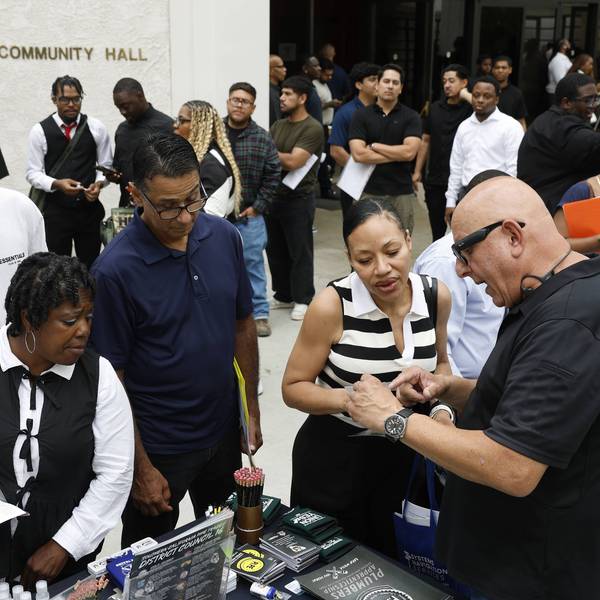
Thousands Look For Employment At Job Fair In Los Angeles

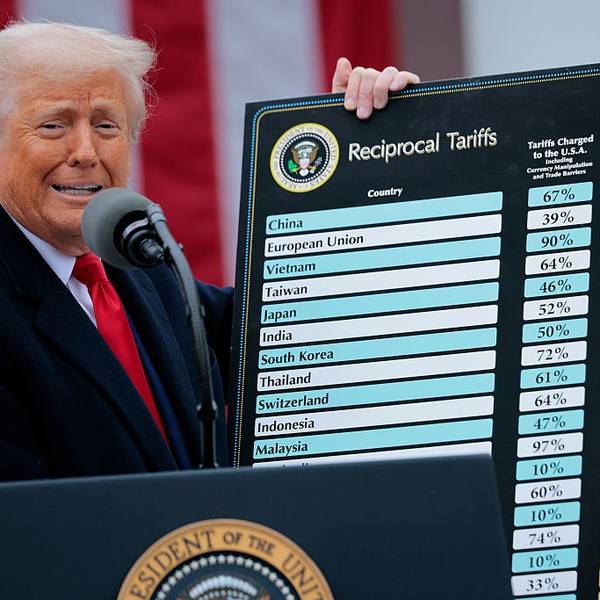
President Trump Holds "Make America Wealthy Again Event" In White House Rose Garden

With Section 122 tariffs—which impose a 10% surcharge on imports from almost all countries—set to expire on July 24, the Trump administration has said it will replace them with permanent Section 301 tariffs, which, according to We Pay the Tariffs will add “new costs on top of the hundreds of billions of dollars businesses have already paid.”

“The latest figures are a damning indictment of tariffs’ impact on the US economy, with lots of pain but little gains for American workers, businesses, and families,” We Pay the Tariffs executive director Dan Anthony said on Wednesday. “The trade deficit is up, goods exports and manufacturing jobs are down, and inflation is at its highest level in years. It’s disappointing that the administration is barreling ahead with a flurry of new tariffs despite the results to date.”

In an open letter to members of Congress signed by small businesses across the country, the coalition noted that “once new tariffs take effect, history shows they are rarely undone.”

“The Section 301 statute says tariffs should terminate after four years. Yet Section 301 tariffs imposed by the first Trump administration in 2018 were continued by the Biden administration, and remain in effect today,” the letter states. “So do many Section 232 tariffs imposed in 2018 and expanded upon in 2025. There is no reason to expect this pattern to change.”

The coalition argued that this is why “Congress must act before more Section 301 and 232 tariffs take effect.”

“This is not a partisan issue. Tariffs are deeply and broadly unpopular with American voters,” the letter asserts. “They are hurting small businesses in every state. Tariffs are taxes, and no president should be able to unilaterally impose hundreds of billions in permanent new taxes without a vote of Congress.”

Progressive economists and consumer advocates argue that tariffs function as a regressive tax, falling disproportionately on working-class families who spend a larger share of their income on consumer goods. They warn that Trump administration tariff policies have also aided large corporations at the expense of smaller competitors.

Critics also note that the tariffs have failed to deliver the manufacturing renaissance promised by Trump, noting that the sector has still shed tens of thousands of jobs even as output increases due to automation, and that workers have seen few benefits from the hundreds of billions of dollars in additional import taxes paid by businesses and consumers.

“We paid—and will be forced to keep paying—the tariffs,” the coalition letter concludes. “We need Congress to act now, before a permanent tariff regime is imposed on small businesses across America.”

Trump’s crowd size fantasy collapses after empty seats are revealed

President Donald Trump began his big speech on Independence Day by announcing his massive crowd size, saying that before the rain-out, the crowd reached 375,000. Later on Truth Social, he bragged that it was 422,000. After the rain, Trump claimed the crowd had dwindled to 150,000. Now reality has come knocking.

A chat between The New Republic's Greg Sargent and senior editor Alex Shephard explained that the president continues to cover for slumping enthusiasm, even from his own supporters.

"I mean, there have been a lot of ridiculous Trump crowd-size claims, but I think this is one of the more brazen ones," explained Shephard for "The Daily Blast" podcast. "The VIP section of this speech wasn’t even full. It was half full by the middle of the speech. People that love Trump and that need things from Trump weren’t willing to stay the entire time."

The event ultimately got rained out, with storms moving through with torrential downpours and powerful winds. Tourists there for the event were forced to shelter in the museum and agency lobbies nearby. When the storms were over, people were allowed to come back into the event, but with the now two-hour delay, it meant the fireworks weren't going off until after 10:30.

"The weather was awful, but I think mostly people did not want to sit through what Trump had promised to be a very long speech. It wasn’t actually that long — I think it was like 30, 35 minutes," said Shepard. "But it was exactly what you would expect. It was this kind of endless recitation of the familiar grievances, with a few kind of new half-baked insults thrown in."

The whole ordeal was indicative of where Trump is right now, he continued.

"Somebody who’s just almost bored, I think, with it, but who has no real argument to make to the American people and is still just kind of falling back on these very, very tired arguments," he added.

Sargent recalled Trump's long history of claiming his crowds were "the biggest" or "the best." He's claimed, “I have 10 times, 20 times, 30 times the crowd size" or "hundreds of thousands." But the reality is that videos and photos show a different story.

Shephard said that the ordeal began with the "Great American State Fair," which had lackluster attendance. The original event that was to be hosted by the bipartisan committee "America 250" was ultimately taken over by Trump's own personal group "Freedom 250" and the "festival of festivals" was turned into what Trump wanted to be a kind of World's Fair kind of event.

"And I think that again, like, the president can be furious about this as much as he wants, but it’s just another example of him living in this total fantasy world. It’s like when he posts about polls where seventy percent of the people love him. It’s just absurd," said Shephard.

He said that it's indicative of Trump working harder to manufacture reality.

"He’s a disciple of the power of positive thinking," explained Shephard. "He believes he can just kind of manipulate reality by saying things, and that by the time people correct him, it’ll be too late. But I think what we’ve seen again and again, especially since the start of this year, is that he’s just totally lost that ability, right? He can just say this stuff and people just ignore it. It doesn’t matter anymore."

Trump loves the poorly educated —and America's IQ decline explains why

The most beautiful human experiment in the world is turning 250. Democracy lasting this long is cause for celebration, but an alarming drop in intelligence suggests its future birthdays are numbered.

For nearly a century, average IQ scores in the U.S. rose consistently, but recent evidence flips this trend on its head.

Studies now show a measurable decline in cognitive scores among Americans across most fields. Northwestern University researchers report that test scores in three out of four cognitive domains have gone down. Another confirmed a steady decline in average IQ scores — with each new generation scoring about five points lower than the one before.

Neil Postman, in his book Amusing Ourselves to Death: Public Discourse in the Age of Show Business, explores this dumbing-down process. Analysts today note how it culminated in the election of a functionally illiterate reality TV host as president, an ignorant man who reduces complex problems to binary oppositions: us versus them, black vs. white, patriots vs. scum, opinion vs. science, etc. No doubt our lowered intelligence led 77 million Americans to vote against their own interests; polls before the 2024 election suggested half the country, lied to by Fox News, was about to engage in self sabotage.

Trump’s base today is comprised of Christians who defend Trump’s debauchery; poor people who donate to a billionaire’s Ponzi schemes while he illegally pocketed nearly $2 billion in profits; and pensioners who still don’t grasp that tax cuts for the 1% threaten their own entitlements.

Trump has done nothing for the common man and everything for his wealthy donors, yet somehow, that fact doesn’t seem to compute. To misquote Jesus, the stupid will always be among us. But stupid seems to be spreading in the U.S., and data suggest that excessive sensory stimulation may be the reason.

Our politics reflect a cognitive decline, but what is causing the decline?

Trump’s declaration, “I love the poorly educated” is a self-own as the U.S. slumbers toward Idiocracy, a funny-not-funny satire about Americans in the year 2500 who have lost the ability to think. In the movie, Americans elect as President a dimwitted pro-wrestler- President Camacho- because he is loud and manipulative and they don’t know any better. The Trump sequel writes itself.

Funny as that movie is, America’s declining cognition, reflected in falling logic, language, and reading comprehension levels, is serious. In 1850, unwashed kids aged 6 to 18 were crammed into a smelly one-room school house with no AC and no technology- and often no books- yet still emerged well-versed in Latin, French, humanities and trigonometry.

Today, with whiteboards, laptops, separate rooms for each grade, and teacher/student ratios historically unheard of, student comprehension levels are falling instead of rising. According to the National Assessment of Educational Progress, math and reading scores for 13 year-olds hit their lowest scores in decades.

It’s our hand held devices, stupid

The explanation may be found in a growing reliance on smart phones, social media and electronic devices that offer addictive and excessive visual and audio stimulation, dulling the brain’s ability to think critically and organically.

Observational studies in human learning have shown a direct link between a child’s exposure to fast-paced television in the first 3 years of life and his subsequent attentional deficits as he gets older. Excessive sensory stimulation (ESS) during childhood has been shown to increase cognitive and behavioral deficits overall. Even rising levels of ADHD among older children and college students are correlated with subjects’ early exposure to excessive electronic media.

More studies are needed on how excessive online stimulation affects cognition and mental health, regardless of age, and Congress may (shockingly) do something about it. In 2023, legislators introduced a bipartisan bill to study how cell phones affect mental health and cognitive development, but it did not advance to a vote.

Over-stimulation, overall, reduces our ability to think

It seems logical that over-stimulating the human brain with loud colors and noises would, over time, reduce our capacity for nuanced and critical thinking. Just as over-reliance on crutches can cause leg muscles to atrophy, over-exposure to electronics and addictive but thoughtless social media can atrophy the learning centers of the brain.

Smart phones aren’t the only culprit. Recent studies have also shown that high levels of noise, including exposure to high-decibel music at home or in the car, and loud, omnipresent television, also leads to cognitive impairment and oxidative stress in the brain.

It’s been reported that 100 million people are exposed to dangerous environmental noise due to traffic, personal listening devices and other sources. Noise pollution has emerged as a risk factor for depression, cognitive impairment and neurodegenerative disorders of the central nervous system leading to emotional stress, anxiety, cognitive and memory defects.

It seems the entire nation could use a long walk in the woods, or an extended visit to one of our 429 national parks — sans devices.

Education levels are affecting U.S. politics

America’s growing political divide may have more to do with education and cognition levels than policy differences. By wide margins, the mostly highly educated Congressional districts in the U.S. elect Democrats, while the least educated districts elect Republicans.

According to data compiled by Politico, Democrats control 77% of the most highly educated Congressional districts, while Republicans control 64% of the least educated districts. The rural poor love Trump even though Democrats deliver kitchen table results that benefit them most: jobs, infrastructure, broadband, healthcare, and industry regulations so trains don’t derail and parts don’t fly off aircraft at 16,000 feet.

Maximilien Robespierre, one of the most influential figures of the French Revolution, was known for his attacks on the monarchy and his advocacy of democratic reforms.

As he astutely observed, “The secret of freedom lies in educating people, whereas the secret of tyranny is in keeping them ignorant.”

Even though Trump’s former advisors widely regard him as an undisciplined moron, he has a preternatural skill: the manipulation of ignorance.

Call it a conman’s intuition.

Sabrina Haake is a political analyst and 25+ year federal trial attorney specializing in 1st and 14th A defense. She writes the free Substack, The Haake Take.

Trump biographer on lookout for the 'literal death watch'

Michael Wolff, the longtime biographer of President Donald Trump, is preparing for the Commander in Chief’s “demise,” he announced on Wednesday. While Wolff asserted that he’s on “a literal deathwatch, as the 80-year-old, obese, sleepless, unfit man, consuming his mortal fast-food diet and overdose of aspirin, seems to do everything possible to kill himself,” he’s also referring to the “downfall” of Trump’s political movement.

“Donald Trump’s end is going to happen,” Wolff declared. “We’re seeing it now. Below the surface of his anger, threats, and bloviation, it’s all coming apart: national fury over the economy, the war, his grift, masked men in the streets, his defacing of Washington, D.C. And, of course, there are his terrible, ever-sinking poll numbers.”

According to Wolff, “He doesn’t retreat; he doesn’t course correct; he only doubles down. We are now seeing his kick-off midterm strategy: he can’t win the election — so he will wage an angry, aggressive, possibly violent campaign against the election itself. As always, it is Trump against the system. He believes he wins, or at least gets a draw, because he is louder, more outlandish, more bilious, more frightening than any response the system can offer.” But as Wolff points out, the president’s cratering poll numbers and growing pushback from Republican lawmakers suggest otherwise.

Wolff is far from the only political insider forecasting Trump’s impending downfall. According to longtime campaign strategist James Carvelle, the president is going to resign by next spring.

“He’s going to walk away because the pain that is coming for him, both the emotional pain and the physical deterioration, you watch it right in front of your eyes,” said Carville on Wednesday. “I don’t have to be a doctor to see this guy can’t move. He can’t get out of a chair. I know what it’s like to be in the 80s. And unlike a lot of people, I know what that job is like, and it’s not compatible. You know, maybe there’s some people 80 who could do that. He’s not one.”

Wednesday brought still more political commentators noting Trump’s deteriorating health and collapsing presidency. According to Atlantic editor and speechwriter to three Republican presidents Peter Wehner, it has become clear that Trump has “entered his decline” as his “regime — and the 80-year-old man who leads it — is breaking apart.”

What’s more, Trump’s “word salad and cognitive confusion” have been on display for the world to see while he’s attended the G7 summit, where his fragile appearance and bizarre actions have prompted Republican political strategist Steve Schmidt to wonder about the president’s “frightening progression of symptoms.”

While Trump’s “aggression, incompetence, and self-destructiveness” are bringing him down, Wolff warns that it “does not mean that Trump ceases to be dangerous.” His health and support may be tanking, but he’s still in office for now, and according to Wolff, “The more threatened he is, the more dangerous he becomes.”

The real problem isn't Trump — it's the dead enders who keep supporting him

The United States is not a grotesque, racist country because of Donald Trump. It is a grotesque, racist country because of the absolutely deplorable people who support him.

There is no him without them.

Read that again.

Without his disgusting supporters, the America-attacking Trump would have been nothing but another wealthy, women-abusing white guy using the money that was handed to him by his sugar daddy to try to stay relevant hawking his broken products, bankrupting start-ups, begging for attention, and cheating on the golf course in the relative obscurity of his leveraged, tacky Florida country club, where the golden bathrooms are overflowing file-holders for all his lost causes.

In other words, he would have been just another filthy-rich Republican …

Except Trump, and his nuclear-powered narcissism just wasn’t content with all that, and desperate for any kind of relevance decided he’d start dealing America’s best-selling product during the past four centuries: hardcore racism.

He knew if he could get his orange little hooks into people and get them to believe he was every bit as big a racist as they were, there wasn’t a single thing he couldn’t claim for himself in America, including the presidency.

“Show us your birth certificate, Barack Obama …”

I have written variations of this piece before, because I have decided that it can never be written about enough. If I have my way, these words will serve as seeds to continue growing a movement and amplifying the powerful words of great artists past and present, who have spent their lives climbing mountains to make sure their message echoes across a country that so badly needs to hear it.

As an aging white man with a pen, I cannot think of a more important topic to lean into, because as long as the color of a person’s skin matters more than their character, we are all living in poisoned, debilitating air.

As long as this idiotic, toxic thing can be exploited to divide us, and hold people down, we are proving without a shadow of a doubt that human beings are the least evolved of God’s living creatures.

Do I expect this bigotry will stop because of the words I put to paper? Of course not.

But that misses the point, too, because this really does need to end just as soon as possible, people, and we all should be doing what we can to put the brakes on it. There is nothing stopping us from doing at least that.

How long will we continue to live with this national emergency?

Just the other evening, during a fake wrestling match on our White House grounds — go ahead and read those 14 words again — a frontal-lobe challenged wrestler named, Josh Hokit, thanked Trump directly for hosting the pathetic event before adding: “And lastly, Michelle Obama is a man. Am I right, America?”

Let’s stop right there for a second.

THIS is what has become of our once hallowed White House grounds. It is now a ghastly plantation, where horrid racism is given the oxygen it needs to breathe by a beady-eyed loathsome orange master who died inside years ago.

It truly is a white’s house.

Trump, wrinkled orange chin jutted forward and celebrating himself while he burns America and the world to a crisp, accepted the bigot Hokit’s words as if they were a bouquet of roses, and smiled.

He smiled.

The President of the United States smiled when a former First Lady was publicly insulted on public property with one of this country’s most insulting, and sickening racist tropes, and all on taxpayers’ dime ...

In other times during my many decades on this earth that ghastly snapshot would be everywhere by now, and roundly condemned by members of both political parties. It would be the beginning of a scandal that would not end until bare minimum, the White House issued a public apology, and showed contrition for such a grotesque, bigoted act.

Except as we close in on America’s 250th birthday, the white’s house has not done any of that.

They have not done any of that because they know that their abhorrent base — many of whom are your white family and friends — love every bit of it.

Turns out, Trump knows them better than you do.

He knows that dragging brown people down lifts them up, and makes them feel good about themselves.

These people didn’t vote for Trump three times because they thought he would improve their lives — there’s been ample proof none of that happened — they did it because he was going to make the lives of the people of color in his country just as miserable as possible.

There’s more than enough proof to back up that claim.

People of color were going to get knocked down and stay down this time. There would be no more voting rights or equal rights measures, because they had inconvenienced enough white people’s lives.

This was all favoritism, not fairness, and in their polluted minds there was nothing fair about lifting people up, who had been held down in chains. Couldn’t these ungrateful Black people have the decency to thank them for removing those chains? Hadn’t these poor white people done enough already?

Well, this time Black people were going to finally learn their lesson and their place in America. This time they were going to be publicly insulted on our White House lawn, caged, and have their voting districts removed. Any institutions, whether it be universities, companies, or media empires that didn’t go along with this would be threatened and severely punished if they dared to speak out against it.

These friends and families of ours — in my case, former friends and family — who STILL support all this are bigots, plain and simple. THEY are America’s greatest sin.

And I know what a few of you white people are thinking right now. I can hear your shuffling feet and pathetic excuses from here. “Well, sure my husband supports Trump, Earl, but I know for a fact he doesn’t like it when Trump does racist things like that.”

Which of course makes it worse.

Because if you vote for, or give safe harbor to a person who acts like a bigot, you are a bigot. You actually know better, but are content to quietly let the cancer spread.

You aren’t the bigger person, you are a sniveling coward.

If one of your husband’s friends told him that you looked like an ape, how would you expect him to react?

Remain friends with the disgusting creep, or belt him in the mouth?

The people I know who support Trump are broken, and simply refuse to be fixed. They somehow think it is their right to inflict themselves on the rest of us, and be just as cruel and odious as they want to be.

It’s all a big, damn joke to them.

These people are cheap shots. Weak. They tried playing me for just another white guy who would go along with all their noxious, racist bile they had done such a clever job of hiding up until 2016. After a decade of screaming at them, I have finally just had to let them go on off and wander in their darkness.

I am no longer worried that my pointed words hurt these people, I am much, much more disheartened that they can’t feel them at all.

So what to do about all this, besides publicly and loudly condemning it and them, while shaking the people who don’t consider this at all? What to do besides standing with people who are worth our loyalty, love and attention?

Vote for Democrats.

I know, I know … but listen to me:

Democrats for all their flaws have passed every important piece of legislation in my lifetime. They give, they don't take. They are not perfect because nobody is.

We simply have to overcome the Republicans’ attacks on America and stand up for her by turning out in overwhelming numbers at the polls to win as many elections as we can.

Again, I realize I am not breaking any news here, just underlining it, and sending it out in boldface type. This means voting for — and better yet working for — the Democratic candidates on the ballot.

Read that again, because I swear to God, if I hear Democrats griping about the candidates who have won their primaries fair and square, I am going to gnaw my keyboard in two, and then come looking for you.

Do you STILL think Kamala Harris wouldn’t have been a far superior president to the repulsive Trump???

I am already seeing this highly stupid crap going on and it positively blows my mind. We stand to lose it all in November unless we can get out of our own way and not let the search for the perfect get in the way of the common good.

Democrats, left-leaners and Independents like myself need to stick together like glue until November. We must become inseparable and walk as one.

That starts RIGHT NOW.

Yes, I have been constructively critical of Democrats in the past, because the party desperately needs some tough love. I do what I can between elections to make sure my team is ready to win, but when election season rolls around the Democrats get my love and my vote every single time.

Anybody who can’t do at least this, needs to stop pretending they are above it all, and start realizing they are part of the problem in America.

Actually it is worse than that: They are bigots.

Do not make me explain this to you again.

D. Earl Stephens is the author of “Toxic Tales: A Caustic Collection of Donald J. Trump’s Very Important Letters” and finished up a 30-year career in journalism as the Managing Editor of Stars and Stripes. You can find all his work here, and follow him on Bluesky here.

There is no bigger Trump lie right now

On June 1st, despite a ceasefire ostensibly underway in the US-Israeli war on Iran, Israel’s prime minister launched a major escalation against Lebanon, including threatening airstrikes against the Lebanese capital. The US president called the Israeli leader, furiously demanding an end to Israel’s escalation. Six days later, Israel attacked Beirut’s southern suburbs, long understood to be a red line for Hezbollah. The Lebanese resistance organization launched a limited response, sending 11 rockets towards Israel, almost all of which were intercepted; no one was hurt or killed. Trump called Netanyahu again, telling him in a brief call that now that Iran and Israel had each “had their fun,” that Israel should stand down.

Commentators across the Middle East and beyond debated whether Netanyahu would abide by Trump’s demand. What virtually none of them mentioned was that Trump had refused to even mention his most important pressure point: that if Israel resisted his order to stand down, the US would simply stop sending tons of weapons and tens of billions of dollars to the Israeli military. The close but sometimes divergent interests of the Middle East’s two powers, the global and the regional, was on full display.

It’s now been 106 days since Trump launched his preemptive and illegal military attack on Iran. On February 28, 2026, the world awoke to the fury of a new war in the Middle East after the United States and Israel had launched their joint assault against Iran, with President Trump and Prime Minister Netanyahu standing shoulder to shoulder against their common foe. Claiming unbridled hegemony was on the agenda for both.

The US-Israeli war on Iran is rooted in longstanding US imperialist strategy and Israel’s national goals.

Today, with yet more fresh promises of a so-called “peace deal” that is nearly ready to be signed by Trump and Iranian leadership, the Israeli military is bombing the suburbs of Beirut despite ongoing claims of a “ceasefire.” Trying to understand the current doom loop, it’s vital we remember how we got here.

In the opening salvo of the US-Israeli attack, Iran’s supreme leader Ali Khamenei, along with an unknown number of other top military and political leaders, was assassinated with a ballistic missile. Just an hour later, the US fired a Tomahawk missile directly at the Shajareh Tayyebeh Elementary School in the northern Iranian city of Minab—killing 156 people, 120 of them children, and destroying the school. The war’s official reasons, initially, were to eliminate the ostensible threat of Iran creating a nuclear weapon, and to destroy its conventional military capacity. The no-daylight US-Israeli partnership, Trump and Netanyahu as BFFs, the collaboration between the US and Israeli warplanes, bombers, drones, missiles… all seemed seamless and perfect.

Three months later, and half a dozen or so “ceasefires” announced, renounced, ignored and denounced, headlines around the world gleefully recounted a Trump phone call with Netanyahu. Focused on Israel’s escalating bombing of Lebanon threatening to derail the latest US-Iran ceasefire, the June 1 call reportedly started with Trump telling Netanyahu “you’re f------- crazy—you’d be in prison if it weren’t for me.“ The US president then went on to his ”Everybody hates you now“ remark. ”Everybody hates Israel because of this,“ he reportedly said.

Trump acknowledged saying it, and then, as is his usual style, moved on, quickly reclaiming his friendship with the Israeli prime minister. As was true with so many earlier ceasefires, Israel continued its massive bombing and its brutal occupation of south Lebanon, making a US-Iran ceasefire impossible. In the meantime, throughout the months of the war, commentators, politicians of all stripes, journalists and analysts across the globe were struggling to figure out what that war was actually being fought for.

War for What?

Real fear of an actual nuclear bomb was certainly not the answer. After all, US intelligence agencies have agreed for years that “Iran is not building a nuclear weapon and that [Supreme Leader Ali] Khamenei has not reauthorized the nuclear weapons program he suspended in 2003.”

Despite that clear assessment, US B-2 stealth bombers still dropped 14 of their 30,000-pound “bunker-buster” bombs on Iran’s civilian centrifuges at Fordo, Isfahan and Natanz at the end of Israel’s 12-day war in June 2025. Trump and his supporters bragged of having “completely and totally obliterated” Iran’s nuclear facilities. And then, eight months after that, in the early days of the US-Israeli 2026 war, those B-2s were back in the air, dropping more 30,000-pound and some smaller versions of the bunker-busters on Iran. Seems they don’t believe even their own intelligence agents.

They thought they could impose imperialism on the cheap—but it turns out not everyone is playing that game.

Rationales for the sudden war in 2026 (launched in the midst of US negotiations with Iran for a long-term ceasefire) were tossed around like confetti, ranging from stopping a nuclear threat (which of course didn’t exist because Iran didn’t have, wasn’t trying to make, and hadn’t even made a decision to try to build a nuclear weapon), to ending Iran’s support for its regional allies, to destroying Iran’s navy, to crippling its missile capacity, to protecting Iranian civilians or maybe encouraging a popular uprising, or perhaps even full-scale regime change. Later, once Iran had responded to the attacks by closing the Strait of Hormuz, Trump shifted to trying to justify the war as a means of forcing the reopening of the Strait, in effect waging the new war to get back to the situation that had existed until the US and Israel launched the war in the first place.

Not a Senseless War

None were very convincing arguments. The popular view emerged that this was a pointless war, being fought for nothing. But that was wrong—there was a purpose. Actually, there were several. The Israeli prime minister has shaped his political career, for more than 35 years, around the claim that only he could bring down the Iranian regime, falsely claiming it as an “existential threat” to Israel. (In fact, even if Iran changed its internal decisions and decided to try to build a nuclear weapon some day, it would not represent an existential threat to Israelis but only to Israel’s 47-year-old nuclear weapons monopoly in the Middle East.) Netanyahu needed the war to continue—any ceasefire, under any conditions, would weaken him politically.

On the US side, some of the war’s goals had to do with the personal obsessions of the president and his minions. Trump’s fixation on expanding US power around the world, and more importantly being seen as presiding over a return to the glory days of unchallenged US global domination, remain a driving force—as does his determination to “get a better deal” than Obama did with the successful Iran nuclear deal in 2015. For his self-defined “secretary of war” Pete Hegseth, the pageantry of a powerful military—not only “the most lethal” force in the world but more white, more male, and even more slim than any other army—could compensate for Hegseth’s lack of experience. For Secretary of State Marco Rubio, all roads lead to regime change in Cuba—and supporting all of Trump’s military assaults, including attacks on fishing boats in the Caribbean, kidnapping the president and seizing the oil resources of Venezuela, bombing Yemen, Somalia and Nigeria, all help set the stage for his life-long goal of destroying the Cuban revolution.

The Search for Hegemony

All those personal obsessions likely played some roles. But the US-Israeli war on Iran is also rooted in longstanding US imperialist strategy and Israel’s national goals. While Trump has shown himself for years as far more committed to maximizing his own and his family’s wealth and power than he is accountable to any particular faction of US capital or US elite power (except perhaps “the billionaires,” writ large), the trajectory of imperial expansion, especially in an era of greater and rising powers around the world, continues to shape much of US policy.

That is where the search for hegemony comes to the fore. For Israel—and especially for its longstanding prime minister—the attack on Iran both demonstrates and reinforces its role as unchallenged regional hegemon. That means asserting its power—a derivative power, given its strategic dependence on the United States, but power nonetheless—to seize land, dispossess and expel whole populations, and exert permanent control over countries, economies, and people—whenever, wherever, and for however long it chooses. Without being held accountable.

For Israel—and especially for its longstanding prime minister—the attack on Iran both demonstrates and reinforces its role as unchallenged regional hegemon.

To be recognized as the regional hegemonic power in the Middle East, Israel needs to not only “mow the grass” in Lebanon and in Gaza (as well as arming and empowering ideologically driven settlers in the West Bank to escalate their violent seizure of Palestinian land and ethnic cleansing of its population), it needs to continue to weaken, threaten, and when possible (with US backing) go to war against Iran, its sole challenger for regional control.

Mowing the Grass

Israelis—military and government officials, academics, journalists and others—routinely use the term “mowing the grass” to describe Tel Aviv’s consistent attacks against Israel’s neighbors. The phrase was first coined to describe Israel’s brutal 22-day assault on Gaza, Operation Cast Lead, that began the day after Christmas 2008 and killed more than 1400 Palestinians, most of them civilians and including 300 children. Since then, it describes the frequent attacks on Gaza or Lebanon—ostensibly aimed at militant organizations but designed originally to kill massive numbers of civilians, displace hundreds of thousands or millions from their homes, and destroy huge swathes of homes, schools, churches, mosques, businesses—to remind everyone who it is who actually holds power.

Israel is saying that it will not allow Iran to remain an obstacle to Tel Aviv’s claim of full-blown dominance of the region. Netanyahu is making good of the threats he’s issued for the last 30 years.

Iran has historically been the main obstacle preventing Israel from consolidating that regional hegemonic role, and part of Netanyahu’s political power depends on his ability to keep the US-Israeli “special relationship” strong and to deal effectively with Iran. So going to war against Iran in complete and willing partnership with the United States serves to strengthen his still-shaky political position. What’s different now is that Israel is saying that it will not allow Iran to remain an obstacle to Tel Aviv’s claim of full-blown dominance of the region. Netanyahu is making good of the threats he’s issued for the last 30 years.

So Netanyahu remains committed to continuing this war against Iran, opposing ceasefires regardless of their terms—and most recently, escalating attacks against Lebanon precisely because they could prevent or shatter any ceasefire. Following the Israel-Hezbollah ceasefire in 2024, UN peacekeepers on the ground documented more than 10,000 Israeli violations of the agreement in just the first year. When a wobbly US-Iran ceasefire was announced on April 8, 2026, Israel responded with massive force against Beirut, launching more than 100 airstrikes within 10 minutes across the capital and killing 357 people, many of them civilians and at least 101 of them children and women.

Back in the USA….

For the United States, going to war against Iran could strengthen Washington’s longstanding commitment to maintaining global domination—a goal particularly relished by its power-obsessed and erratic president. The war was designed to both demonstrate and bolster the US role as unchallenged global hegemon. And doing so arm in arm with Israel, the regional version.

What a team they thought they would make. What they didn’t reckon with was the reality of Iran—its military, its government, its people. While there is no question US-Israeli military might massively outstrips that of Iran, it turned out that Tehran was able to use its not-insignificant drone and missile capacity in ways that maximized its power.

While there is no question US-Israeli military might massively outstrips that of Iran, it turned out that Tehran was able to use its not-insignificant drone and missile capacity in ways that maximized its power.

For example, Iran’s relatively few strikes on US bases and sometimes domestic facilities in the surrounding US-backed Gulf states had political consequences beyond their comparatively low levels of casualties. They showed how “protection” in the form of US military bases, weapons and troops in those countries did not keep their people safe, but rather laid a target on their backs. Most especially, Iran’s few direct attacks on ships attempting to cross the Strait of Hormuz early in the war, had the much broader effect of shutting down the vital waterway entirely, as shipowners and insurance companies refused to take the risk.

Miscalculations

When Israel carried out its guided missile attack on the first day of the war, killing the supreme leader and a number of other top officials, the cheering in Washington and Tel Aviv reflected the assumption that the decapitation of the government would lead to chaos and its inability to function. The cheerleaders were wrong. As Narges Bajoghli and Vali Nasr noted in Foreign Affairs, the US and Israel “expected a quick victory through targeted assassinations of Iran’s leadership. But decapitation did not produce regime collapse. Instead, it opened the door for a new generation to take over.” Not only did Khamenei’s son take over his father’s position, but younger military, political, and business leaders filled in the gaps across the structures of power.

And while the Iranian leadership had been significantly weakened by public mobilization against both governmental inability to solve the escalating economic crisis and its increasingly repressive attacks against protesters, it appears it was not further weakened by the US-Israeli assault. As Nasr and Bajoghli describe the situation, the public anger of January 2026 in response to escalating repression of the mass uprisings, didn’t disappear with the US-Israeli assault. They wrote:

The war’s destruction has been vast: public infrastructure, factories, schools, hospitals, historic monuments, and even entire neighborhoods lie in ruins. As Israeli and American bombs and missiles pummeled the landscape, Trump threatened to arm separatists, redraw Iran’s borders, crush its economy and annihilate its civilization. Together, these military and rhetorical assaults provoked a nationalist reaction that cut across political divisions. Public anger has not disappeared. The grief, frustration and accumulated resentment of decades of misrule and repression remain. What has changed is the political landscape in which those feelings find expression. Dissent is now refracted through a national struggle against a foreign enemy that Iranians compare to Alexander the Great, who conquered the Persian empire in the 4th century BC; the Arab armies that invaded in the 7th century AD; and the Mongols, who came six centuries after that.Contrary to American and Israeli expectations, the war has not sparked street demonstrations. The longer it went on, the less the regime appeared threatened by public uprisings. Iranian society mobilized not against the state but alongside it, holding daily rallies across the country, forming human chains and gathering on bridges threatened by Trump. The sharp divide between state and society that had characterized Iran in January blurred—not through persuasion or repression, but through the shared experience of living through the bombing and witnessing its destruction.

Palestine

There was another reason for the US-Israeli war, that explains at least the timing, if not the overall rationale—Palestine. Israel has been committing genocide in Gaza for two years and eight months. There are now more than 73,000 known, identified, named Palestinians in Gaza who have been killed by Israeli bombs, tanks, bullets, drones, missiles, almost all paid for (and to a large degree produced) by US taxpayers. Thousands more lie dead under the rubble of what were once the cities, towns, refugee camps of the decimated Gaza Strip. The statistics belie the lives lost—babies, elders, children. Journalists and health workers in staggering numbers. And Israel’s genocide continues, people are still being killed by Israeli bombs, tanks and drones, as well as deliberately-imposed shortages of water, food, medical supplies, shelter.

The Gaza genocide is not unrelated or incidental to the US-Israeli war in Iran—it is a primary enabler. It is precisely the level of impunity, the absolute lack of accountability for any of the perpetrators of this crime against humanity, that has given Israeli and US leaders the confidence to go ahead with what many have called the “Gazafication of Iran” and the “Gazafication of Lebanon” without fearing there might be a price to be paid.

The Gaza genocide is not unrelated or incidental to the US-Israeli war in Iran—it is a primary enabler.

The international arrest warrants issued by the International Criminal Court against Israeli leaders (Israel assassinated the Hamas leaders who were similarly charged) are ignored in most of the US-allied countries that Netanyahu and his former defense minister might want to visit. South Africa’s unprecedented effort to hold Israel accountable at the International Court of Justice for its violations of the Genocide Convention resulted in a powerful preliminary ruling that Israel’s actions plausibly do constitute genocide. Israel was ordered to carry out specific actions—starting with an end to killing people in Gaza—but it has yet to face any consequences for ignoring those orders. And no one knows when the final ruling might be issued—or if it will lead to some level of enforcement, either in the United Nations, by a coalition of governments, or, most likely by a newly-enraged, newly-engaged global civil society ready to move with ever greater energy, strategic clarity and political power to impose serious consequences on the governments and individuals responsible for the first genocide in history to be carried out openly, proudly, and visible to the world.

War Over War

For now, while the war against Iran continues, it looks like both Israel and the United States are moving into a different phase. They are still looking to claim power, still working to reshape political relations and consolidate regional and global power across the middle east. But rather than simply escalating again, as Israel still is in Lebanon, or continuing a grinding daily assault as it still is in Gaza—both actions armed and paid for by the US—they are facing some changed circumstances. Just maybe Washington and Tel Aviv are finding that it’s harder than they thought to re-order the whole Middle East—and to do that in tandem is harder than ever.

Trump seemed to think he could accomplish something dramatic and “beautiful” in Iran—encourage a popular uprising, maybe seize the oil and replace the leadership’s political orientation as if it were Venezuela—but then found that wasn’t so likely. Turns out Iran is not Venezuela. Netanyahu has massive public support among Jewish Israelis for continuing the war in Iran, though support for the war in Lebanon is not so popular. (It should not be forgotten that after 18 years of occupying South Lebanon, Israeli troops were finally pulled out in 2000 primarily because the government could not survive the mobilization of Israeli mothers angry that their sons in the IDF were occasionally being killed by Hezbollah’s retaliation actions..)

Trump seemed to think he could accomplish something dramatic and “beautiful” in Iran—encourage a popular uprising, maybe seize the oil and replace the leadership’s political orientation as if it were Venezuela—but then found that wasn’t so likely.

At home Netanyahu may be able to get away with claiming victory over Iran even if a ceasefire is imposed, by continuing Israel’s longstanding practice of assassinating Iranian scientists and political/military leaders, and occasional bombing raids. But Israel’s plummeting losses in the war of global legitimacy are certainly not likely to be reversed any time soon. The most recent Pew survey indicates sky-high majorities holding negative views of Israel and Netanyahu around the world—up to 95% in Pakistan, 78% negative in Sweden and Spain.

The global Palestinian rights mobilizations and the even broader movements for ceasefire and an end to genocide of course play a major role. Social movements and civil society activists around the world will continue to hold up the ICJ decisions and the UN General Assembly resolutions requiring governments to impose arms embargoes, boycotts, divestment, and sanctions against Israel.

And as the Strait remains closed and food shortages mount in the poorest countries, as Arab governments fearing public opposition at home reduce their ties with Israel and reject expansion of the Abraham Accords, and as Israel continues to kill Lebanese and Palestinian families, Trump’s claims will be less likely to be believed. With the mid-terms only a few months off, his claims of “We’re the winner, we won” are already ringing increasingly hollow. It doesn’t mean he won’t make the claims, it just means they’re not going to work.

For Trump, given the unexpected level of resilience in Iran, Tehran’s access to a virtually unlimited supply of cheap drones that are doing real damage to Gulf Arab states hosting US bases and troops, and its willingness to close the Strait as a pressure point with global ramifications, it’s going to be difficult to claim this war as a victory.

The search to consolidate regional and global power continues. It’s a big part of the reason the US and Israel are launching new wars and escalating longstanding attacks. People are still losing lands and lives as these hegemons rely on war to consolidate their positions. But neither Israel in the Middle East nor the United States in the world are unchallenged. They thought they could impose imperialism on the cheap—but it turns out not everyone is playing that game. The search for hegemonic power is far from settled.

Americans are on the brink of losing it all — and good people know it

Let’s start with some questions today, before we arrive at the answer.

What if Kamala Harris had become president, promptly leveled the historic East Wing of our White House, and then spent each day like a petrified drama queen shrieking that taxpayers should purchase her a new ballroom?

What if Harris had spent her time in office plastering her face and name on inanimate objects, while food prices she promised to lower spiraled out of control, and then belittled the people who dared mention this?

I’m not done.

What if Harris and her administration had spent their time attacking science and vaccines and then did nothing as Measles — MEASLES — made a deadly comeback across America?

What if Harris had become president and picked silly and insulting fights with our NATO partners who have been with us since WWII, while threatening to invade Greenland like some petulant child?

What if after running a campaign on no new wars, Harris appointed a drunken, racist talk show host to be her Secretary of Defense, who then proceeded to commit a series of war crimes, shared top-secret intelligence with God knows who, brazenly blocked military promotions of women and people of color, and then led a moronic war in Iran that has only succeeded in making America a more dangerous and expensive place?

Sorry, I’m not done yet.

What if instead of supporting Ukraine during their heroic fight on the frontline of democracy that benefits America, Harris berated its leader and then rolled out the red carpet for the murdering fascist, Vladimir Putin, on U.S. soil?

What if instead of prosecuting law and order, Harris appointed HER personal lawyer as OUR attorney general and then went about spending billions of taxpayer dollars to reward the traitors who attacked us on January 6, 2021?

Can you imagine?

What if Kamala Harris had become president and leveled idiotic tariffs on every country she could locate on a map that resulted in making things more expensive for Americans?

What would all those sanctimonious MAGA farmers say about that?

What if instead of answering questions from the media, Harris called them names like piggy, and enemies of the people?

What if after becoming president Harris stayed awake at night hate-posting unhinged bilge directed at 70 percent of America?

What if Harris had become president and got into a bitter feud with the Pope?

What if we found out Harris had been mentioned more than 30,000 times in the Epstein Files, and was a longtime friend of the child-rapist?

What if Harris had become president and spent the first 17 months in office spending more time at Walter Reed Medical Hospital than she did with her husband, and then publicly bragged about passing basic cognitive tests while being held up on swollen ankles?

Can you imagine????

What if Kamala Harris had become president and invited thousands of Blacks to immigrate to America from South Africa, after saying she was closing our borders?

What if Kamala Harris had become president and led a government-wide attack on rural white voters by making it as hard as possible for them to vote?

What is Harris had become president and depicted herself as Jesus Christ in a social media posting?

What if Harris had become president and filled her cabinet with unqualified rightwing talk show hosts and billionaires, whose only talents are filling their bottomless pockets with our money?

What if after becoming president, Harris did everything in her power to strip people of their healthcare, and medicare and medicaid benefits to benefit corporate raiders?

What if after becoming president, Harris set about putting actions in place that will pollute our air and drinking water …?

OK, I’ll stop there, my friends, because we all have things to do this morning while we carry on through the most insane, destructive timeline in American history.

The truth is none of those things would have happened had Harris — or ANY — Democrat been elected president, because we — Democrats and Left-Leaners — would have never allowed it, nor elected anybody — much less a convicted felon — who even hinted at these appalling attacks on America, Americans, and our standing in the world.

It must be said often, and out loud that in 2026 America, our two major political parties are publicly held to completely different standards.

In fact, one of them is held to absolutely NO standards at all.

Read that again.

This is indisputable, and we simply must get to the point where we accept at least this much, or we are done for good.

Finished.

That this ongoing and brutal numbing of our sensibilities has somehow been normalized to such a truly terrifying degree by our media, as well as the people and institutions who are charged with monitoring the America condition and the threats facing her citizens, is a terrible, terrible tragedy, it really is.

The annihilation of the barriers that used to separate good from evil and right from wrong have transformed America and its insane military might, into the most dangerous country in the world. When anything can be justified — even an attack on OUR OWN CAPITOL — everybody is in deep trouble.

We are spiraling out of control, and on the brink of losing our democracy for good, and the people who dare to pay attention — the blessed woke — know it.

That is most likely you.

This disregard of the truth, and just plain human decency is taking a terrible toll on average, good-hearted people in this country who have watched, jaws dropped, the past decade as millions have been given permission to willingly surrender to their very worst instincts, while following a grotesque man and party that are leading us to our bitter end.

That many of them are friends and family has been almost too much to bear and comprehend. How long have they carried this disease inside them? Can they be cured?

Either way, they and their debilitating weakness, and a busted media that tries to understand and excuse them, are to blame for our demise.

We feel powerless to get through to them to stop their madness, because they have been provided cover and coddled by the people and institutions I mentioned above, who have somehow accepted this as our new normal.

They are weak in mind and heart. They are the lowest among us, and refuse to lift themselves up, or even consider the damage they are doing to a country that they think even less of than themselves.

Well let me tell you something: I have no trouble stepping on them to get to higher places where we can properly survey the damage they have caused and set about repairing it.

I will not get over this or them. I will call them out and our condition in America for what it is: hideous.

The normalization of this ongoing rot inside our White House simply has to stop — or bare minimum be recognized for it is — if we are to have any hope of carrying ourselves as a half-decent nation making an honest run at once again searching for the common good.

That starts with recognizing the truth, and shouting it out, instead of normalizing chaos and odious behavior.

And if that truth hurts the people who are wrecking our society, then there is still a sliver of hope, because at least we will know they aren’t completely dead inside.

These aren't normal times we are living in unless we just surrender and accept that they are, my friends.

Well, I just can’t let that happen.

Can you?

D. Earl Stephens is the author of “Toxic Tales: A Caustic Collection of Donald J. Trump’s Very Important Letters” and finished up a 30-year career in journalism as the Managing Editor of Stars and Stripes. You can find all his work here, and follow him on Bluesky here.

@2026 - AlterNet Media Inc. All Rights Reserved. - "Poynter" fonts provided by fontsempire.com.