
Latest in the Epstein scandal makes Melania's tedious documentary worth watching

Editor's note: This story was updated to correct typos.
Smack dab in the Rust Belt city of Allentown, Pennsylvania, the Movie Tavern Trexlertown is a welcome hybrid of multiplex and gastropub. Yet even though I was there to join a large audience to experience a sci-fi masterpiece called “Project Hail Mary,” I allowed my curiosity to briefly lead me on a tangent about a film with a drastically — um — different quality.
“Was there anything like these crowds for ‘Melania’?” I asked the employee who sold me my ticket. They bristled at the title; I clarified that I was a film critic seeking demographic information and not a supporter of President Donald Trump. They relaxed, then answered: “Not a lot of people saw that, but a few did.” “Melania” viewers tended to be groups of senior citizens turning out to support Trump.
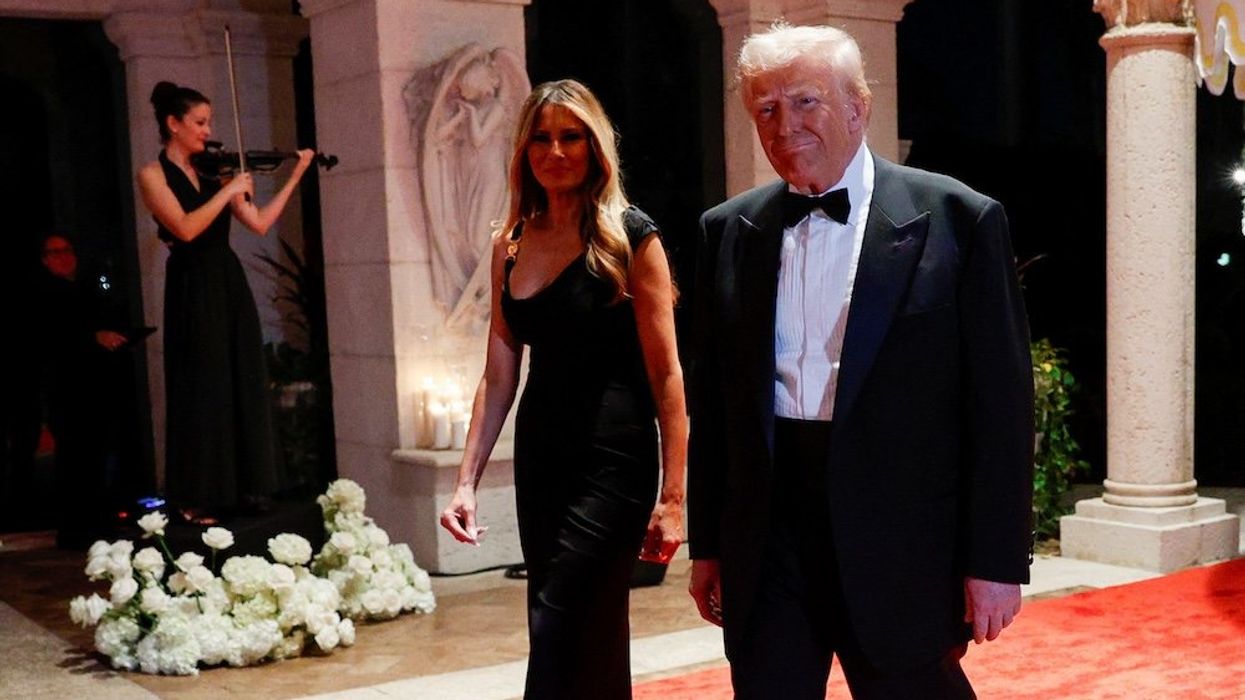
I cannot imagine any form of political self-expression more masochistic than watching “Melania.” The literally plotless documentary about the 20 days before Trump’s second inauguration is, on its face, stupefyingly dull — a hagiographic non-portrait of a non-entity of a first lady — and I cannot recommend it either as a genuinely good film or even as an ironically entertaining one. One scene cracks that facade, her attendance at President Jimmy Carter's memorial, and it exposes how narcissism-fueled deflection collapses when incompetently executed.
To understand that fascinating moment, which puts the “scene” in “obscene,” one must juxtapose it with Melania Trump’s recent speech about her husband's and her own controversial ties to the late Jeffrey Epstein, the infamous convicted child sex trafficker to the rich and powerful.
In terms of their legacies, Carter was as far removed from Trump as two human beings can be from one another. He served a single distinguished presidential term from 1977 to 1981 and is best remembered for achieving a lasting peace between Israel and Egypt, returning the Panama Canal to Panama, supporting liberal social legislation (such as on women’s rights and disability rights), struggling with inflation and slowly solving a hostage crisis with Iran.
You learn exactly none of this in “Melania.” In fact, from this movie, you know nothing about Carter’s life or achievements other than the fact that he once was a president and now he is dead. Instead all we hear about is Melania use the historic, solemn ceremony held in the January after his Dec. 29, 2024 passing as an opportunity to talk about her deceased mother. Given that the late Amalija Knavs did indeed pass away one year earlier, this is forgivable up to a point; it is understandable to mention her mother, but not to focus entirely on her — or, to be more precise, Melania’s performance of a grief response, which receives far more attention than any details about Knavs herself.
The problem, from a dramatic standpoint, is that Melania’s act is so hollow it becomes its own kind of confession. She talks about her mother in platitudes delivered with so little conviction, such a lack of emotion, that the matriarchal shift feels less like a sincere tribute than a roundabout opportunity to make Carter’s story about herself. One who watches “Melania” for the Carter scene will learn absolutely nothing about Carter, true, but they will also learn only slightly more about Amalija Knavs.
The scene is the thesis — a woman surrounded by weight and gravity, contributing nothing.
I’d like to contribute something from my own interaction with Carter, in the summer of 2018 for a Salon Magazine interview about the anniversary of his 1979 speech on America’s existential “crisis of confidence.” We spoke briefly twice, with his bristly demeanor on both occasions being not dissimilar to that of the aforementioned movie theater cashier. I don’t know why Carter felt this way, but I do know his ornery attitude fueled this observation about Trump’s presidency.
“I think that under Trump the government is worse than it has been before,” Carter explained by email. “This is the first time I remember when the truth is ignored, allies are deliberately aggravated, China, Europe, Mexico and Canada are hurt economically and have to hurt us in response, Americans see the future worse than the present, and immigrants are treated cruelly.”
When asked if America still has a “crisis of confidence,” he said that “we still have the same crises" of that time.
He then added “plus a serious loss of faith in democracy, the truth, treating all people as equals, each generation believing life would be better, America has a good system of justice, etc.” When I pointed out that in 1979 he observed “what you see too often in Washington and elsewhere around the country is a system of government that seems incapable of action. You see a Congress twisted and pulled in every direction by hundreds of well-financed and powerful special interests,” he concluded “this is much worse than when I gave the speech.”
I could not help but think of these “hundreds of well-financed and powerful special interests” in both the White House and Congress when it comes to the Epstein scandal. Combined with my ongoing anger at Trump for refusing to keep the flag lowered after Carter’s death during his inaugural ceremonies, I felt indignant at the Trumps’ ostentatious neutrality toward Carter’s life and legacy. If nothing else, Trump could learn from Carter’s longevity; the health-conscious Baptist was the only president to make it to 100, which looks increasingly unlikely for Trump given his penchant for Franken-burgers and angry outbursts about things he can’t control.
This brings us back to Melania Trump’s White House speech, which in its angry defensiveness betrayed more authentic emotion in less than 10 minutes than “Melania” the film did in more than 100. The first lady’s speech was seemingly prompted by various impending salacious reports about the relationship between the future president and first lady and the notorious pedophile (including that the Trumps first slept together on an Epstein plane named after “Lolita,” a book about a fictional pedophile which inspired a classic 1962 black comedy film with the same title... which is also far better than “Melania,” directed by Epstein associate Brett Ratner).
Yet despite finally bringing some emotional realness to her public presence, Melania could not do the same with factual realness. For instance, despite saying she only interacted with Epstein’s close aide Ghislaine Maxwell casually, in 2002 Melania sent an email to Maxwell saying “HI!”, describing Maxwell’s travel plans and signing it “Love, Melania.” Maxwell meanwhile referred to then-Melania Knauss as “sweet pea.” Perhaps more damningly, a 2016 email to Epstein from a redacted sender alleged Melania actually met Donald through Epstein.
“I remember flying back with Donald on his plane the first weekend I went to visit you in Florida was the weekend he met Melania and he kept on coming out of the bedroom saying 'wow what a hot piece of a--,’” the unknown sender wrote in the email.
"These images and stories are completely false,” Melania Trump said in her speech. “I am not a witness or a named witness in connection with any of Epstein's crimes."
When I juxtapose the emptiness of these two moments — Melania’s reaction to Carter’s memorial service and her reaction to being confronted over her ties to Epstein — the bottomless abyss reflects the absolute self-involvement that permeates every level of both Trumps’ entire being.
When they talk constantly about themselves, and make every story one in which they are the central characters, we inevitably go along with them simply because they possess so much power that they can compel conversations in that direction through sheer brute force. In the process, we start viewing the tragedies of others — a former president who died, countless children who were exploited — not in terms of the actual suffering, but the narcissistic self-interest of those who wish to ignore them either out of indifference or something more sinister. Even worse, we do not learn lessons that they have to teach us about the injustices that those in power perpetrate.
The emptiness was always the story. Now we know why.

