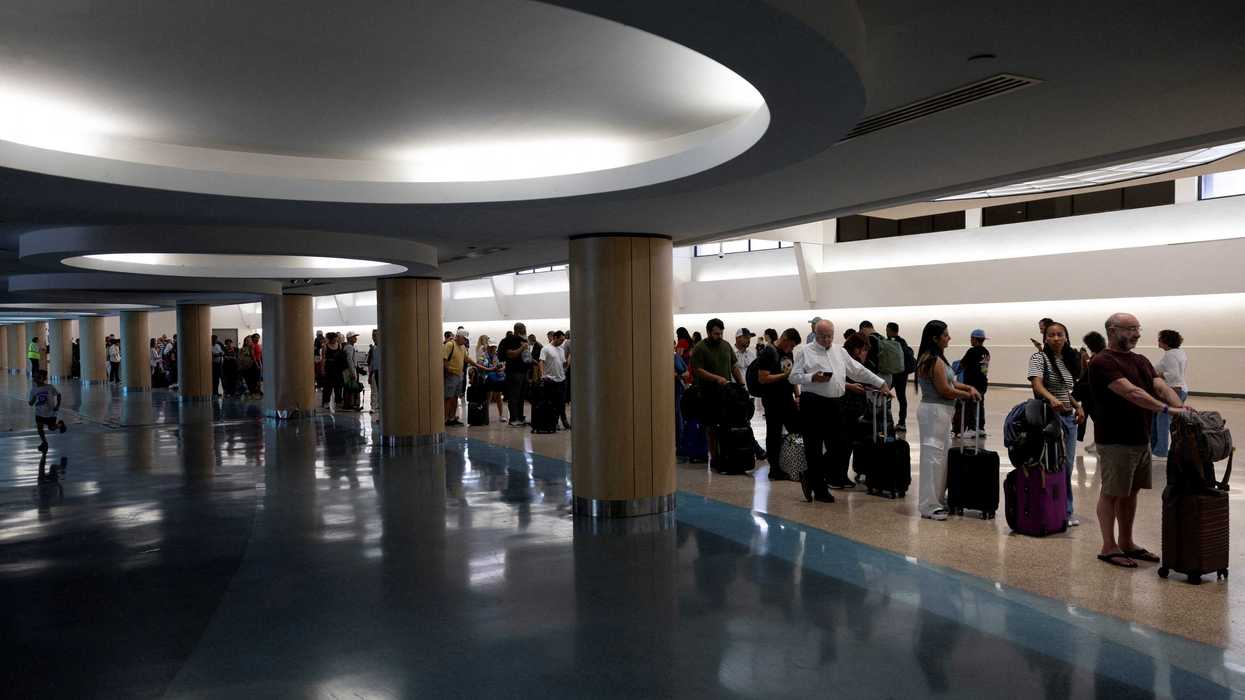
During a partial shutdown of the United States' federal government earlier this year, countless Americans were frustrated by long airport lines and delayed or canceled flights. The shutdown was resolved, but air travelers still have plenty of frustrations —including missing connecting flights. That aggravation, according to data scientist Sheldon H. Jacobson, is a persistent problem for American air travelers.
In an op-ed for The Hill, Jacobson lays out some reasons why so many Americans are missing their connecting flights.
"The FAA (Federal Aviation Administration) tracks flights delays, which typically impacts around 25 percent of flights," the data scientist explains. "Given that there are around 25,000 scheduled flights on average every day, that means that over 6000 of them arrive late on average. But what constitutes a late flight? The FAA defines any flight as late if it arrives 15 minutes or more after its scheduled arrival time. This means that a flight that arrives 14 minutes after its scheduled arrival time is classified as on-time, while adding just one minute to this time flips the classification to late."
Jacobson continues, "The 15-minute time may appear somewhat arbitrary. However, given the large number of travelers that connect to a flight through a hub airport, with connection times running as little as 30 minutes at some airports, every extra minute that an airplane must taxi before passengers deplane can make the difference between some passengers making their connections and others missing them."
According to Jacobson, 60 percent of people flying out of Atlanta's Hartsfield Airport are connecting passengers; at Charlotte Douglas Airport, the number is 70 percent. Hartsfield is a Delta hub, while Douglas is an American Airlines hub.
"For passengers without connections," Jacobson warns, "late arriving flights are a nuisance and inconvenience. For passengers with connections, late arriving flights may be highly disruptive, resulting in interruptions that may delay their arrival to their final destinations by several hours, or even days."
The data scientist argues that the airline industry needs to conduct a lot more research on passengers missing their connecting flights.
"For hub airports," Jacobson says, "what would be more informative for travelers is to report the percentage of connecting passengers who miss their connections…. The percent of flights that arrive late only provides a useful measure of problems faced by air travelers on direct flights. For connecting passengers, they want to know when they will arrive at their final destination, which is not captured by flight delay data alone."