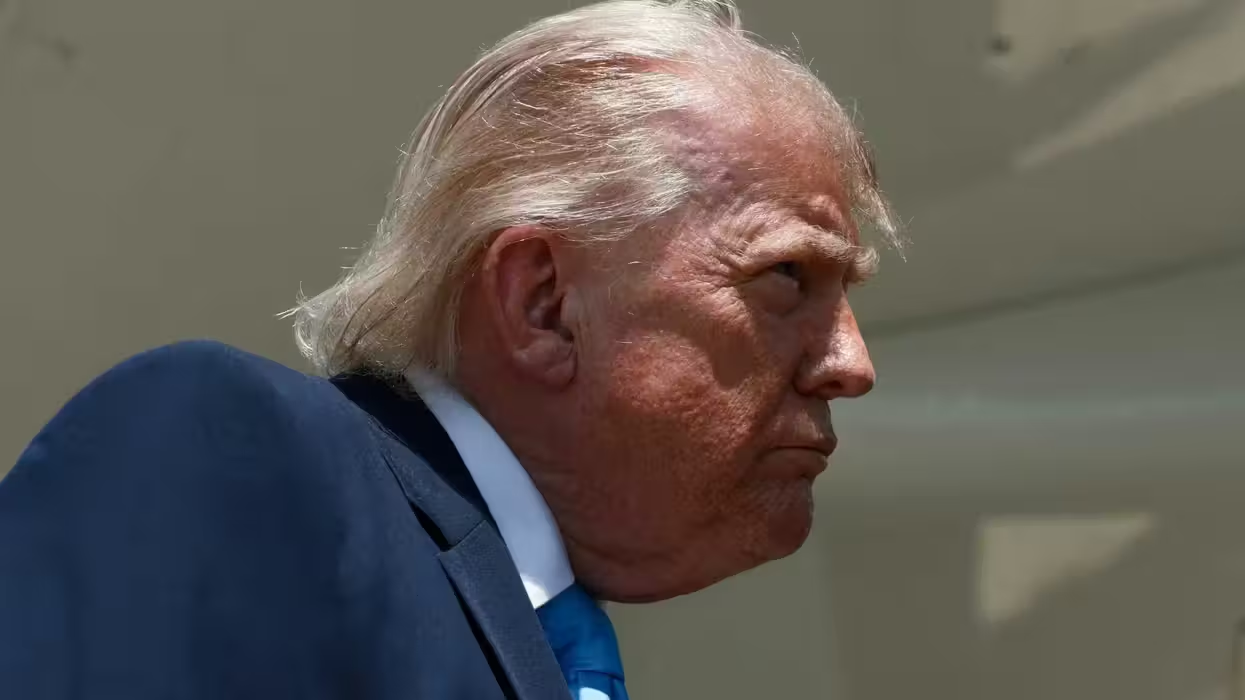
On Wednesday, a bizarre incident in which President Donald Trump appeared to awkwardly steal a pair of scissors after a ribbon-cutting ceremony went viral as viewers accused the commander-in-chief of theft. But according to pathologist Hilary Shae — who specializes in neurological rehabilitation — 80-year-old Trump’s little larceny may not mean he’s a kleptomaniac, but could be a sign of serious cognitive decline.
“It seems like Donald Trump has become a little bit of a kleptomaniac recently,” said Shae in a video posted Thursday night. “But quite honestly, it actually looks more like a sign of dementia.”
She began by noting information revealed by the new tell-all book Regime Change, which exposed a slew of the Trump administration’s backroom secrets. In it, says Shae, the authors “talked about the fact that Donald Trump would take things from the hallways and put them in his room. He would go in and take things from Melania's room and put them in his room. And they made it sound like it was a competition, but quite honestly, I'm not sure that's what it was. And then there's this clip of him taking scissors from the ribbon-cutting ceremony for the Theodore Roosevelt Presidential Library.”
As Shae explains, while this could easily look like kleptomania, people with dementia often develop what looks like kleptomania without having the actual disorder in the psychiatric sense of the word.
“Instead,” she says, “the stealing is usually a symptom of changes in the brain affecting memory, judgment, impulse control, or the ability to recognize ownership. Within the memory impairment, this person may genuinely believe that an item belongs to them or may forget that they already owned something similar, and so they think that it's theirs and they put something in their own pocket or purse just with the intention of taking it.”
This, she says, can be a sign of “executive dysfunction” in which “damage to the frontal lobes can impair planning and judgment and inhibition, and that can make it harder to resist an impulse or recognize that an action is inappropriate, like pocketing a pair of scissors on a live broadcast. There can also be difficulty with understanding ownership, not just from a memory sense. So, not the ‘I think it's mine,’ but sometimes just the concept of what is mine versus someone else's can become blurred. There is no real ownership at some point.”
Shae explains that this sort of activity is often associated with what is called “behavioral variant frontotemporal dementia.” As she elaborates, “Because this condition causes loss of inhibition, causes impulsivity, compulsive behaviors, and poor judgment, someone with frontotemporal dementia may really become this stereotype of a kleptomaniac.”
It may also be caused by Alzheimer's disease, which is commonly associated with memory issues. And if the president is experiencing visual hallucinations and delusions in addition to his light-fingered behavior, Shae suggests it may be symptomatic of Lewy body dementia.
“So I do not think that Donald Trump is actually, psychiatrically speaking, suffering from kleptomania,” she concludes. “I do believe it is just one more sign and symptom of dementia.”