
The tragic phone call that signaled the end of American unity
(Gage Skidmore)
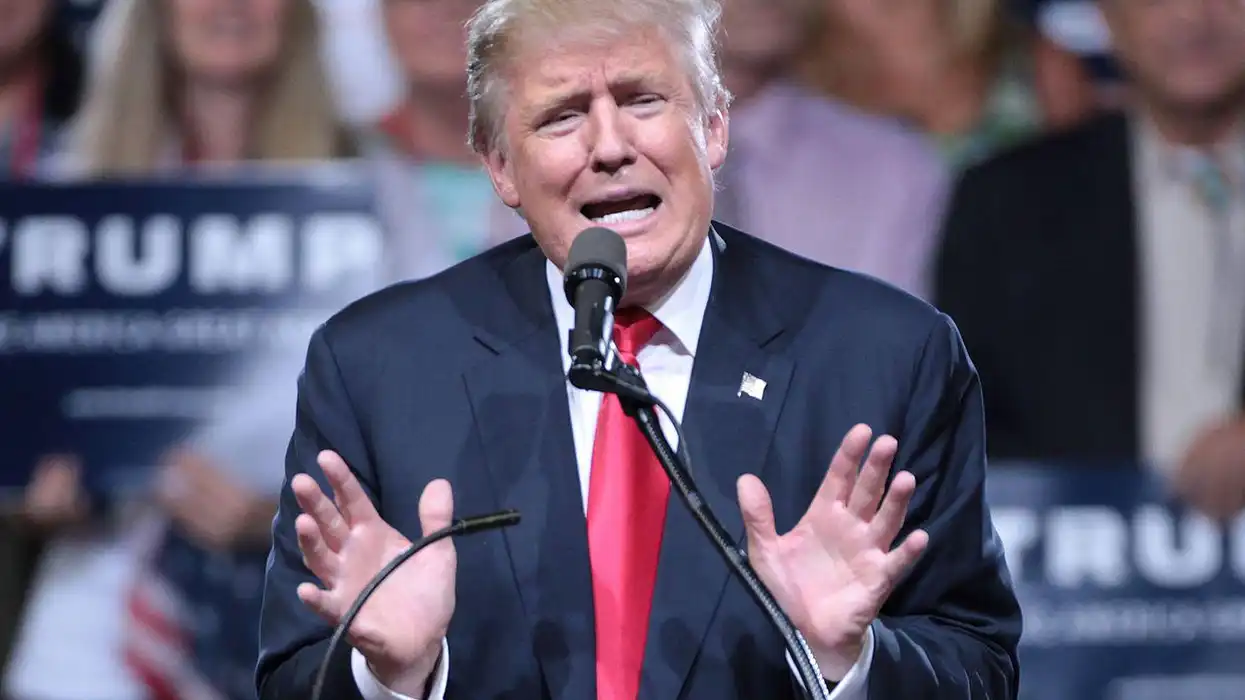
Donald Trump speaking at a campaign rally at Veterans Memorial Coliseum at the Arizona State Fairgrounds in Phoenix, Arizona, in June 2016.

Donald Trump speaking at a campaign rally at Veterans Memorial Coliseum at the Arizona State Fairgrounds in Phoenix, Arizona, in June 2016.
Editor's Note: This article has been updated to fix a typo in the transcript.
When my phone rang and I heard my father tell me to sit down, I knew terrible news would soon follow. He hadn't uttered a word of bad news yet, but I could just tell.
It was March 27, 2024, and as I soon learned, my dear friend had suffered a devastatingly serious fall. Sen. Joe Lieberman (D-CT) had died.
To understand why I believe so strongly in the importance of Americans coming together despite their political differences, I need to describe Lieberman's career, because more than any other single individual he inspired me to feel this way. Indeed, typing those words about his death is still emotionally difficult for me, and not merely because Lieberman was one of the kindest celebrities I ever met in my decade-and-a-half long career as a journalist. When Lieberman passed away, an important spirit in American politics — the idea that people must learn to disagree without being disagreeable, and ultimately come together to solve our country's problems — suffered a mortal blow along with him.
I say this as someone who is much to the left of Lieberman on many issues and individuals, from health care reform and the war in Iraq to Israeli Prime Minister Benjamin Netanyahu's policies and the economic ideology of Rep. Alexandria Ocasio-Cortez (D-NY). As I wrote in my Salon obituary for Lieberman, our disagreements were not a bug in our friendship, but a feature. To quote Lieberman's comments in the 2024 Jonathan Gruber documentary about his life, "Centered," he was a center-leftist friends with two conservatives, Sens. John McCain (R-AZ) and Lindsey Graham (R-SC), because what united them as Americans mattered more than what divided them as senators.
“It was so classically American," Lieberman said. "If you looked at our biographies, the three of us couldn’t be more different. Really, I mean, religiously, geographically, our own experience. Yet there we were in the U.S. Senate together, and we became just the fastest of friends.”
Friendships like these weren't merely personally gratifying; they were politically important. Everyone in America, indeed the world, leads a different life because of Lieberman's ability to work across the aisle, even if one doesn't agree with aspects of his legacy. He was a key figure in repealing the military's ban on allowing gay members to openly serve, to protect the LGBTQ community through hate crimes legislation, to require video game manufacturers to provide ratings for parents, to open up free trade with other nations, in pushing environmental legislation to address climate change, to create the Department of Homeland Security, to convince President George W. Bush (a Republican) to declare war against Iraq, to oppose a public option in the health care reform bill passed by President Barack Obama (a Democrat). When the 2000 Democratic presidential nominee, Vice President Al Gore, chose Lieberman as his vice presidential running mate, he became the first (and to date only Jew) to appear on a national ticket.
It isn't a coincidence that the above list contains a mix of liberal and conservative positions. Lieberman didn't fit into a neat ideological box, and that's precisely why he was able to achieve so much.
The death of a great dream.
Perhaps the greatest tragedy of Lieberman's career — and, in my opinion, all American history — was the Lieberman achievement that never was. During the 2008 presidential election, McCain nearly chose Lieberman as his vice presidential running mate. Had he done so, it would have been only the second time in American history that a Republican and Democrat sought the presidency for a major party on the same ticket, with the other being President Abraham Lincoln's decision to run with a Democratic senator, Tennessee's Andrew Johnson, during the thick of the Civil War in 1864. I was fortunate to write about the Lincoln-Johnson ticket with Lieberman for a scholarly journal shortly before his passing, as well as about the possible McCain-Lieberman ticket for Salon Magazine shortly after McCain's death in 2018.
More important than this trivia point, though, it could have put the Republican Party on a more moderate path than the one it is currently on. Imagine how the GOP would be different if, less than two decades ago, a pro-choice and pro-LGBTQ Democrat had been its vice presidential candidate. For one thing, it wouldn't have experienced the far right shift that occurred by McCain ultimately selecting Alaska Gov. Sarah Palin, a MAGA Republican before President Donald Trump transformed that party through his MAGA movement. Palin normalized extremism in the Republican brand in a way that even the presidencies of the very conservative Ronald Reagan and George W. Bush had not yet done. Moreover, a McCain-Lieberman ticket could have conceivably defeated the Democratic slate of Obama of Illinois and Sen. Joe Biden of Delaware... and even if it had not, would have at least drawn a generation of moderate conservatives instead of extremists into positions of influence within that organization.
When I spoke with Lieberman, he didn't share my optimism, predicting that the Democrats would have won regardless of who the Republicans nominated because of the unpopular Iraq war and growing Great Recession. McCain, who wrote in his book "The Restless Wave" (which I highly recommend) that he wanted Lieberman because it "would be an emphatic statement that I intended to govern collaboratively with an emphasis on problem solving not politics," admitted that his advisers eventually convinced him "a pro-choice pick" would "fatally divide the Republican Party." Yet I suspect McCain's original instinct, namely that being bipartisan "would have been very good politics" as well as good government, may have actually been the correct one.
Or as Lieberman recalled McCain telling him in his book "The Centrist Solution" (which I also highly recommend), "That's the point Joey. People are fed up with all the partisanship in our government. Maybe a bipartisan national ticket is exactly what the people want and need."
Introducing Clarine Nardi Riddle.
This brings me to Clarine Nardi Riddle. When it comes to resumes, hers is one of the most impressive I've encountered among a political figure who isn't also a national celebrity. She is the only woman to have served as Connecticut attorney general (1989-1991), was a judge on the Connecticut Superior Court, became Senior Vice President and General Counsel of the National Multi Housing Council and acted as Lieberman's chief of staff during key moments in American history. She co-founded No Labels, an organization that encourages politicians from all parties to work together, and is currently senior counsel at the premiere law firm Kasowitz LLP.
And that is just a short list.
For this AlterNet exclusive, I spoke with Riddle both about Lieberman's legacy and about why bipartisanship in the modern era sometimes feels as mythical as unicorns. To this day, as Riddle's Kasowitz profile explains, she is instrumental in representing "defense, aerospace, technology, telecommunications, education, and government clients, as well as individuals, in developing relationships with key decision makers on both sides of the aisle on Capitol Hill; advocating for legislative, regulatory and policy changes; creating and executing complex government strategies; conducting outreach efforts to various think tanks; and building coalitions to ensure her clients’ government affairs and public policy objectives are achieved."
In short, if there is anyone whose biography and current experiences make her poised to shed light on these subjects, it is Riddle. And personally, I'm grateful to stay in touch with her because she remains one of the last connections I have to my late friend, who I miss every day.
And yes, in large part it is because he was very nice to me, regularly corresponding with a liberal journalist who he could have easily written off. But it was also because he was a centrist in the truest sense of the term. To use his own definition:
“It means, I think more broadly, that you’re willing to compromise, to come to the center, and meet with people of opposite points of view so that you can get something done.”
Interview — One man's legacy.
The following interview has been lightly edited for clarity and length.
ROZSA: What do you think made it possible for [Sen. Lieberman], who was obviously very passionate about his own views, to set aside that passion and develop bonds with people from different persuasions?
RIDDLE: I think it was — have you seen the documentary about him?
ROZSA: I did. I saw it after our first chat.
RIDDLE: Good. Great. I think it was both his religious upbringing, which urged him to be a listener — and I must admit, he did spend more time listening than talking, if you know what I mean — and I think also his legal training. I remember sitting across from him at his desk when he was Attorney General, and we were puzzling over a matter in the Connecticut legislature. The Democrat was saying one thing, and the Republican was saying another, and we were saying, "You know, the Republican really has a good point here." Of course, it wasn't as partisan back then — it was pre-'88. But it was like the facts mattered. The facts mattered and the arguments mattered.
And there's not always one side that's correct. It's like a lawyer has to line up the facts and then come to a conclusion. So I think it was both his religious background and his community involvement in things, but also his legal training, that made him balance things all the time. Because you learn arguments as a lawyer — when I was a judge, you'd hear one side and say, "Oh my gosh, how could you do that to him?" And then you'd listen to the other side say, "Oh, you didn't tell me about that." So the lawyer in him realized that all the facts had to be put on the table. I think he learned that as a state senate majority leader too, because he was a Democratic majority leader in Connecticut.
And that gave him even more appreciation for [Democratic former Senate Majority Leader] Harry Reid, from when he himself had been in the State Senate before going to the US Senate. He understood that role, because you do play roles when you're in these public servant positions. He understood that Harry could settle things many times, but other times he couldn't, because of the pressure. So Senator Lieberman had to do what he needed to do to get things done without Harry Reid going off the cliff. I hope that's clear.
I've told this to a few people. The memorial service — I'm certain you've watched the YouTube of that.
ROZSA: Mm-hmm.
RIDDLE: Before the memorial service, we brought the people who were going to speak, and some dignitaries, into the library next door — we called it the green room. Sen. [Mitch] McConnell [R-KY] was there with his wife. I went up to him and thanked him for coming. He wasn't well two years ago — he was already getting diminished then. His mind was sharp, but he was slow. And he said to me, "You know, Joe was the most centrist senator that I ever knew. Senators, or individuals, run for the Senate to either make a point or make a difference. And Joe Lieberman came to make a difference."
And he did.
It took him five minutes to say that. And I said, "You were so right." It brought a tear to my eye, and I even adjusted my own remarks to point to that — to say exactly, "make a difference." I mean, I knew that, but I hadn't put it in my remarks. I thought, let me leave that in at one point in my own remarks at the memorial service. He was a person who came to the table. Recently, when I'm working with some of my own clients and they want to take credit for something, I say, "You know, Senator Lieberman used to always say, you can do a lot of good things in Washington, D.C. if you don't worry about who's taking credit." That was another big thing about him — he was a worker.
Not that he wasn't a great communicator — he was — but he wasn't trying to communicate all the time. He could communicate what he was doing, but he was a worker bee, and he was a policy wonk. We did this when he was Attorney General. We did this when he was state senate majority leader. We were always looking at the front page of the paper, seeing what we could do — how we could make a difference, what role we could play to help move the ball forward — as a state senate majority leader, as the attorney general, and then as a senator. Because he was so committed to public service and to the country.
That was a long answer to a question, but it tells you the aura about him. That's what I remember about him.
ROZSA: When he ran for president in 2004, I told him this story: I volunteered to play him in a mock debate at Bard College, where I was an undergraduate. And then the day of the tryouts, he dropped out.
RIDDLE: Aww!
ROZSA: And I had to switch to [Sen] John Edwards [D-NC]. And he laughed at that because he did not care for John Edwards.
RIDDLE: Oh, that's funny. Yeah, that's really funny. He and I had not talked about John Edwards that much. He and I were pretty simpatico, so there were things we talked about, and things we just kind of let go, you know? We had worked together for so long, and I knew his inclinations on things. But yeah, that doesn't surprise me.
Interview — The decay of bipartisanship.
ROZSA: You've had a very extensive career in law and in politics. Why do you personally think, Ms. Riddle, that bipartisanship and tolerance for different perspectives has diminished so much since Lieberman's own Senate career?
RIDDLE: Good question, Matt. Why has it diminished so much? I've worked in local government; I've worked in state government; I've worked in the federal government; I've worked in the legislative branch; I've worked in the executive branch; and I've worked in the judicial branch. So I've been able to span all of the branches and all the levels. And I do think there are a number of things that have happened along the way.
One of them was [Republican former House Speaker Newt] Gingrich, in '92 or '94 — I can't remember which year, but I could pin it down — when he urged everybody not to move to D.C., but to stay in their districts and campaign so they could keep getting elected. I think that was a turning point in people not meeting other people here in DC and getting to know them. Because if they only come in on Monday night and leave on Thursday night, they're doing partisan stuff Tuesday, Wednesday, and Thursday, and they're not getting to know their colleagues. They're not getting involved in the community with their family. They're totally focused on partisan types of things.
When Joe moved here, when Joe came here in '89, he was told, "Move here. Bring your family. Get involved in the community, in the schools, in the synagogue. Go to dinner with your colleagues. Do those kinds of things." Because we all know it's easier to attack somebody you don't know than somebody you do know. When you know somebody, you're more sensitive about attacking them if you're going to differ with them.
So I think proximity here is important. Now granted, they have responsibilities in their states — I'm not saying they shouldn't go back for district duties — but they don't need to be there every weekend. They can be here to get the work done. Here, you see [Sen. John] Cornyn [R-TX] and [Sen. Thom] Tillis [R-NC] worked over the weekend on the issue with [Attorney General Todd] Blanche. There's no reason they couldn't. On the other end, if they only stay here all the time in the fishbowl of D.C. — I reflect many times on when I was the city's deputy corporation counsel. The city government is where the rubber meets the road. It's the potholes, it's the trash, it's the economic development — it's all those things.
So city officials are with the people regularly, on a daily basis, hearing from them at funerals, at christenings, at all kinds of events. People here get detached, even though they go back — or if they live there over the weekends, they get pulled into their own narrow things at home, and many times they're not in tune with what's happening more broadly.
So I'm not giving you a complete answer, because I think social media has played a role in this too — the water cooler being online, and people playing off of each other online, and anger personifying itself in that way, whereas it used to be whispered at the water cooler or at the diner. Now it's out there for anybody to see. And I think that's been part of what keeps us apart.
And he other thing — before Joe would agree to do the documentary, he said, "I want you all to put together a civics curriculum for high school kids," because he was seeing that they didn't understand the three branches of government, didn't understand the roles, what the purposes were. It wasn't getting taught. So now we've got the modules — you can look it up yourself, civics250.org. You can go see the modules we've created. But it's like pulling teeth to get teachers to agree to use it. In some states it's mandatory, but in others, that civics education is not mandatory. And he said any school that did do the program would get the documentary to show, so they could see the discussion about civility and bipartisanship and the importance of working together to solve problems. That's what the modules talk about too.
ROZSA: I think — and you can appreciate this — he, when he was on the ticket with [2000 Democratic presidential nominee Al] Gore, came back and said he did not experience antisemitism. He told me that in our interview. And I have to say, if he had run today, I think he would have experienced antisemitism.
RIDDLE: Of course, because social media has revved up since then. Of course, there are other things going on too, but the point is that the internet and the media have personified it and amplified it. Oh, definitely, definitely. You see it with [Gov.] Josh Shapiro [D-PA]. You see —
ROZSA: [Sen.] Jon Ossoff [D-GA]
RIDDLE: Ossoff. You see it with others, for sure. So I guess I think — why I'm saying local, state, and federal — is that people get detached here from the problems of everyday citizens. Sn. Lieberman, I always said, had a sixth sense. He was amazing at tapping into the concerns of everyday citizens. He had an extra sense that a lot of politicians didn't have.
When I first interviewed with him in '78, it was so cute. I had worked for the Indiana legislature. Indiana is a tad bit more conservative than Connecticut, but I value a lot of the values of Indiana — good ethics, good people, decent people, kind people. Conservative, but good values. The legislature — I got a chuckle out of this. The Indiana legislature, at the time I left, was working on certification for social workers. They wanted to do it, but they went through a whole process before they made the decision to do it and pay for it. I come to Connecticut at the same time — Connecticut adopts it, saying they're going to require certification, but then they don't fund it for three years. That's the same time Indiana funded it — adopted it and funded it. So Connecticut said they were doing it, and then three years later, they funded it. Whereas Indiana wouldn't announce it until they were ready — but once they said it, they funded it right away. It was the different cultures of the two bodies, and the two ethics of the two states.
And so when he interviewed me for the position, it was so cute. He said, "I'm working on a bill on condominium conversion. How many months should we give the elderly if their condos get converted and they have to move out? Nine months? 18 months? Three years? What do you think it should be?" And I said, "Well, this is for age 65 and older?" I don't know if it was 50 and older or 65 and older — I can't remember now. But coming from Indiana, I'm thinking, oh, they'll probably say nine months. And I said, "Well, maybe 18 months would make sense." He said, "I think I'm going to go with three years." We were just chewing the fat, in the sense of an interview — what would be reasonable for an elderly person to have to move out of a condominium that was being converted.
So, how shall I put it — he just had an extra sense about people that brought humanity to bear. It was like — you know, he didn't vote for Don't Ask, Don't Tell, because he had voted for gay rights when he was a state legislator.
ROZSA: And he was also instrumental in repealing Don't Ask, Don't Tell.
RIDDLE: I was a part of that. We worked on that. There is a book that the serviceman wrote about it — just so you know, you can get it. The serviceman we worked with wrote a book about it. And I guess why I say that is, people don't usually think of that with him, but he had staked that out when he was a state legislator — that he was for gay rights.
ROZSA: He was very much ahead of the curve on that.
RIDDLE: Yeah. And then when it happened with [Democratic President Bill] Clinton, his own personal ethics were, "You can't have a person be something that they're not." And for them not to be able to talk about it, not to be able to be asked about it, was just an anathema to him as a person.
Anyway, there's just so — I guess I don't have a full answer to why we are where we are. It was interesting — I went up to Dana Bash at the memorial service for [Sen.] Lindsey [Graham R-SC] at the cathedral, because we had to wait to leave. We were all standing around, and I reintroduced myself and talked about the three amigos and bipartisanship. She immediately said, "We're never going back to that, are we?" And I said, "Well, I certainly hope so." And she talked about the confluence of things right now.
And of course, I'm with No Labels, and I'm still going to be working hard on it. I see today that [Sen.] Markwayne Mullin [R-OK] is being attacked for trying to be bipartisan, and I certainly hope people will start to stand up for him for that. Compromise is not a dirty word. Listening to other people is a good thing. I feel like the public, at some point — I do believe that the extremes, with the primary system, have too much control, or too much weight... At No Labels, we've talked about having one primary date every year, just like one election date every year, so that it gets into everybody's brain that that's the date of the primary, and you should come out for it — across the country, everybody does it the same day. Whether it's an open primary or a closed primary, it's the zealots who come out. I vote in a primary — I don't consider myself a zealot, but I'm a dedicated citizen. But the people who get motivated to come out in August — this is what Connecticut has, an August primary, which is kind of crazy. Anyway, there are so many fixes that need to be made to rejigger this. I think ranked-choice voting is helpful.
It can be helpful. Of course, it can potentially be gamed, but it's helpful because it tries to force people to appeal to more than just a narrow group.
ROZSA: Everything you've said reminds me of an anecdote that Lieberman shared, about when he campaigned with Mayor Ed Koch. I love this story — [New York City Mayor Ed] Koch [D] would go to voters who'd say, "I like what you stand for on these issues, but I really disagree with you on this one." And he'd say, "Listen, if you agree with me on eight out of ten issues, you should vote for me. If you agree with me on ten out of ten, you should get your head examined."
RIDDLE: Yes, you should go see a psychiatrist. Exactly.
ROZSA: And there's wisdom in that, because if you agree with a politician on every single issue, it suggests you're not thinking for yourself.
RIDDLE: Totally, totally.
ROZSA: And that makes it harder to compromise. It means you're very rigid in your thinking.
RIDDLE: Right, right, right.
ROZSA: So is there anything else you'd like to say before we part ways?
RIDDLE: No, but I hope that gives you a sense of where both of us stand, because we were pretty simpatico on this. When No Labels got started, Joe asked me to sit and help Nancy [Jacobson] at the beginning, and I kept saying, "Get everybody around the table, get everybody around the table, get everybody around the table" — because until you do that... And we did. That's how we started it, and that's what ultimately created the Problem Solvers Caucus. It took steps to get there, but that's what did it. [Republican President Donald] Trump has just made it very hard for Republicans.
ROZSA: I think it has a lot to do with his style.
RIDDLE: Yes, totally his style. Everything he says, with his policies — there's always a kernel of truth in them. It's like Clinton had the Lincoln Bedroom for things, but now Trump has grown that a hundred times beyond the Clinton Bedroom, with the donors. It's a style — it's his whole approach, everything.

