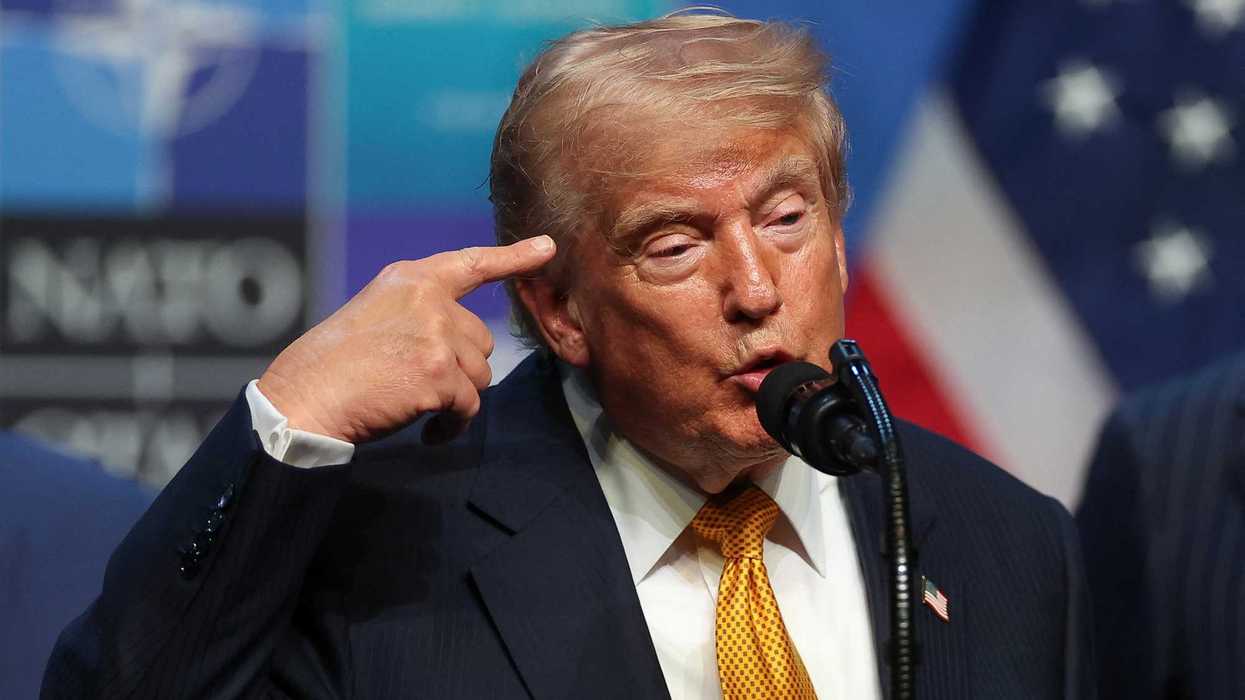
President Donald Trump is planning on campaigning aggressively for Republican candidates in the upcoming midterm elections, despite growing internal divisions within his movement and a number of anecdotes indicating some of his base is turning on him.
Now a legendary Republican political strategist is bluntly stating that, by not putting his ego aside, Trump is jeopardizing his party’s political chances in 2026.
“A far better course would be to minimize the president’s political profile after Labor Day,” President George W. Bush's senior adviser and deputy chief of staff Karl Rove wrote for The Wall Street Journal on Wednesday. “Mr. Trump is unpopular. His approval in the RealClearPolitics average is 39 [percent]. A season of political rallies won’t improve that. Less campaigning might.”
He added, “It makes no sense to help Democrats more easily tie a Republican candidate to voters’ low opinion of Mr. Trump. Get the president to raise money at private fundraisers but avoid high-profile rallies in battlegrounds that will only energize an already excited Democratic electorate and make it more difficult for Republicans to contrast themselves with their opponents.”
Rove then mentioned how, when Bush was unpopular during the 2006 midterm elections with an average approval rating of 38 percent, he strategically campaigned in states like Colorado, Florida, Georgia, Indiana, Kansas, Montana, Nebraska, South Carolina and Texas because he remained popular there. Otherwise he avoided hitting the stump.
“By lowering his profile and mostly avoiding the campaign trail, Mr. Bush gave Republicans a better chance to keep their fire focused on their Democratic opponents,” Rove observed. Yet he added an important caveat.
“Still, as is customary in midterms, Republicans lost—30 House seats that year,” he wrote. “In Mr. Trump’s first midterm, in 2018, he campaigned extensively and the GOP lost 42 seats. He didn’t even have the albatross of an unpopular Middle East war weighing him down. Fewer campaign rallies and more presidential actions that make a meaningful difference in people’s lives could produce a better outcome this time.”
Acknowledging that Trump has yet to take his advice, Rove concluded that “there are good Republicans on the ballot who don’t deserve to be defeated but will be unless the president and his advisers forgo needless and unhelpful political spectacles this fall.”
It is entirely possible that Trump is unconcerned with his polling and other ominous midterm election signs because he plans on stealing them. Experts who spoke to AlterNet in June speculated that this is exactly the case.
“What they all add up to is a desire to avoid any accountability to the voters in the midterm elections — to ensure, to preordain the outcome of a midterm that he thinks is going to go badly for him,” Dan Vicuña, Senior Policy Director for Voting and Fair Representation at Common Cause, told AlterNet at the time. “We know, from the Big Lie of the 2020 election to spurring on a violent revolt to overthrow a free and fair election, that he has no respect for democratic norms, for the voice of the people. This is entirely about his own power and his own ego. He will even invest in protecting that ego and protecting his power at the expense of the needs of the public. People are suffering with high gas prices and affordability issues, and he does not care. All that matters is protecting his power, and he has no interest in whether he does that through democratic means.”
He continued, “I think this all adds up to a desire to ensure that his party stays in power and his ability to do what he wants — to attack vulnerable communities — remains intact.”
Vicuña also observed that “I think some of these attempts to federalize, to nationalize elections are clearly illegal. You've seen some of that overreach already struck down — attempts to order independent agencies to force a strict voter ID requirement on people. That has been rejected. Common Cause is in court challenging the latest executive order to turn the United States Postal Service into some election administration agency and to create a further bureaucratic layer to make it more difficult to vote by mail. In terms of the president's authority to order around USPS, it's illegal. In terms of USPS's authority to become some sort of national election administration agency, it far exceeds the legal authority that Congress gave to the postal service. The statute describing what kind of work the postal service would do is about postal service work — processing mail and selling stamps. It has nothing to do with election administration.”
Susannah Goodman, Common Cause’s Policy Director in the Voting and Fair Representation Program, also speculated that Trump's attempts to make sure he cannot lose control of Congress due to the voters' will has crossed the lines of legality.
“The other thing is that, as you well know, the administration has been trying to compel states to turn their voter rolls over to the federal government and to consolidate all of that in a mega database,” Goodman told AlterNet. “A number of states have refused to turn over their unredacted voter rolls with personal identifying information — Social Security numbers, driver's licenses, et cetera. Common Cause and our partners have intervened in, I think, 17 of those cases on behalf of voters.”
She continued, “I don't believe there has been a single case, Dan — correct me if I'm wrong — where, when the state has resisted and claimed they are not going to turn these voter rolls over, the court has dismissed the case or compelled the states to turn them over. The government has not had a compelling reason, and the states have won. So when states fight back, they win. We have been involved in that litigation. That is another huge power grab by the administration. It is also an illegal power grab, and when we have pushed back, we have won.”