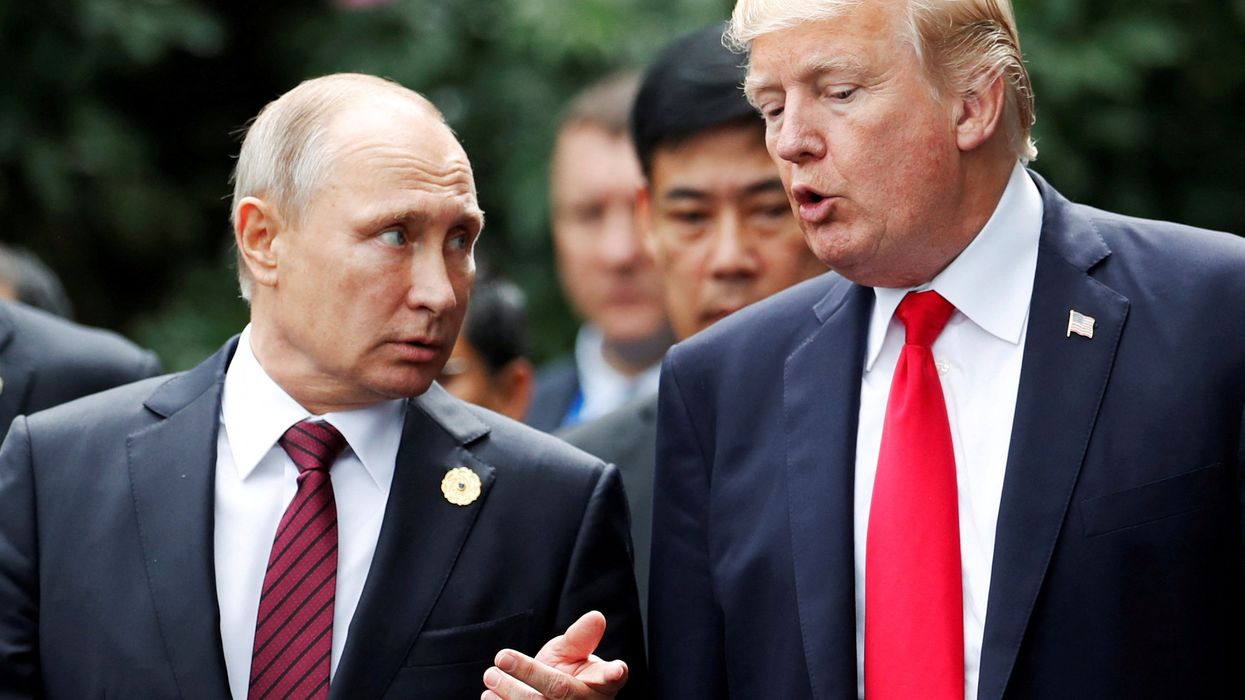
President Donald Trump, 80, has long behaved in ways that raise alarms about his health, from falling asleep in meetings to slurring his words. Now a new report is raising alarms about his health for a different reason — a mysterious bulge that appeared at the back of his pants on Thursday as he met with his self-described "friend," Russian dictator Vladimir Putin.
"The 80-year-old president’s bulge was spotted in a video posted by his communications adviser Margo Martin, who filmed him greeting Putin, 74, on the sidelines of the APEC Leaders’ Summit in Shenzhen, China," reported The Daily Beast's Erkki Forster on Thursday. "As Trump walked toward Putin, a bizarre, rigid-looking bump jutted out from under the back of his suit. It was most pronounced just above his right hip, where a stiff, pointy protrusion appeared to press against the fabric of his suit."
Forster added, "He shook Putin’s hand before leaning in to whisper something in his ear, to which the usually stony-faced Putin responded with a broad smile."
After describing the exchange, one in which Trump and Putin went out of their way to express friendly feelings for one another, Forster pointed out that many prominent observers were baffled by Trump's bulge.
"Independent journalist Aaron Rupar wrote, 'note Trump’s a-- contraption,'" Forster wrote. "'I noticed that and it’s got to be some kind of medical device,' one X user replied, as another responded, 'Right? Some kind of pump? Bag?' One person chimed in, 'I believe he is using an exoskeleton device that is designed to go over clothes. No one will ever notice.'"
Not everyone agrees that it is appropriate to discuss how Trump's aging impacts his health. Speaking to AlterNet in September, S. Jay Olshansky, a University of Illinois Chicago emeritus professor best known for developing the "biodemographic paradigm" of mortality, expressed his reservations.
"I can't draw any conclusions about the president's cognitive functioning based on the decisions that he's making on a day-to-day basis, because I don't have all of the relevant information that's used to make those decisions," Olshansky told AlterNet.
"What I can say is that I used to believe that presidents, presidential candidates should be protected from revealing their full medical records, where this kind of information would likely be located," he added. "I used to believe that presidents and presidential candidates should be allowed to withhold that information just like anyone else. It's private health information. I've changed my tune fairly recently. I've come to the conclusion that these kinds of issues should be addressed like with airline pilots, for example, where they do need to be tested and evaluated because the decisions that they make on a day-to-day basis can influence the health of other individuals, where their decisions can influence them directly or indirectly."
He concluded, "And I think presidents and presidential candidates also need to abide by the same rules. So I think they do need to be evaluated. I think that information does need to be made publicly available. And it's only there, where that information is made publicly available, will we know whether or not there are any cognitive or physical health challenges associated with a president or presidential candidate. And even then, I would be less concerned about physical functioning. I actually really couldn't care less about whether somebody's eye isn't working as well or their knee isn't working or hip isn't working. These are all age-related changes that occur to all of us at one level or another. But cognitive functioning is a different issue, and I think that's the point that you're raising. And the only person I would trust to provide any reliable assessment of cognitive functioning would be the individual's physician."