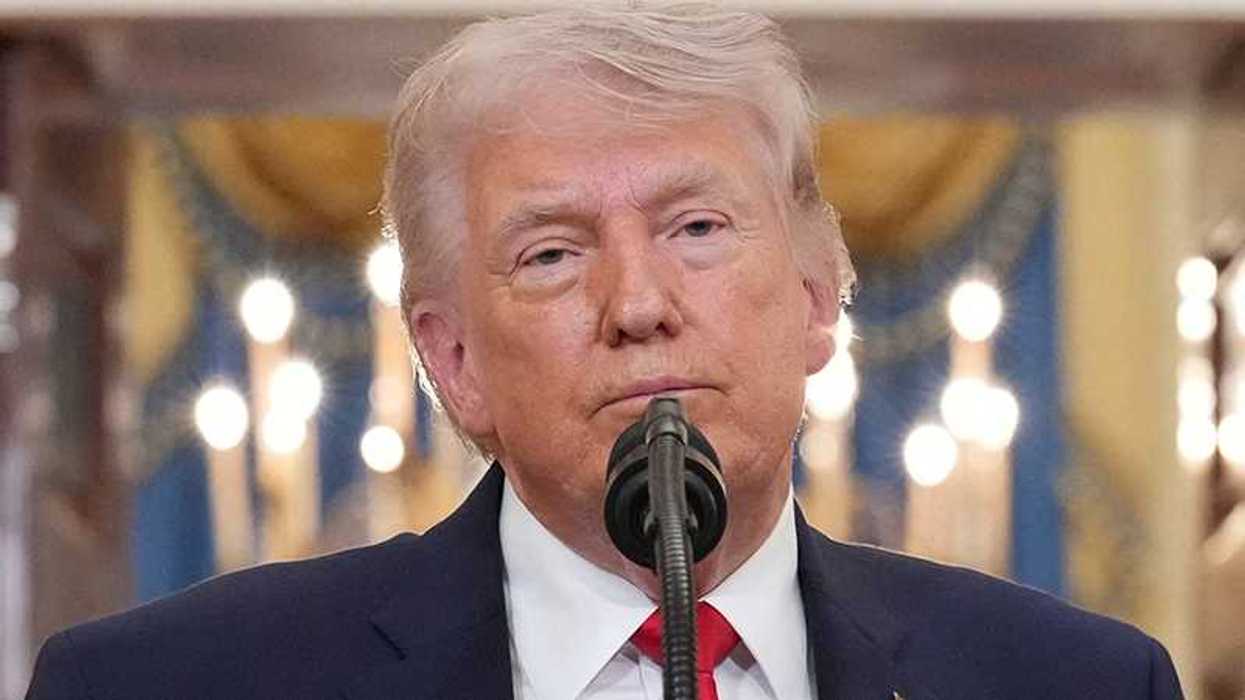
President Donald Trump has politicized America’s intelligence-gathering operations to an unprecedented degree, and a former CIA analyst who worked for Trump’s NSC is now raising the alarm.
“In 2025, I watched from inside the White House and at the CIA as the intelligence community came under assault: senior officers fired in public, clearances revoked for dissent, decade-old assessments denounced by the CIA director in the press,” Julia Curlee, a former CIA analyst and an NSC director for Presidents Joe Biden and Donald Trump, wrote for Lawfare on Monday. “Earlier this month, the campaign reached the raw intelligence itself, as the White House declassified selected reporting to sustain election interference claims that the intelligence community’s own finished analysis would not support.”
As one example of Trump’s politicizing intelligence, Curlee described how members of the CIA with expertise in Venezuela were fired when they did not back the administration’s position on taking over that country.
“Twenty years later, days after taking office, the second Trump administration tasked the National Intelligence Council (NIC) to assess whether the Venezuelan regime had directed Tren de Aragua—a criminal gang—to invade the United States,” Curlee wrote. “The question, from Homeland Security Adviser Stephen Miller, matched nearly word for word the predicate for the Alien Enemies Act of 1798, last invoked in World War II to intern Japanese, German, and Italian nationals.”
She added that she knows this firsthand because she tasked the Venezuela assessment.
“I was the NSC’s acting senior director for intelligence programs across the transition—Biden’s last week, Trump’s first,” Curlee said. “I knew the NIC, the intelligence community’s most senior, most deliberate analytic body, would carefully weigh the evidence and reach a consensus position. How much rode on that judgment became clear when the administration carried out lethal strikes on alleged drug boats off Venezuela and, in January 2026, sent U.S. forces into Caracas to seize Nicolás Maduro himself.”
She added, “The NIC did not give the answer the White House wanted, concluding that Tren de Aragua had not entered the country at Maduro’s direction, undercutting the administration’s case in court. Director of National Intelligence (DNI) Tulsi Gabbard denounced the finding, and her chief of staff, Joe Kent, pressed the acting NIC chair to “rethink” it. When he held firm, Gabbard had him walked out of the building, ending the career of one of the country’s most accomplished analysts.”
From there, Curlee lists other ways that Trump has pushed out people in the CIA and other intelligence agencies for engaging in work that the president disliked for purely political reasons.
“From its first days, the second Trump administration treated the intelligence community not as an instrument of the state but as an enemy within: a ‘deep state’ that had allegedly lain in wait for the president during his first term,” Curlee wrote. “The aim was explicit: Put career civil servants ‘in trauma’ to make them not want to come to work. At the CIA, that program arrived on schedule.”
She continued, “First they came for the people. On day one, the president revoked the clearances of 51 former officers who had spoken on Russian election interference. A month later, amid the purge of trans service members, the DNI fired 100 trans intelligence officers from 15 agencies. In May 2025, she fired two senior analysts over the Tren de Aragua assessment. And in August 2025, Gabbard publicly revoked 37 more clearances—including that of one of the intelligence community’s most respected experts on Russia—seemingly without irony, for the ‘politicization or weaponization of intelligence.’”
Curlee said that Trump then denounced findings that had previously been proven beyond reasonable doubt, from Russia’s meddling in the 2016 presidential election to warnings about white nationalist terrorism, violence against LGBT people and assessments about women’s reproductive health.
“And the threat did not stop at termination,” Curlee pointed out. “Former CIA Director John Brennan was referred for criminal investigation and interviewed by the FBI over the same analysis the administration had set out to discredit. The lesson reached every desk—a clearance, and with it a livelihood, could be revoked with a phone call; a career could end in front of a grand jury. By mid-2026, the president was describing intelligence that contradicted his preferred reality as ‘treason.’”
Curlee also warned about Trump politicizing intelligence during his July 16th speech falsely claiming that China had meddled in the 2020 presidential election, which Trump lost to Biden.
“The president delivered a primetime address alleging that China had interfered in the 2020 election, built on a mass declassification of election-related intelligence assembled by the White House’s Government Transparency Task Force—a body created to comb the classified archives for material to amplify the president’s election claims,” Curlee wrote. “The release put raw reporting before the public to overrule the intelligence community’s coordinated conclusion that Beijing ‘did not intend to try to affect the election.’”
She also wrote that “raw reporting is dangerous in public precisely because it is raw. A dissemination from the field carries source descriptors and reliability caveats so that the reader knows how much weight it can bear; it has not yet been weighed against the rest of the collection, evaluated for source quality, or reconciled with what the community already knows. That is what analysis is for. Strip away the caveats, and it stops being intelligence and becomes ammunition.”
In addition to wronging individuals who dedicated their lives to protecting American lives and democratic institutions, Curlee said that this also causes America to blunder into conflicts like the ongoing war against Iran.
“When officers watch their colleagues fired and stripped of their livelihoods for reaching unwelcome conclusions, the institution does not need to be ordered into silence,” Curlee opined. “It has been taught.”
She concluded, “The damage inflicted by the Trump administration will take decades to repair. A generation of officers with irreplaceable skills and expertise has walked out the door, and the barriers to return—a fresh background investigation and polygraph, and a hiring system built for entry-level recruits rather than returning senior officers—make them far harder to bring back than they were to lose. Skepticism is also justified about whether any reform could restrain an administration willing to bend the law.”
Curlee is not alone in warning against Trump’s politicization of intelligence. Earlier in July, The Atlantic reported on a survey of intelligence agents saying they felt pressured to bow to Trump’s political agenda.
“The survey, which covers last year and was sent to members of the agency’s analytic workforce, combines multiple-choice questions with an open-ended section where respondents can give feedback in their own words,” The Atlantic reported. It later added, “Among the analysts’ concerns was last year’s dismissal of two senior career intelligence officers after one of Gabbard’s deputies tried to rewrite their assessment that Venezuela was not directing a criminal gang, Tren de Aragua. The administration wanted to claim the opposite to create a legal basis for deporting Venezuelan immigrants."
In April former CIA director William J. Burns furthered this observation to explain how America entered its ongoing war against Iran.
“President Trump’s war of choice with Iran has paid little attention to our past mistakes and added many of his own,” Burns argued. “He assumed that bombs and assassinations could bring about regime change. He misread tactical military success as a workable strategy. He made policy choices based on Presidential Id and court politics. He negotiated on the fly with little forethought or planning.”