

Why Trump refuses to touch a radical 1971 playbook to kill inflation
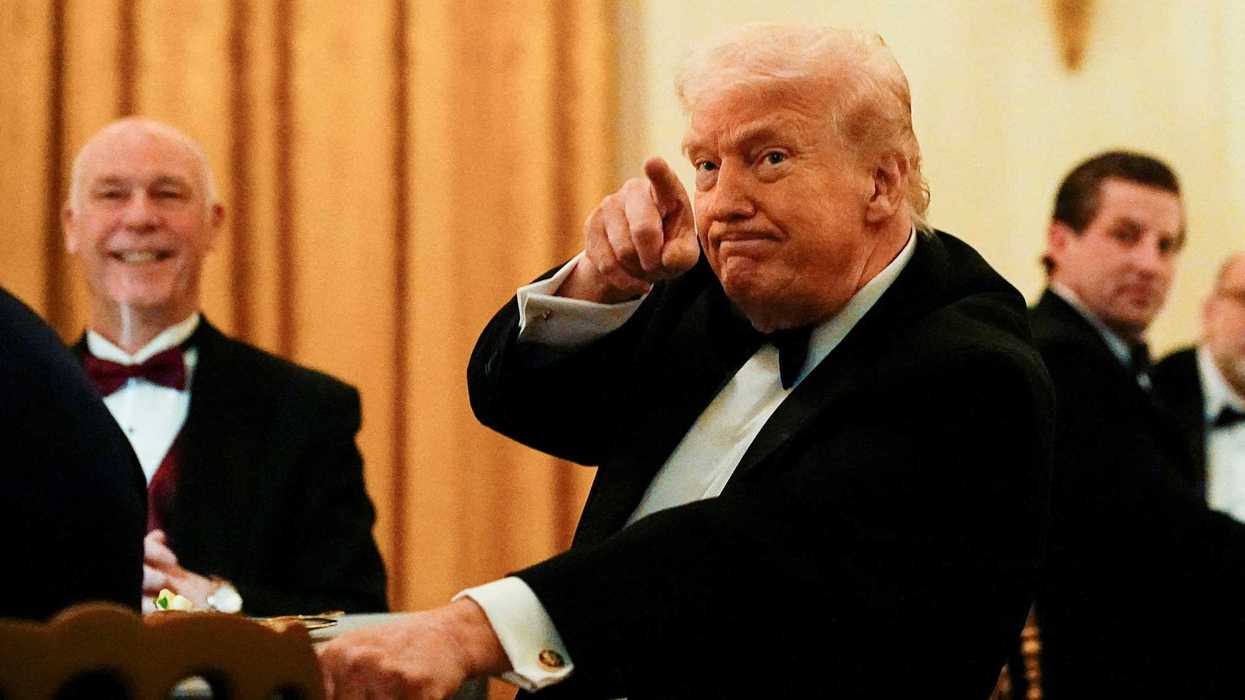
President Donald Trump attends a Governors Dinner at the White House in Washington, D.C., U.S., February 21, 2026.
iPresident Donald Trump, like his Republican predecessor President Richard Nixon, is struggling with inflation so intractable, it is threatening his political future. From plummeting in the polls to losing support among establishment Republicans, Trump's political position is weakening every day prices remain high. Despite this, he has proved either unable or unwilling (or both) to get them under control.
Yet Nixon ultimately got out of the exact same quagmire as Trump in a two-pronged bold stroke. First he announced, and over time implemented, price controls. Simultaneously he took America off the gold standard. Why does Trump refuse to implement price controls? Cryptocurrency being at best a dubious alternative to legitimate currency, what has he done to prop up America's dollar?
If Trump is willing to support Nixon when it comes to the Watergate scandal that forced the latter's disgraced resignation, why won't he support him when it comes to areas of his presidency wherein Nixon was arguably successful?
To better understand this question, I spoke with Luke Nichter, professor of history at Chapman University, who edited two volumes of Nixon's White House tapes that are both readable and thorough (though massive), and can therefore be rightly considered an official Nixonologist.
In the following interview, we started with Nixon's price controls and whether Trump can implement something similar, then moved on to deeper questions about what Trump's presidency means for the future.
The following interview has been edited for clarity, context and length.
Why doesn't Trump impose price controls or prop up the dollar like Nixon?
Matthew Rozsa: Trump admires Nixon in other ways but does not seem to admire his 1971 decision to impose price controls. Why do you think Trump doesn’t borrow from Nixon on prices? That would certainly address the issue of inflation.
Luke Nichter: It’s an interesting question. I think the fundamental difference is that the international order in the early ’70s was totally different. We were in the last gasps of the Bretton Woods system: the dollar fixed to gold, and other major currencies at fixed exchange rates to the dollar. That system had been in decline since 1958. It was created in 1944, and other countries had to accept the dollar and these fixed exchange rates in exchange for promised fiscal discipline at home in the United States. Most economic historians would say that by the 1950s, we weren’t keeping our end of the deal, and they weren’t either. They didn’t want dollars anymore; they wanted the gold equivalent. And we were spending too much money. We were printing more money than we had gold backing it at Fort Knox and other places.
That got worse in the 1960s with the Vietnam War and domestic spending on the Great Society, both of which continued under Nixon. So by the summer of 1971, which you referred to at the outset, the alarm bells went off: We had $30 billion in printed currency in circulation, and only about a third of that had the necessary gold backing. The Europeans were about to make another request to convert more dollars to gold. It was a matter of days, a week or 10 days, before the U.S. dollar would default for the first time. That had never occurred. That’s why Nixon had to take extraordinary action. And I think the reason wage and price controls happened is that this was a generation that remembered the Depression. They grew up during the Depression.
If you look at monetary policy during the Depression, the Federal Reserve actually made it worse. Our collective understanding now is that when we enter an economic downturn, we need looser monetary policy. Keynesian economics taught us that. In the Great Depression, the Federal Reserve initially tightened the money supply and made it worse. So these policymakers in ‘71 were worried they would cause a second Great Depression. Nixon didn’t understand this. He basically went along with the advice of the people around him, especially Arthur Burns, the chairman of the Fed, who wanted these protectionist measures as a hedge, an insurance policy against causing a second Great Depression. That’s what fundamentally makes that period different from today: We don’t have a similar level of emergency.
Rozsa: You say we don’t have the same level of emergency, and economically that is true. But from Trump’s perspective, politically, it is not. If he is willing to “nationalize elections,” as he puts it — which I’m using as a catch-all term for the panoply of methods he is considering to rig the midterms — then why not use this tool in his toolkit?
Nichter: I don’t think you can do that by executive order. People often point at Congress as the problem: Why won’t Congress act? I read something interesting recently that said it’s not that Congress doesn’t act; it’s that the three branches of government are no longer doing what they were traditionally intended to do. Trump is passing policies by fiat or by executive order, so he’s sort of acting like the legislative branch, because Congress isn’t doing these things. Then the judicial branch is acting more like the executive. It’s acting as a referee: You can do this, but you can’t do that. And Congress is reduced to holding a lot of hearings and talking, but not necessarily taking leadership.
So they’ve become kind of the judicial branch. We’ve had a sort of corruption of the three branches of government, where none of them is really functioning the way our founders intended.
Rozsa: How was Nixon able not only to impose price controls but also to remove America from the gold standard in 1971?
Nichter: It was a process. It didn’t all happen in ‘71. He gave a speech on Aug. 15 that year, and he was able to do it as a temporary measure. But that fall, when Congress returned, there was massive legislation, and the whole system wasn’t patched up until ‘73, when George Shultz was Treasury secretary. Since then, exchange rates have permanently floated. There has been no tie to gold.
So it took a long time. We had to sell it to our allies, especially in Europe and, very importantly by then, the emerging Japanese. And Congress was very, very involved in that process. It wasn’t just executive action.
Rozsa: Nevertheless, it seems Nixon was able to use the various instruments of government to effectuate this ambitious goal, and he put everyone on alert in 1971 that he intended to do so. If Trump were to do something analogous now and follow through on it, he could, like Nixon, control prices. Am I wrong?
Nichter: He could, but he doesn’t have the mandate. The mandate comes from the national emergency. I don’t think the American people would be convinced that we have a national emergency of the kind Nixon faced, a default of the dollar. No one’s talking about a default of the dollar today.
Rozsa: People turned a blind eye when Trump attempted a coup after losing the 2020 election. I’m saying perhaps people’s threshold for abuses of power is high enough that they would allow Trump, perhaps even applaud him.
Nichter: I’m back to where we started our conversation: Young people especially don’t have the sensitivity toward these subjects that people did during Nixon’s time. So I concede that point.
Why do Trump and his associates seem so much worse than Nixon and his counterparts?
Rozsa: When I was reading the August 1971 section of your book, and in particular analyzing the arguments made by President Nixon, Treasury Secretary Connally and [George Shultz, Director of the Office of Management and Budget] as they discussed the gold standard and price controls, it was fascinating. Whatever you think of them morally or politically, they were intelligent men addressing a complicated issue in a pragmatic way that ultimately proved effective. Why do you think the quality of our leadership today seems diminished?
Nichter: Well, I don’t know that it is. It might be.
Rozsa: Just to be clear before you continue: The analogs for those three men today are Donald Trump as president, Scott Bessent as Treasury secretary and Russell Vought as Head of the Office of Management and Budget. Please go on.
Nichter: On the Nixon tapes, there are also many conversations where they complain about the lack of strong leaders in that era: Why don’t we have a de Gaulle or a Churchill? I think humans, since the beginning of humans, have always looked to the past as the time when we were smarter, we were wiser, we had more leaders. And the reason you came to that conclusion when reading those pages is that it took 40 years for those tapes to be declassified, and there was a process that involved the discovery of new knowledge. The conclusions you came to reading those pages were not the conclusions of the people who lived through that year.
Rozsa: Are you saying you think Trump, Bessent and [Vought] would not come across as inferior to Nixon, Connally and Shultz?
Nichter: It’s taken 50 years to have this conversation about Nixon. I hope you’ll call me back in 50 years, and we can look back on the Trump years.
Rozsa: I hope to be alive in 50 years, and I hope you are too.
Nichter: I don’t know if I want to be. But what we’re really talking about is politics versus history, and history is something different. When political subjects finally pass fully into history — and that’s a very important statement — it usually means everybody’s gone. There’s no human memory. We have a personal detachment from divisive subjects, so we’re willing to open our minds and reconsider what we thought we knew. That will also happen one day with the Trump years. If we can return to a sense of normalcy in politics on both sides of the aisle, the Trump years might still look like an aberration 50 years from now. But if things keep getting crazier in our political system, which seems to be the broader trend line we’re on, it’s possible that in 50 years things will be so much crazier that people say, “I remember how calm it was during the Trump years.”
The events don’t change, but human memory, and how we remember them in history, is a moving target, relative to what occurs afterward.

