Conservative studio's new movie 'Drummer Boy' might shock its MAGA fanbase
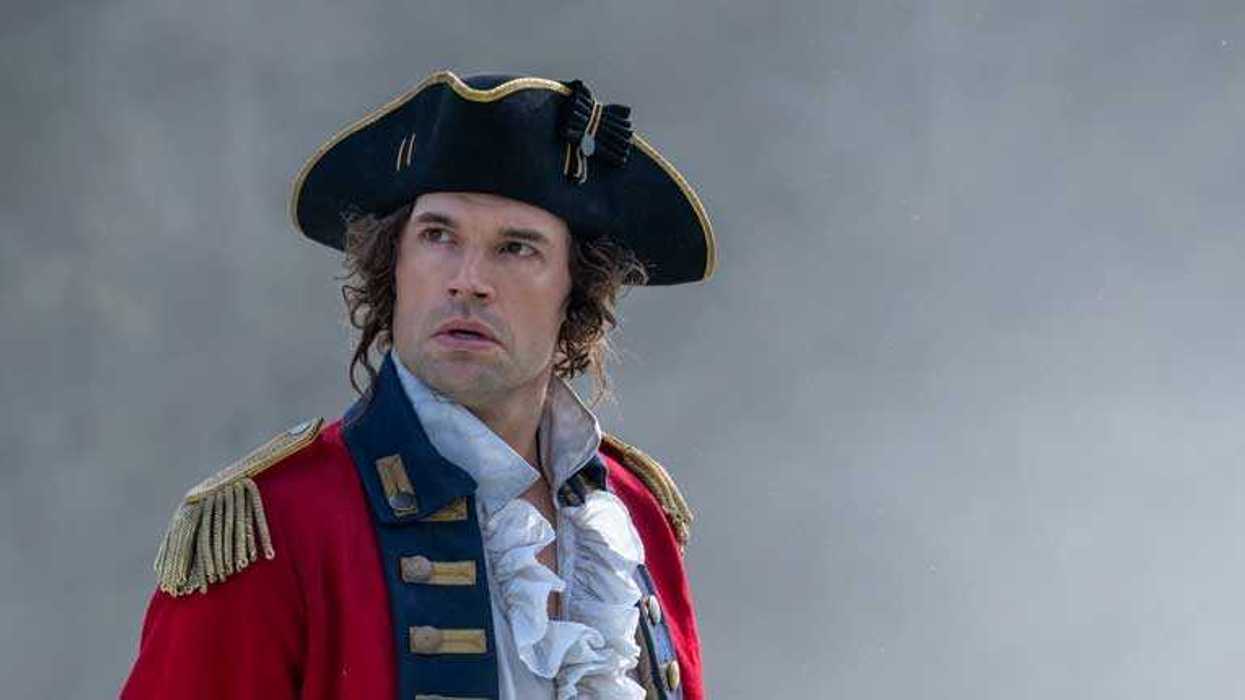

Angel Studios releases a lot of right-leaning movies, and for this reason I expected "Drummer Boy" to have a conservative bent. Imagine my surprise, then, when there was a scene so sympathetic to slaves and critical of America's founding fathers, one might dare call it "woke." Two slaves, Emmaline (India Brown) and Margaret (Beverley Knight), read the preamble to America's Declaration of Independence. Penned by Thomas Jefferson, who would later serve as president, they recite his assertion that "all men are created equal, that they are endowed by their Creator with certain unalienable Rights, that among these are Life, Liberty and the pursuit of Happiness."
Then they note his hypocrisy. And at that moment, I gave immense credit to "Drummer Boy" co-directors Joel David and Ben Smallbone, as well as screenwriter Richard L. Ramsey, for sharing this "woke" observation with Angel Studios' conservative audience.
"You know, Richard L. Ramsey was the screenwriter, and I'm an immigrant to this great country; he's a bit more of a history buff than me," Joel David Smallbone, who plays Emmaline's love interest and co-protagonist Jeremiah Clem, told AlterNet. "But I never felt that moment being charged. I felt it reflecting the idea of the overall film, and that is that we all have light and shadow. We all have hard things. We all have secrets. We all have things we struggle with. My character has really some stuff that he's working through. And so I felt it more on the level of going, this is just reality, you know? And yeah. Emmaline, by the way, and Margaret, two great characters in the film."
His real-life brother Ben said he accepts the risk that some sensitive audience members might be triggered by this moment.
"Look, absolutely, I could see people taking offense to a lot of things in the film, but to me, we're truth tellers," Ben Smallbone told AlterNet. "As filmmakers, as storytellers, we tell the reality of the story that is known as truth. And it is a historical fact that Thomas Jefferson had slaves, and the statement that he made in the Declaration of Independence was in contrast to some of the things that he himself was believing. So look, if people find that controversial, it is fact, it is in the history books, it is truth, and we're just telling the truth in our film."
It is in the history books that Jefferson owned slaves, just as it is in the history books that he and the other founding fathers wanted a strict separation between church and state. Unfortunately Angel Studios pushed out the conservative film "A Great Awakening," which spreads the false Christian nationalist claim that evangelist George Whitefield inspired founding father Benjamin Franklin. Even less overtly ideological Angel Studios films, like "Young Washington" and "The Brink of War" (about Presidents George Washington and Ronald Reagan, respectively). For this reason, I began to think of Jefferson's best quality — his ability to pen eloquent phrases like "I contemplate with sovereign reverence that act of the whole American people which declared that their legislature should make no law respecting an establishment of religion or prohibiting the free exercise thereof, thus building a wall of separation between church and state." — whenever "Drummer Boy" began getting religious on its audience.
(It is worth mentioning here that I am Jewish.)
Fortunately, Ben Smallbone reassured me that this was not the case. At this point, I now turn to my interview with the Smallbone brothers about their fictional counterparts, the Clem brothers, and why they felt the need to tell this religious American Revolutionary War story.
The following interview has been lightly edited for clarity, context, length and to omit answers quoted earlier in the article.
Speaking to Joel David Smallbone.
Matthew Rozsa: I identified a lot with the character of Benjamin Clem because I am also physically disabled. I also tend to get in trouble for expressing unpopular political opinions in public. Who was he inspired by? And is he intended to encourage other downtrodden people to express unpopular political opinions in public?
Joel David Smallbone: (laughs) What an opening question. Look, Ben is an amalgamation of a lot of people. You know, I can't help but pull from personal experience. I'm one of six siblings. I've got four brothers, two younger brothers. And I'm a little bit of a chronic rescuer, Matthew. And so I can tend to tamp down the people, even younger brothers, that I'm trying to help in my own way, but at the same time I'm actually robbing them and I'm stifling them. And so I was sort of pulling from my own experience with Ben. Yeah.
Matthew Rozsa: At one point in the film, the British remind me of, dare I say, President Trump. They defend King George III by citing the divine right of kings, much as Trump says he was put here by God to lead America; that we must fight a war against France, as opposed to Iran, to protect our way of life; and they confiscate grain like Trump levying tariffs willy-nilly. Obviously, none of this was intentional on your part, but as people in an America that is experiencing conditions like those of the revolution, do you have any thoughts on whether people should be as bold today in standing up for themselves as the characters in the film?
Joel Smallbone: Mm. Mm.
Matthew Rozsa: You're going "mm, mm." I'm curious what that means.
Joel Smallbone: I'll say this. There's an old saying: We make our plans, but God orders our steps. And I'm so proud of the fact that this film is coming out three days after midterm elections, and that as people are grappling with exactly the question you just asked. Is this a reflection of history? Are we repeating ourselves? All of these questions, those are the questions we were asking ourselves as we wrote it. You know, what is freedom? What is forgiveness? Who are we? What is our identity? And I like asking questions, Matthew. That's my heart, is to ask questions. And so I love that you're pulling all of these pieces. My job is to provoke them. (laughs) Your job is to ask the question as well.
Speaking to Ben Smallbone.
Matthew Rozsa: The movie talks a lot about Christ in terms of understanding America's origins. Does it also acknowledge the importance of church-state separation?
Ben Smallbone: Look, I'm an Australian. I'm an immigrant to the United States of America. I've spent 30 years of my life here. And I will say loudly and proudly as an American citizen and an Australian citizen now, this is one of the greatest countries in the world, and the opportunities that we've been given here have been incredible. The statement that you make, look, the separation of church and state is a part of the government, and I believe that is an essential part of that. For the story of the film, no, we don't make a direct statement about that, and we don't plan to make a direct statement about that in the film. You know, this was the founding of the United States 250 years ago. There was no acknowledgement of really what was gonna happen, who was gonna win. Were the British gonna take over? Were they gonna free the slaves? Were the United States gonna free the slaves if the Patriots won? And so this is a story truly trying to discover what unites us instead of what divides us. And so, look, I don't know exactly where that would be stated in the film, but it is not in there presently.
Matthew Rozsa: I would say, and this is what I find intriguing about the film, is that it's about stating opinions that others might disagree with. The whole catalyst for the story is that Benjamin Clem refuses to not express his political views, even though he is in a public setting, on that occasion his family business, in which doing so might get him in trouble. To me, that is a powerful moment in the story, especially since it has repercussions for every character going forward. How is that relevant today? Why did you choose to make this a tale that at its core is about expressing yourself even when it's unpopular?
Ben Smallbone: You know, there's a statement within the creative Christian arts, if you will, the Christian industry, of "Oftentimes we create art the way we wish the world was, but not the way the world really is." And as a filmmaker and a storyteller that wants to portray the truth and tell what I believe is truth, that is really important to me. And whether people call it woke, or whether liberals watch it and are offended by the religious nature of some of the elements in there, I'm gonna tell my version of what the truth is, and you can take from it what you will. I don't see the film as, hopefully, controversial. I see the film as uplifting. I see the film as something that hopefully unites people, makes them ask beautiful questions about life's biggest questions, and brings us together, because, gosh, we are united in the name of this country, but we're more divided than ever before. And what can we do to bring the country together to celebrate our similarities instead of our differences?