
Entitativity: The mind trick cult experts say is dividing America
REUTERS/Jeff Kowalsky
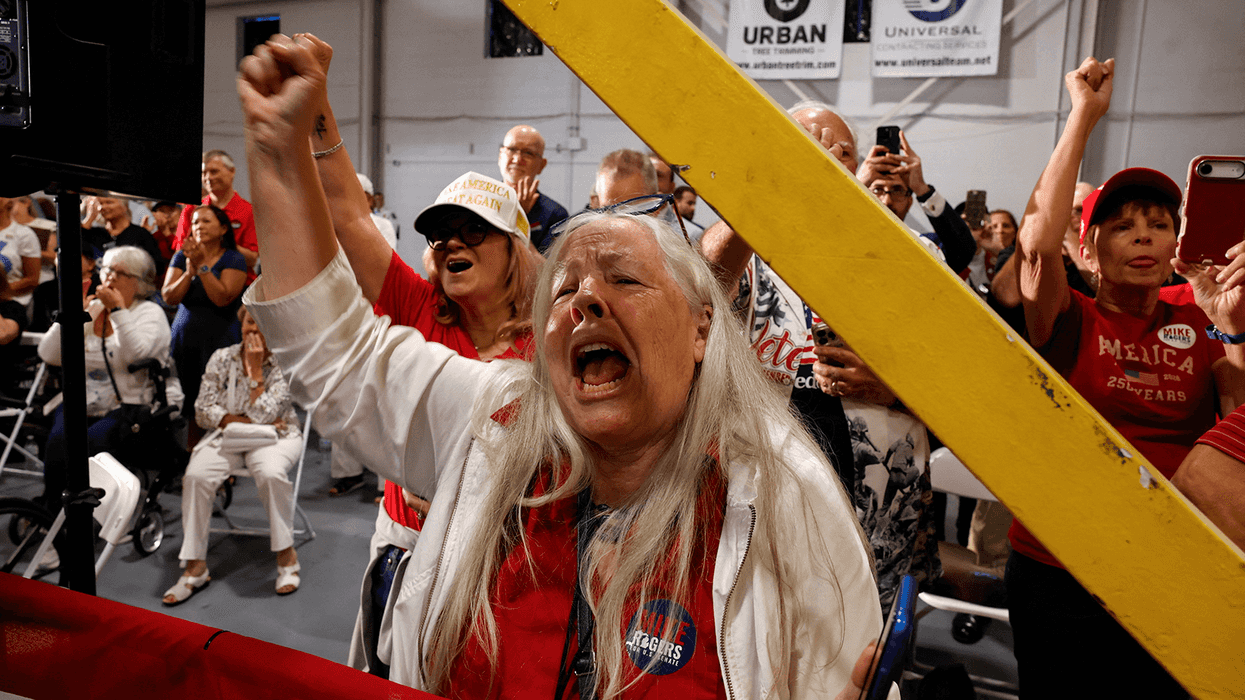
People cheer as U.S. Vice President JD Vance delivers remarks at a MAGA Inc. event in Sterling Heights, Michigan, US., August 31, 2026.

People cheer as U.S. Vice President JD Vance delivers remarks at a MAGA Inc. event in Sterling Heights, Michigan, US., August 31, 2026.
The philosopher Michel Foucault argued that language does not neutrally describe reality, but instead actively shapes it. A recent scientific study analyzing political language seems to support his thesis. It shows that subtle choices in our wording massively impact the partisan bias in conversations about a wide range of sensitive political issues.
it all comes down to a single word that refers to how much a group of people is perceived as cohesive and real — entitativity.
"Research on novel groups suggests that perceived entitativity is driven by how others label these groups," Carsten W. Sander and Juliane Degner recently wrote in the journal Social Psychological and Personality Science. "Using fine-tuned transformer models to automatically classify Facebook posts (N = 45,780) and comments (N = 769,684), we show that this effect also holds for established political groups. Specifically, posts containing noun labels (e.g., “Senate Republicans”) rather than adjective labels (e.g., “Republican senators”) and using these labels generically (e.g., “Democrats want”) rather than non-generically (e.g., “some Democrats want”) receive higher proportions of comments expressing partisan prejudice."
This means that scientists conducted earlier studies involving political groups that they invented so participants had never heard of them. When they did this, they realized that words which subtly promoted entitativity led to participants viewing those groups as one unit, while those which did not tended to view them as separate individuals. They then tested whether this would also occur with regular humans, doing so by scanning roughly 46,000 Facebook posts and approximately 770,000 comments.
That is exactly what happened.
“In essence, perceiving a group as entitative makes group members appear more interchangeable,” Sander, a research associate at Humboldt University of Berlin, told PsyPost. “People then generalize one member’s behavior to the whole group, retaliate against one group member for offenses committed by another, and generally show more outgroup prejudice. We reasoned that this could also fuel political polarization, understood as growing prejudice toward the political outparty.”
Speaking with AlterNet in August about President Donald Trump and his political movement, cult expert Dr. Steven Hassan broke down how these movements subtly manipulate their followers to create cult-like cohesion and loyalty. In addition to the way they word their views in casual online posts, they also create media ecosystems in which their followers develop incorrect perceptions of reality through repeated positive reinforcement from their social networks.
"It really comes down to what information sources they're relying on and who their network is that they identify with," Hassan told AlterNet. "So if they really love Joe Rogan, they're going to follow a lot of his views. And consequently, when he turns against Trump, Trump loses a lot of followers. What I'm trying to convey is that we're living in an age of digital manipulation that's never been seen before."

