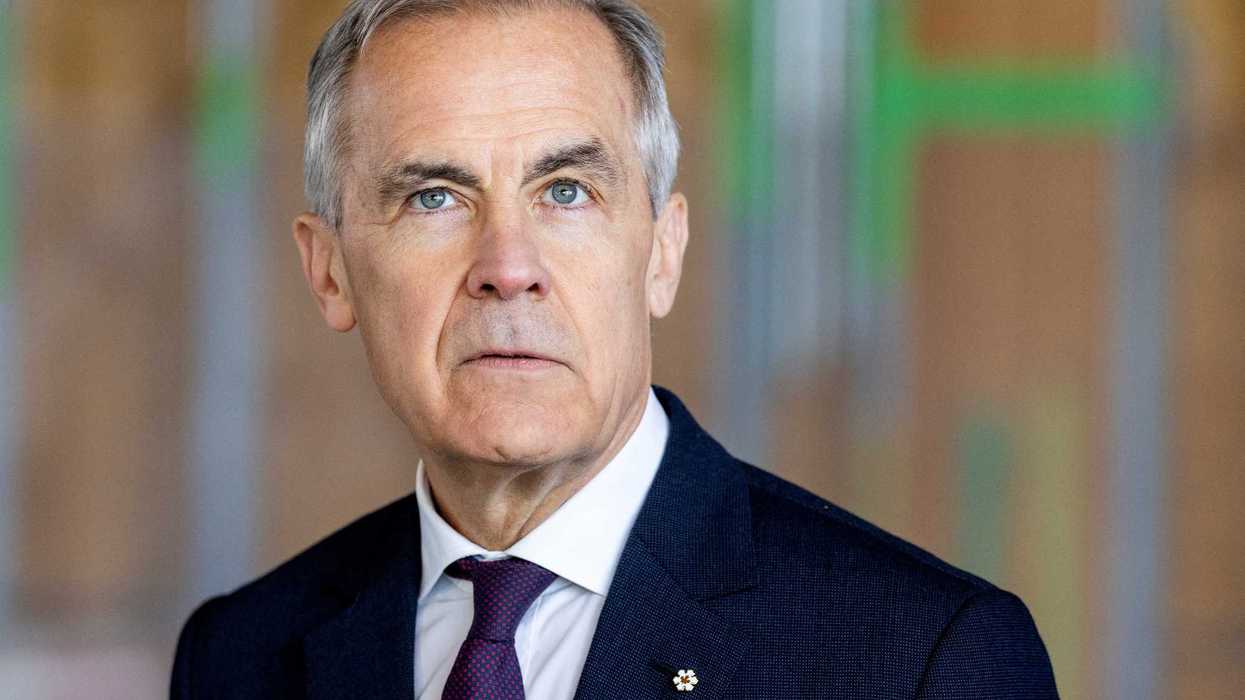
President Donald Trump's ongoing trade war and war of words against Canada, one of America's closest allies, has already started alienating many of his supporters. Despite this, Trump continues to double down on his belligerent posture toward Canada — and, in response, Canadian Prime Minister Mark Carney is comparing Trump's America to the America that existed during the Civil War era.
"'Canada came to life, in many ways, in response to American aggression,' Mr. Carney said in his Tuesday video, referencing the country’s first prime minister, Sir John A. Macdonald, who stood up to the United States in the second half of the 19th century," The New York Times' Matina Stevis-Gridneff reported on Tuesday. Carney continued, “At an incredible human and financial cost, Canadians took what was a country on paper and made it real."
As Your Halifax Now wrote on Tuesday, in his speech Carney pointed out that "when Canada became its own country, Prime Minister Sir John A. MacDonald built a rail line from the Atlantic to the Pacific and how, a century later, the Trans-Canada Highway would do the same."
He added, “Canada is a nation forged in adversity, a country that prides itself on doing what’s right, not what’s easy, a nation that knows we’re always stronger together. Canada came to life in many ways in response to American aggression."
During the 19th century, America's government frequently clashed with Canada because the Americans who supported "Manifest Destiny" insisted they had a right to lands controlled by Canada. Fearing that the United States would build a sophisticated railroad infrastructure in Canadian provinces to create a fait accompli, Canada pushed through its own nationwide railway system as fast as possible. MacDonald also famously urged Canadian provinces to allow their centralized federal government to acquire more power, pointing to the political volatility in the United States before, during and after the Civil War as proof of both America's potential unreliability and the dangers of excessive decentralization.
In the Stevis-Gridneff report, which quoted Carney's speech as saying that "the most powerful actions have come from you, buying Canadian and traveling in Canada, decisions at the kitchen table, not the boardroom table," The New York Times journalist described how Trump has provoked Carney to take this stance.
"In the days since the collapse of the trade talks, Mr. Trump has doubled down on provoking Mr. Carney and Canadians: he has signed an executive order to rename Lake Ontario 'Lake America'; resumed calling for Canada to be a state; and hurled accusations, many of which aren’t true, seeking to portray his country’s closest neighbor and longtime ally as a 'nasty' adversary...." the Times reported.
Further down the article it added, "In the past few days, he has posted a map of North America with the U.S. flag superimposed on Canada, Iceland and other countries, as well as an A.I.-generated image of himself towering over Mr. Carney on the ice during a hockey game and calling the prime minister 'governor.' (Mr. Carney played hockey for both Harvard and Oxford University while attending the institutions as a student)."
Speaking with AlterNet on Monday, Dr. Richard D. Wolff — professor emeritus of economics at the University of Massachusetts Amherst – contextualized Canadian resistance in terms of economic as well as nationalistic variables.
"It's not just Mr. Carney, he is the expression of something that he knows as a politician is now a very popular view in Canada," Wolff told AlterNet. "He's not going to be held to blame because this or that difficulty happens. If he can show, as he often can, that the United States' hostility, tariff policy number one, is the root cause, then he gets a pass. The kind of anger that might often be addressed to a politician won't be, because they correctly perceive that the problem is something else. And so they appeal to the politician when he comes up with solutions or attempted solution to keep workers' needs in mind."
While Canadians appear ready and willing to accept financial sacrifices to protect their sovereignty, it is unclear whether American consumers feel the same way. Regardless, though, the ongoing trade war is bound to raise prices.
"Just this week, Trump announced 50 percent tariffs on our largest trading partner, Canada, which will further increase inflation," economist Dr. Robert J. Shapiro, who was a top official for President Bill Clinton, told AlterNet in August.