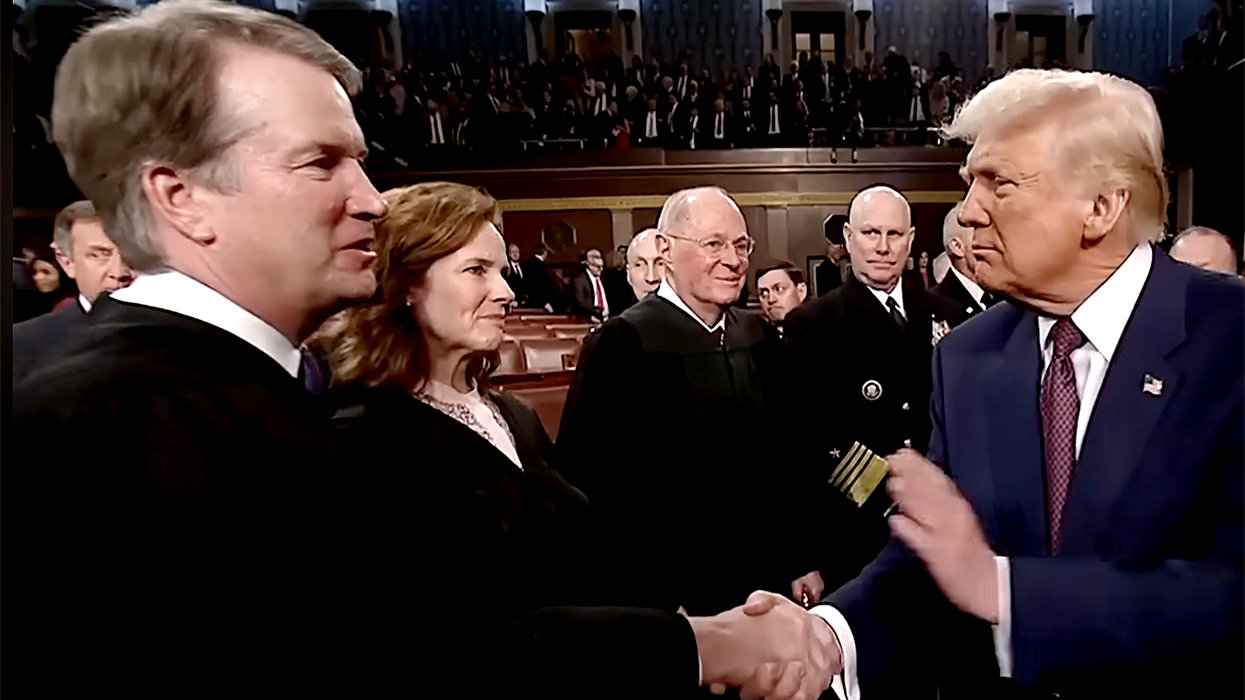
The biggest news over the Supreme Court this week dealt with the immigration rulings, but one ruling upended the campaign finance laws, handing more control to national political parties.
Punchbowl News' weekend newsletter pointed out that the ruling in NRSC vs. FEC will easily transform how each party controls elections, despite the fastest-growing group of voters being independents. The report explained that it isn't as earthshattering as the Citizens United ruling, but Ally Mutnick said that it's a bigger deal than many are reporting.
"The campaign arms have more control than ever. The most essential part of the decision allows campaigns and party committees — the DNC, RNC, NRSC, DSCC, NRCC and DCCC — to freely coordinate with the candidates they are trying to elect," wrote Mutnick. "That means they can run unlimited TV ads together as one entity and at the cheaper rate offered to candidates. Party committees can take much larger donations than campaigns and have tens of millions of dollars."
She said that this will supercharge candidates and overpopulate the airwaves. It's also a motivator for the political parties to cooperate with their party more effectively by hiring the people they want and adhering to the strategy they demand.
It means more right-leaning Democrats like Joe Manchin would fall more fully under the party's thumb, but it also means that Republicans like Rep. Tom Massie (Ky.) and Marjorie Taylor Greene (Ga.) remain under the control of President Donald Trump.
Before Tuesday, the committees could only spend a limited amount in coordination with a campaign, muting their potential influence," explained Mutnick. "Now the threat of withholding support has a lot more teeth to it."
Looking to the 2026 election, she pointed out that Democrats may not raise a lot of money as a party, but their candidates do exceptionally well while Republicans struggle.
Under this new ruling, Mutnick said to "consider Georgia’s Senate race. Sen. Jon Ossoff (D-Ga.) ended April with $32.5 million in the bank. The eventual GOP nominee, Rep. Mike Collins (Ga.), ended April with $1.7 million. Before, the NRSC would have to pay four or five times what Collins would pay to run TV ads for him."
Republicans can now use the lower ad rates to mount a stronger fight.
Democrats have proposed the DISCLOSE Act, which would require public reporting of all funds raised and spent and eliminate so-called "dark money" in politics. The long-shot option proposed by the Brennan Center for Justice is to pass an Amendment to the Constitution severely limiting money spent in political elections