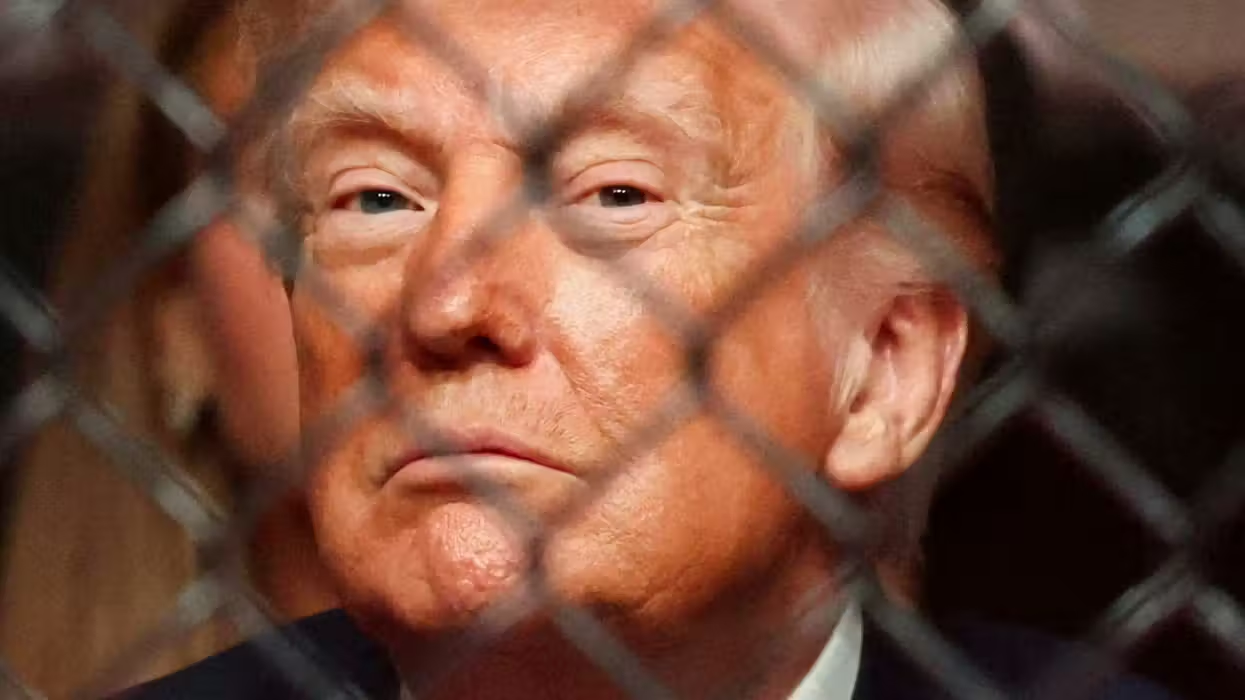
President Donald Trump has recently summoned the ghost of one of his Republican predecessors, President Richard Nixon, in everything from appealing to race in his campaigns (think Nixon's "Southern Strategy") to openly agreeing with Nixon's claim that he was the victim rather than the villain during the Watergate scandal.
To better understand why Trump is so captivated by the man who served roughly half a century earlier (1969-1974 for Nixon versus 2017-2021 and 2025-2029 for Trump), I spoke with a top Nixonologist, .Luke Nichter, professor of history at Chapman University. I highly recommend Nichter's transcriptions of the Nixon White House tapes, which were published in two volumes.
This interview has been edited for clarity, context and length.
Was Nixon a victim of the "deep state"?
Matthew Rozsa: How accurate is the new narrative that Nixon was a victim of the “deep state”? What does the historical record actually show?
Luke Nichter: Well, that’s complicated. I’m not really someone who uses the term “deep state,” necessarily. The people who advocate for this will point out that all of our national institutions and cultural institutions, because they are dominated by the left, were the enemies of Nixon since his anti-communism and his [Whittaker] Chambers days, and were desperate to topple him. My answer to that is: Ask the Clintons about that. These same institutions also went after the Clintons in some cases. So I think what we learn is that the reality is often more complicated than the headline or the soundbite. On the other hand, I do think it’s a bit like a National Enquirer headline, where there’s always some kernel of truth somewhere in the story. Obviously Nixon was an easy target, and to some degree that’s because he had made himself one.
He was provocative. He was a very aggressive partisan back in his congressional years, during his House Un-American Activities Committee days. So by the time he reached the presidency — I can’t say it any better than Lyndon Johnson once said it — politicians are like ships. They attract enemies throughout their career, even when they don’t try to. They attract enemies the way a ship’s hull attracts barnacles. And when Richard Nixon reached the White House, he already had a lot of barnacles, long before Watergate happened.
Rozsa: In a sense, it sounds like you’re saying that Nixon was, to an extent, persecuted by powerful enemies — not perhaps a literal deep state, but certainly individuals both within the state bureaucracy and in powerful outside institutions like the media and academia that widely despised him. Would you say that is accurate?
Nichter: I would say I’m saying that, but I’m also raising a slightly different question. One of the narratives of Nixon, and maybe this is changing a little bit, is that he was excessively partisan at various points during his career. I wonder if the question we should be asking instead is whether he wasn’t partisan enough. All presidents since Nixon who have been in a potential impeachment scenario, whether that be Reagan with Iran-Contra, or Clinton, or Trump twice, all knew something that Nixon didn’t know. They all knew they needed to whip the vote in the Senate. Anytime the House of Representatives is controlled by a political party different from the White House, we are in our founders’ worst nightmare: a potential impeachment scenario.
Prior to Nixon, we hadn’t had this for 100 years, going back to the period of your expertise in the 19th century and Andrew Johnson. There was no one who had living memory of this by the time of the Nixon presidency. It’s much more common now. So what I’m saying is that a number of people on the right, and Republicans, were also happy to see Nixon go. This wasn’t just a sort of liberal silent coup against Nixon. Look at ending the war, improving relations with communists, going to China and going to Moscow, and creating the EPA. He didn’t reduce the size of the government after the Great Society; it grew under Nixon. It’s underappreciated that a lot of Nixon’s critics were actually on the right, and that’s very different from what’s in the history today.
Rozsa: By “the history today,” do you mean the situation with Trump, that he does not have the same coalition against him that Nixon did?
Nichter: By “the history today,” I just mean the history that’s been written in the 50 years since Nixon’s presidency. The early works of history were focused almost entirely on Watergate and his resignation. Then gradually it spread out to Cold War histories, whether Vietnam or Nixon and China. And I think historians, because they often lack political experience, don’t appreciate that a lot of Nixon’s critics were on his right.
Could righteous Republicans oust Trump from power?
Rozsa: My earlier question was: Do you think there is the same coalition against Trump that existed against Nixon, or at least a coalition of analogous size and power?
Nichter: I think there are elements of it that are similar, but some parts of the country have changed dramatically. We’re a much more diverse nation than we were in Nixon’s America. The media landscape has completely changed. I hear comments like JD Vance’s at the Nixon Library, that if Watergate happened today, it would be over in 12 hours. I don’t know exactly what he means by that. If he means the original break-in, or years of litigation, well, that wouldn’t be over in 12 hours. But I remind myself, when I walk to class where I teach 18-, 19- and 20-year-olds, that they haven’t lived a single year of their lives without a war someplace. They haven’t lived a single year of their lives with a normal budget process.
It’s been since the 1990s, I think. And their standards of normal political decorum are completely different from what Americans living in the Nixon years had. I don’t think this means we should excuse Nixon or Watergate. But on the day I teach the actual break-in, and I talk about the five men who were arrested at the DNC, the damaged filing cabinet, the political espionage and the records that were taken, a timid hand goes up in the classroom and they say, “When are you going to get to the really good stuff that happened?” And I say, “That was the break-in.” You can’t break into your neighbor’s house; that’s a crime, obviously. But younger people often assume, because it dominates the history books so much more than any other subject from the Nixon years, that it must have been some terrible moment in the country.
And I think by the standards of politics today, Watergate is less noteworthy to younger people in particular.
Rozsa: I can confirm that from my own experience. I was recently talking about Watergate with an Uber driver who was also younger, and he was shocked that it was, as I put it to him, Nixon’s reelection committee breaking into his opponent’s headquarters. That’s the most succinct way of summing it up if you have to do so in a sentence.
Nichter: I think you’re right.
Rozsa: I do want to return to the question of the coalitions that assembled against both Nixon and Trump, and then I’ll move on. Trump is losing support from elements of the right because of his war against Iran, his refusal to release the Jeffrey Epstein files, his tariffs, his corruption, his failure to bring down prices and his failure to help farmers. Is it possible that those fractures in Trump’s coalition could, like the anger toward Nixon you described from the right wing of his day, give Democrats enough power to, if not remove him from office, at least stop him from stealing the midterm elections, stop him from stealing the next presidential election, and stop him from further egregiously abusing his office for the rest of his term?
Nichter: I actually don’t think that’s the reason Trump’s popularity is in decline. Those are convenient reasons, and they’re tangible things we can point to. But in the longer arc of history, there are a few points I would make. Number one, presidential second terms are usually unsuccessful. This is perhaps a flaw in our system. The mountaintop is reelection, and then it’s usually not successful after that point. Take Nixon’s reelection in ‘72 or Trump’s comeback in 2024. What do his supporters say? They say he’s all-powerful at this point. And the critics, the people who were not happy with the outcome, say: He’s going to take over. It’s going to be terrible. He’s going to destroy the fabric of our country. The truth is often somewhere in the middle. Trump wasn’t all-powerful when he was reelected, nor was Nixon.
Power began to drain from him immediately after reelection. Understanding the dynamics of politics, and the vehicle of history, is the way to see this. The reason Trump’s losing support isn’t any different from George W. Bush in his second term or Harry Truman in his. All three ended up in the 20s in public approval by the time they left office, and the reason is that they’re not on the ballot anymore. It’s difficult to keep supporters engaged. That’s Trump’s major problem. Has Iran made it worse? Yes. Has the price of gas made it worse? Yes. Has inflation made it worse? Has corruption made it worse? All of that is true. But it wouldn’t change the fact that he’s not on the ballot, and he’s not going to be on the ballot in 2028.
So even Republicans are looking ahead to a post-Trump world, and that means the Trump world becomes a little more irrelevant each day. I think that’s the primary contributor, if you look at the lessons of history.