

The 'magic button' illusion —and why Trump’s latest threats just evaporated
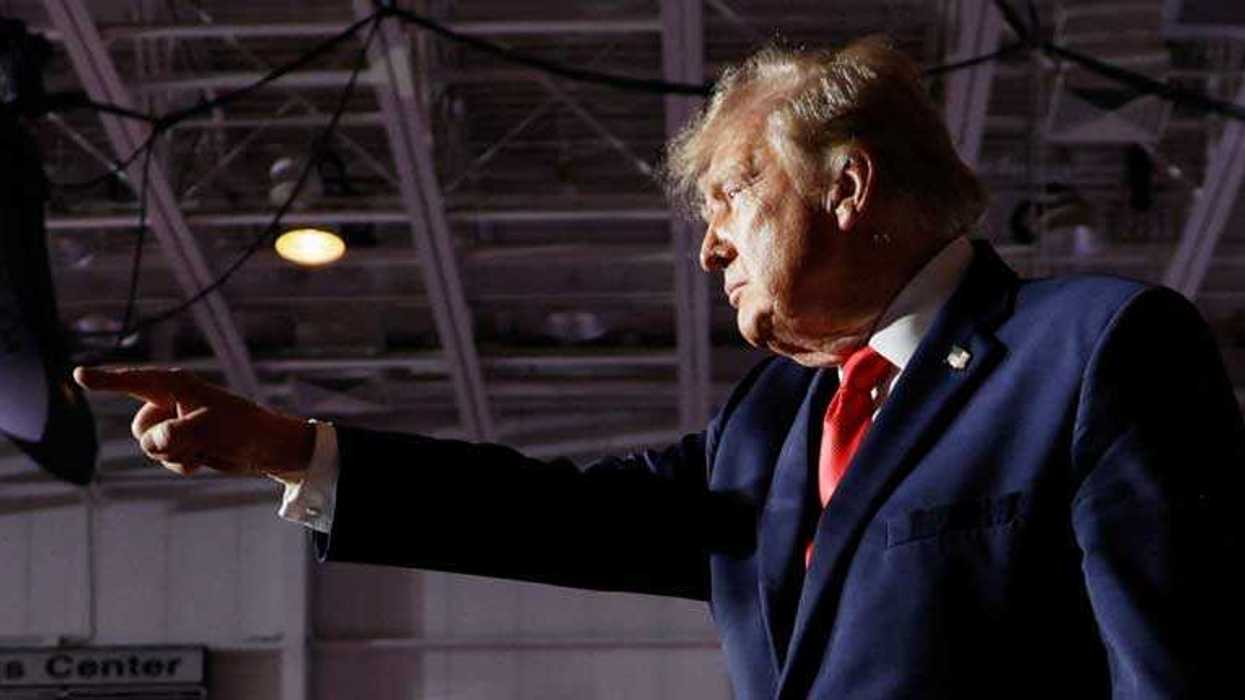
US President Donald Trump points during a midterm campaign rally at Five Flags Center in Dubuque, Iowa, US, November 1, 2026.
When I interviewed Loyola Law School professor Justin Levitt in September, I reviewed President Donald Trump's various threats to steal the 2026 midterm elections. As I put it at the time, I had five main concerns:
"One, that he will purge people from the rolls. Two, that he will seize ballot boxes before, during or after the election process has played out. Three, that he will use law enforcement to try to intimidate people who are voting. Four, that he will file frivolous lawsuits in order to overturn votes, and use MAGA supporters who are embedded in the system to facilitate that. And five, that if all of those other efforts fail, he will simply have Congress try to reject the results should they empower a Democratic-run legislature."
Levitt — who served under Presidents Barack Obama and Joe Biden as Deputy Assistant Attorney General and Senior Policy Advisor for Democracy and Voting Rights, respectively — repeatedly reassured me that none of these things could happen. Come Election Day and Democrats won both the Senate and House so overwhelmingly, it became practically impossible for Trump to contest the results. (Instead he is reportedly blaming his unpopular Iran War.)
Freshly vindicated, Levitt spoke to AlterNet about the role that activists, the media and ordinary citizens play in protecting democratic institutions from those who would corrupt them.
The following interview has been lightly edited for clarity, context and length.
Matthew Rozsa: I want to ask why President Trump is not trying to overturn the midterms in court, as I predicted he would.
Justin Levitt: Because that’s not a thing, and because even he can see that it’s not a thing. There are margins that are simply too large to even try the magic wand. If the races were closer, a lot closer, he might try and fail, as if there was ever a realistic possibility that he would actually succeed. But at this point, even he can see that there is no magic button to vanish the vote. And so he’s not going to try. He’s delusional. He’s still dangerous. The fact that a major network felt the need to ask him, “Are you going to declare martial law?” which isn’t a thing. He’s deeply disturbed. We’ve got a lot of work to do. So this is a victory lap in the sense that the system held exactly as I thought it would, but that is not to say we are out of danger at all.
But he’s mostly a marketing guy rather than truly living in his own fantasy world. He’s trying to project power and therefore change the world by projecting power. And it turns out that there are some realities that are so stark that even a guy who thinks he’s the best marketing genius on the planet can’t overcome. He can convince people, or try to convince people, that up is sideways. He cannot convince people that up is down, because—
Matthew Rozsa: I want to point out that if pro-democracy groups had not prepared for every contingency, and if journalists like myself had not rigorously covered all of the possible things Trump might attempt to do, he may have actually made the efforts that we were worried about. Part of what dissuaded him was the knowledge that he would be fiercely opposed and exposed.
Justin Levitt: So I’ll agree with you on the first, 100 percent.
Matthew Rozsa: What do you mean by the first?
Justin Levitt: The pro-democracy groups, civil society standing up. And I’ll get to the press in just a second. I will absolutely agree with you 100 percent. I didn’t ever suggest that the election system of the country would hold by itself. Election officials were as prepared as I had ever seen them, ever, so that voters didn’t have to be. And they got a huge amount of help. So you’re absolutely right that there were a lot of people working very, very hard, some behind the scenes and some not, to make sure that the results we saw were the results. And I don’t mean campaign people working very hard, though obviously they were. That’s not what I mean. I mean there were a lot of people working very hard to make sure that whatever choices the people made were actually going to be the result.
That’s right. On the press, I think there was some reporting that was deeply informative, that let people know about potential sources of danger, that helped people understand. I mean, yesterday’s elections were a rebuke to the president and a vote for not only the blah, blah, blah, but accountability. And that doesn’t happen without people understanding what’s going on, and that doesn’t happen without the press. So that is all true, right?
In addition to that, I think there was a lot of hyperventilating, not in describing what the president was thinking, but in failing to inform the public that it wouldn’t work. I think there were a lot of pieces, reporting and op-eds and columns, that didn’t do a great job distinguishing between the president’s and the government’s threats and when they had a realistic chance of succeeding. And so I’m not particularly willing to say that the press got this one right. Now, like I said, there’s a lot of great reporting going on.
Matthew Rozsa: When you say that there was hysteria about whether Trump could have pulled it off: if the results had been closer, if instead of a blue wave it had been a blue trickle, Trump might have been able to mop it up.
Justin Levitt: No. No, that’s where we disagree, my friend. Trump would have tried, but there’s a difference between making the attempt and succeeding. And if you don’t believe that, I give you January 6th. The elections weren’t overturned on January 6th. And even if Mike Pence had decided not to be a hero, they wouldn’t have been overturned, because that’s not a thing, because we are actually in charge. So I absolutely give you that a more narrow result would have led to him trying, including filing in court, including maybe sending the DOJ out or the FBI out or ICE out or something. There are lots of available possible moves for him to make, but none of them lead to a different end game. None of them. And that was the thing I was saying from the get-go. Let me put it this way.
The size of the blue wave didn’t change the result that the people were going to have their opinions heard. It changed the process, because he’s not attempting to undermine what the people have chosen. But there’s no chess game where the pieces magically transform into a crossword.

