
Red state's noncitizen voter list hits more Republicans than Democrats
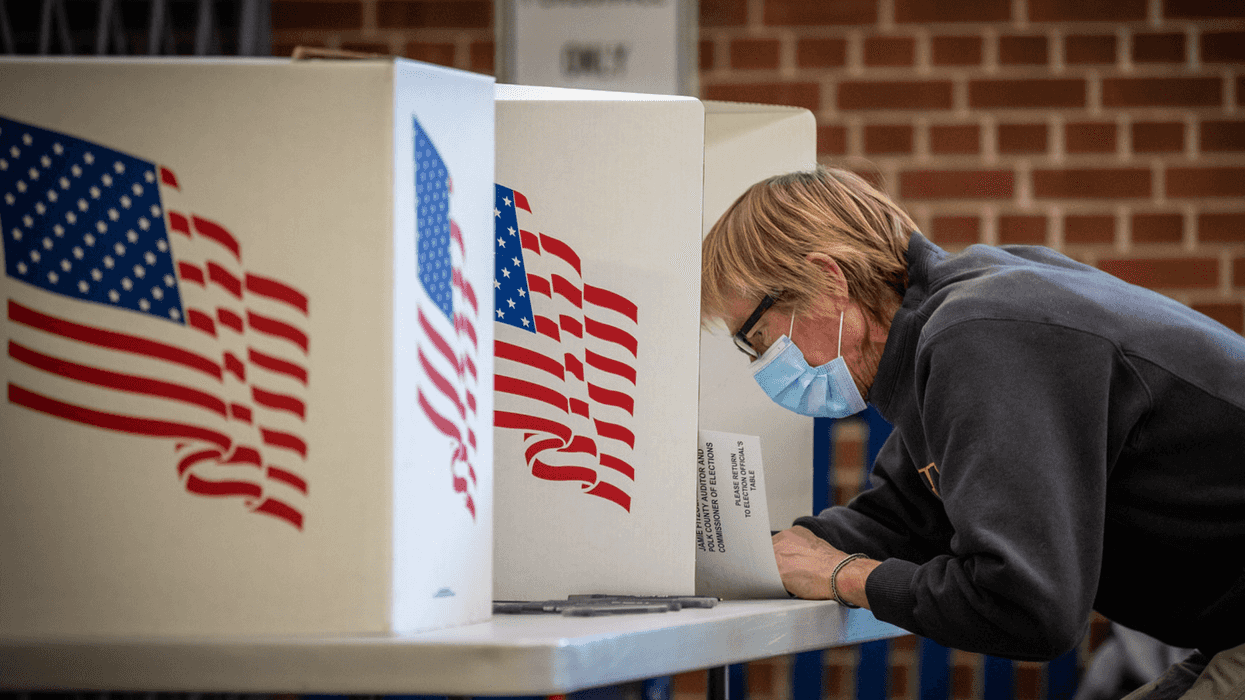
(Photo: Phil Roeder / Creative Commons)
Voters in Des Moines precincts 43, 61 and 62 cast their ballots at Roosevelt High School.

Voters in Des Moines precincts 43, 61 and 62 cast their ballots at Roosevelt High School.
More than 2,800 Alaskans are on a list of alleged noncitizens registered to vote in the state, according to a document obtained by the Alaska Beacon via a public records request.
The list, dated Friday, was released after the division removed more than 3,000 Alaskans from the state’s active voter list following an unusual data-sharing arrangement with the Division of Motor Vehicles.
Of the 2,809 people on the list of possible noncitizens, 2,502 are listed as “undeclared” voters — the default for new registrants who haven’t picked a political party. The list includes more registered Republicans (122) than Democrats (100), Libertarians (3) or Green (5) voters.
There are more women (1,556) than men (1,244). More than half (1,589), say they live in Anchorage, but there are many people on the list from Fairbanks, Juneau, Kodiak and Unalaska. There are some in rural Alaska, too — in places like Kotlik, Elim and Galena.
Seven hundred and sixty-three have voted at least once in a state or federal election. Unless they prove their citizenship, that could make those people subject to criminal prosecution.
Already, the state has charged 11 Whittier residents for voting without citizenship. Those defendants remain on the list provided to the Beacon on Friday.
The list includes people flagged for a variety of reasons, not just the data-sharing arrangement with DMV, but the DMV data appears to be the reason why most people are on the list.
In August 2025, the Division of Elections released a list containing the names of 541 possible noncitizens. This year’s list is more than five times as large.
It also appears to contain many errors.
This year, the Division of Elections compared the entire state’s list of active voters with DMV data, a new practice. Prior procedure involved comparing only a fraction of the list.
After this year’s comparison, the Division of Elections moved more than three thousand voters to the inactive list with the condition code “NC,” meaning noncitizen.
People on the inactive list can still vote, but only if they fill out additional forms to prove their identity. In addition, someone on the inactive list is on a path to be purged from the state’s voter rolls altogether.
Anyone affected by the removal also will no longer appear in the Division of Elections’ online registration checker. To have their voter registration reactivated, anyone on the inactive list needs to contact the Division of Elections and affirm that they are a citizen.
A problem with the procedure used by the Division of Elections this year is that many of the relevant DMV records are old, and many of the affected voters have become citizens since obtaining driver’s licenses as noncitizens.
According to a series of interviews conducted by the Beacon and a review of the list of alleged noncitizens, the problem appears to be most acute for Alaskans who became naturalized citizens between 2016 and 2026.
After the DMV-related removals, more than 600 people have contacted the division to say that they are citizens and that they were removed in error. More than 100 people have said they were not citizens.
More than 2,000 of the removed residents haven’t responded to a letter sent by the Division of Elections about the change.
Noncitizens are not allowed to vote in state or federal elections in Alaska, and President Donald Trump has urged Congress to mandate citizenship checks in elections nationally.
In December, as part of a federal effort to identify noncitizen voting, the Alaska Division of Elections shared a copy of its active voter roll with the U.S. Department of Justice. Most states have refused to turn over their data, citing privacy concerns. In Alaska, privacy advocates sued the state over the issue. That lawsuit is not expected to be resolved until after the election.
The Beacon consulted with immigration attorneys and privacy experts after receiving its public records request and has decided to not publish the list.
The New York Times reported Monday that the U.S. Department of Homeland Security is using lists like the one obtained by the Beacon to target Americans for deportation.
The large number of errors within Alaska’s list could cause innocent residents to be targeted by the federal government.
Immigration attorney Margaret Stock said she is representing a military spouse who is seeking to become a permanent noncitizen resident of the United States, but that person was incorrectly registered to vote by the DMV and is on the list despite canceling her registration soon after.
Last year, the inadvertent registration of a Kodiak couple exposed that the DMV had been improperly registering noncitizens to vote for years, even if they had indicated that they were not citizens.
It isn’t clear why the Division of Elections expanded its data-sharing arrangement with the DMV, or why it used DMV data rather than Permanent Fund dividend data, which is updated annually. The Division of Elections has not answered questions from the Beacon or state legislators.
In a legal analysis published Monday by the Anchorage Daily News, an attorney for the Alaska Legislature said the large-scale removal may have violated state and federal law.
Shortly after this article was published, the Alaska chapter of the American Civil Liberties Union said it had sent a letter to the Division of Elections and Lt. Gov. Nancy Dahlstrom, warning that the ACLU and other groups share the belief that the state has violated state and federal law for a variety of reasons, including the timing of the removals and because notice letters that were sent to affected voters only in English.
The letter asks the division to take eight “remedial steps” in order to fix the problem, including additional training for poll workers so they are able to help Alaskans affected by the removals.
Should the state not take action, the letter would serve as a pre-lawsuit notice required by federal law.

