Here's what 1860 and 1968 can teach us about the 2020 presidential election
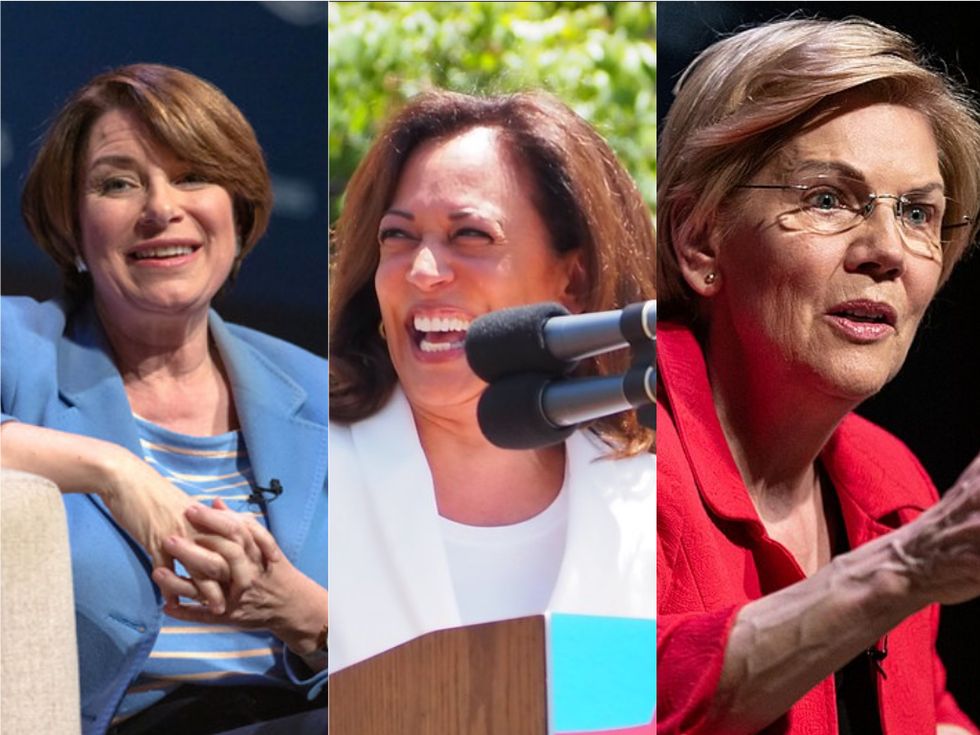
Lorie Shaull/U.S. Sen. Kamala Harris speaks at L.A.'s Families Belong Together March by lukeharold is licensed under CC CC0 1.0 /
Rally at US Sen 0196 Senator Elizabeth Warren" by mdfriendofhillary is licensed under CC BY-SA 2.0
“Four years of Donald Trump,” former Vice President Joe Biden claims, “would be an aberration in American history. Eight years will fundamentally change who we are as a nation.” Biden, of course, is running for president.
There are lessons that can be learned from examining this election’s parallels with two previous presidential elections – 1860 and 1968 – both of which left America deeply divided.
Slavery and geography in 1860
In the lead-up to the 1860 election, the nation was splintered by the question of slavery and by geography, with sectional conflicts between the more industrial northern states from the more agrarian South.
A third party,the Constitutional Union Party, nominated John Bell. It was a splinter party composed of disillusioned Democrats and former members of the Whig party (a major political party in the mid-19th century which stood for protective tariffs, national banking, and federal aid for internal improvements). The Constitutional Union Party wanted to avoid secession over slavery. Bell’s
Abraham Lincoln, an opponent of slavery, was the Republican candidate. Yet he promised to let the South hold onto its slaves so long as slavery was not extended to any new territories.
“Wrong as we think slavery is,” Lincoln said, “we can yet afford to let it alone where it is… but can we, while our votes will prevent it, allow it to spread into the National Territories, and to overrun us here in these Free States? If our sense of duty forbids this, then let us stand by our duty, fearlessly and effectively.”
Despite winning the election, whites allied with the Southern Democratic Party did not see Lincoln as a legitimate president because of his opposition to the expansion of slavery and perceived hostility to the beliefs and values of Southerners.
Seven Southern states seceded between Lincoln’s election and inauguration: South Carolina, Mississippi, Florida, Alabama, Georgia, Louisiana and Texas.
A little more than 100 years later, the 1968 election was marked by extraordinary bitterness arising from the Vietnam War, the legacy of the assassinations of Martin Luther King Jr. and Robert F. Kennedy, and a backlash against the ongoing civil rights revolution.
In 1968, Republicans nominated Richard Nixon, who relied on a “Southern Strategy” that used opposition to desegregation and barely concealed racist appeals to “law and order” to enlist the support of white Southerners.
“There are two kinds of Americans,” Nixon said, “the ordinary middle-class folks with the white picket fence who play by the rules and pay their taxes and don’t protest and the people who basically come from the left.”
Like today’s Democratic Party, in which some candidates are calling for revolutionary changes while others offer only reform, the Democrats of 50 years ago had to choose among candidates with starkly different visions of the future of their party and the nation.
The Democrats fractured over the Vietnam War with their division on display during the nominating convention. They chose the establishment candidate, Vice President Hubert Humphrey, as their standard bearer.
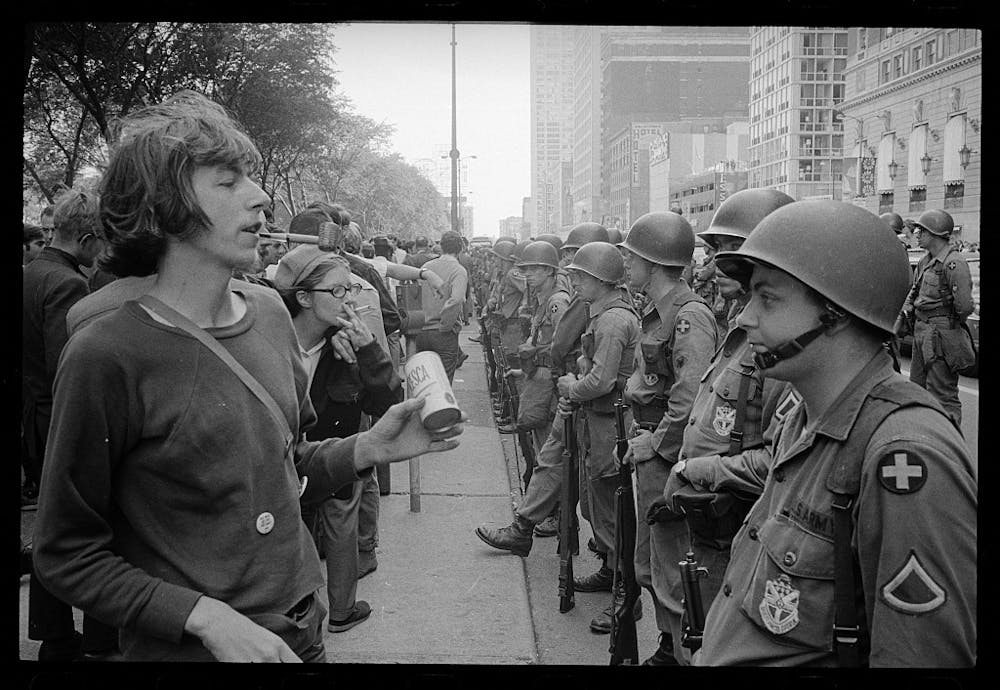
The 1968 Democratic convention in Chicago was filled with conflict, including this encounter between a demonstrator and National Guard soldiers on Aug. 26.
Today the leading contender for the Democratic nomination for president is yet another establishment candidate and a former vice president – Joe Biden.
In 1968, Segregationist Gov. George Wallace of Alabama, a Democrat well-known for his declaration “segregation now, segregation tomorrow, segregation forever,” ran a third party campaign for president.
Wallace promoted what The New York Times called a “visceral populism” and used raucous rallies to belittle his opponents. He asked his supporters to “Stand Up for America.”
Wallace received 13.5% of the vote. He carried five Southern states - Alabama, Arkansas, Georgia, Louisiana, Mississippi – and almost won enough votes to throw the election to the House of Representatives to decide.
Since his entrance into national politics, President Trump has borrowed from both Nixon and Wallace, sometimes using the same rallying cries. Thus, in 2016 his campaign handed out signs at his rallies, “The Silent Majority Stands with Trump.” And he skillfully evokes the populism of Wallace’s “Stand Up for America” when he promises to “Make America Great Again.”
‘A house divided’
In the 1860 and 1968 elections, arguments about race and appeals to racial resentment were used in ways that injured America. The current campaign is lining up to be a repeat performance.
The 1860 and 1968 elections also offer warnings that the vitriol surrounding an election can leave the losing side feeling that it cannot reconcile with those who prevailed and the winning side angry even after its victory. Such vitriol, I believe, is the daily grist of the politics on both sides of the 2020 campaign.
As the country faces the prospect of a rancorous 2020 presidential election, the elections of 1860 and 1968 should remind all Americans of Lincoln’s prophetic warning that “a house divided against itself cannot stand.”