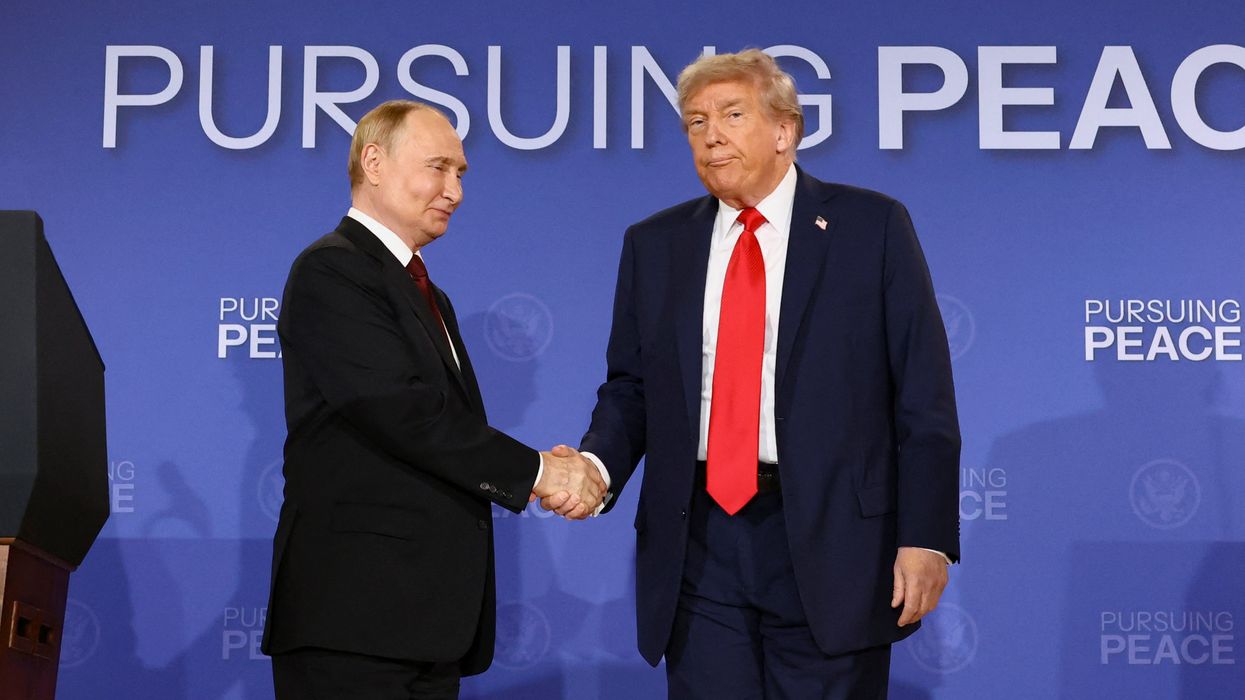
President Donald Trump has repeatedly said that investigators exonerated him of accusations of improper connections with the Russian government, but a new report complicates that claim by exposing a previously-overlooked FBI investigation into those foreign ties.
“For the last year, the Trump administration’s efforts to seek retribution against intelligence officials and FBI agents who investigated Russia’s 2016 election meddling have been spearheaded by federal prosecutors in South Florida trying to build a criminal case,” reported The New York Times' Michael S. Schmidt on Monday. “But in recent weeks, the White House has added a dimension to its push to rewrite the history of the Russia investigation, releasing a trove of previously classified FBI memos that it says back up President Trump’s claims that a so-called deep state was out to get him.”
He added, “There is little new of substance in the documents, and nothing that fundamentally undercuts the FBI’s rationale for pursuing the Russia investigation. But the material does shed new light on an often overlooked aspect of the swirl of events surrounding Mr. Trump in his first months in office in 2017: the bureau’s remarkable decision to open a separate counterintelligence investigation into the president of the United States, and how that inquiry was sidetracked before it had much of a chance to get going.”
The article went on to argue that the investigation was prompted by Trump’s May 2017 firing of FBI Director James B. Comey, which senior officials and counterintelligence agents worried was done to obstruct his investigation into Russia’s 2016 election meddling.
“Referring to the counterintelligence inquiry, one of the declassified memos made public by the White House last week said: ‘The goal of the investigation is to determine if President Trump is or was directed by, controlled by, and/or coordinated activities with, the Russian Federation in a manner constituting a threat to the national security of the United States and/or a violation of federal criminal statutes,’” Schmidt wrote.
Ultimately the FBI’s investigation was superseded by special counsel Robert Mueller’s probe into potential collusion between Trump and Russia.
“When Mr. Mueller’s report was released in 2019, it said that the investigation had found no evidence that Mr. Trump and his campaign had conspired with the Russians during the 2016 election,” Schmidt wrote. “But Mr. Mueller declined to make a determination about whether Mr. Trump obstructed justice. The report did not contain a section on Mr. Trump’s personal ties to Russia and whether he was compromised or represented a counterintelligence threat.”
Schmidt continued, “Shortly after the report was released, Mr. Mueller testified about it before Congress, acknowledging under questioning that he had not examined whether, for example, Russian oligarchs had laundered money through Mr. Trump’s businesses.”
In July Anthony Scaramucci, a former communications director for Trump, argued that the president is indeed compromised by Russia.
“If Trump is disavowing NATO and breaking an 80 year tradition — something’s wrong,” Scaramucci posted on X. “If Trump is praising Vladimir Putin, whose entire economy is slightly smaller than the state of Texas — something’s wrong. If Trump is disavowing the 1994 defense agreement where we told Ukraine to give up their nuclear weapons and we’d protect them — the agreement that got him impeached in his first term — something is wrong.”
Meanwhile in May, Rep. Don Bacon (R-NE) argued Trump’s seeming hostility toward Ukraine in its fight against the Russian invasion is proof that the president has a pro-Russia bias. He described Trump as “totally failing” in Russia and that he favored Russian President Vladimir Putin over Ukrainian president Volodymyr Zelenskyy.