
Who’s really to blame for the US’ historic defense blunder
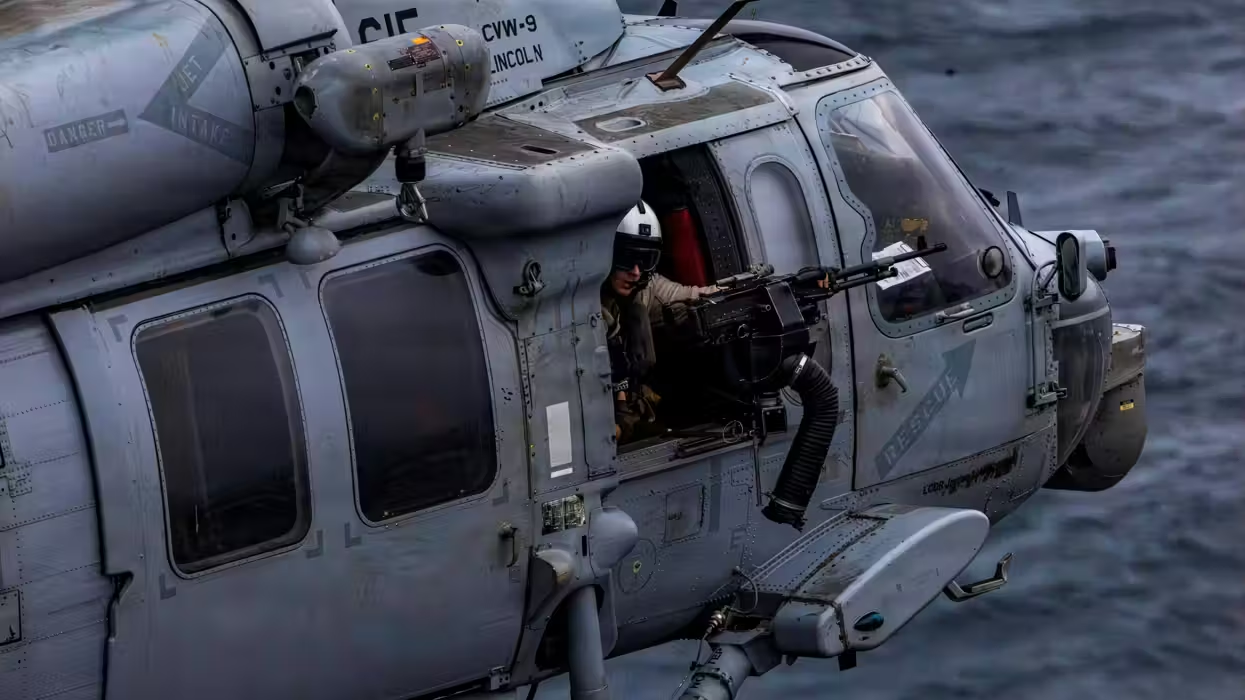
An MH-60S Sea Hawk on August 14, 2026. U.S. Navy/Handout via REUTERS.
An MH-60S Sea Hawk on August 14, 2026. U.S. Navy/Handout via REUTERS.

An MH-60S Sea Hawk on August 14, 2026. U.S. Navy/Handout via REUTERS.
U.S. President Donald Trump continues to insist that his ongoing war with Iran is necessarily in order to prevent the country's regime from developing a nuclear weapon. But according to conservative journalist David Drucker, the United States is facing a major threat from a military/national security standpoint: a depleted supply of crucial weapons.
Drucker, in a Bloomberg News opinion column, explains, "The U.S. still maintains the world's most powerful military. Those unmatched capabilities provide deterrence, global influence and economic prosperity. There's just one problem: We're running out of bullets. In Washington DC, the preferred parlance is 'munitions shortage,' a development that some military analysts are calling a crisis. In plain English: Stockpiles of critical offensive and defensive missiles are severely depleted and shrinking, and our domestic industrial base is inadequate to the task of swift replenishment."
The conservative writer continues, "Worse than that, Democrats and Republicans in Congress are dithering, as is lawmakers' habit when bipartisan cooperation and difficult votes are required. President Donald Trump, for his part, is insisting — predictably — that this issue is a fiction perpetrated and perpetuated by a 'treasonous' media. This challenge is hardly the fault of this Congress, or this president, alone. But it does exist, and it is jeopardizing military readiness, limiting America's strategic options and limiting — to borrow Defense Secretary Pete Hegseth's favorite word — lethality."
One of the people who's sounding the alarm about the U.S. military is former Defense Department Comptroller Elaine McCusker, who served in the first Trump administration.
McCusker, in an interview, told Drucker, "This is not a way for a global leader like the United States to treat a military it expects to be able to respond to crises anywhere at any time and fight and win without question. The crises we face now come from years of decisions — across administrations and sessions of Congress."
According to McCusker, roughly 60 percent of the military's budget goes to "must pay bills" such as salaries, military bases upkeep, training of troops and combat exercises.
"That leaves about 40 percent for both weapons innovation and modernization and, theoretically, for refilling equipment and ordnance reserves," Drucker warns. "And as defense sources have emphasized to me during conversations over the past several weeks, there is even less cash available for those crucial priorities, because the military was ordered into battles neither Trump nor Congress had budgeted for, including continued action in the Caribbean and an Iran war now in its seventh month. But the source of the problem long precedes the Iran war — and, for that matter, Russia's invasion of Ukraine."
Drucker continues, "The seeds of today's munitions shortage were planted in our 1990s Cold War triumph over the Soviet Union … In ensuing years, White Houses and Congresses under both political parties declined to update stockpiles that were slowly becoming outdated. Compounding the error, the government also allowed munitions manufacturing capacity to atrophy, to say nothing of military shipbuilding. So, even if Congress and Trump flipped on the spending spigot tomorrow, fresh missile supplies wouldn't roll off assembly lines for at least two years, likely longer."

