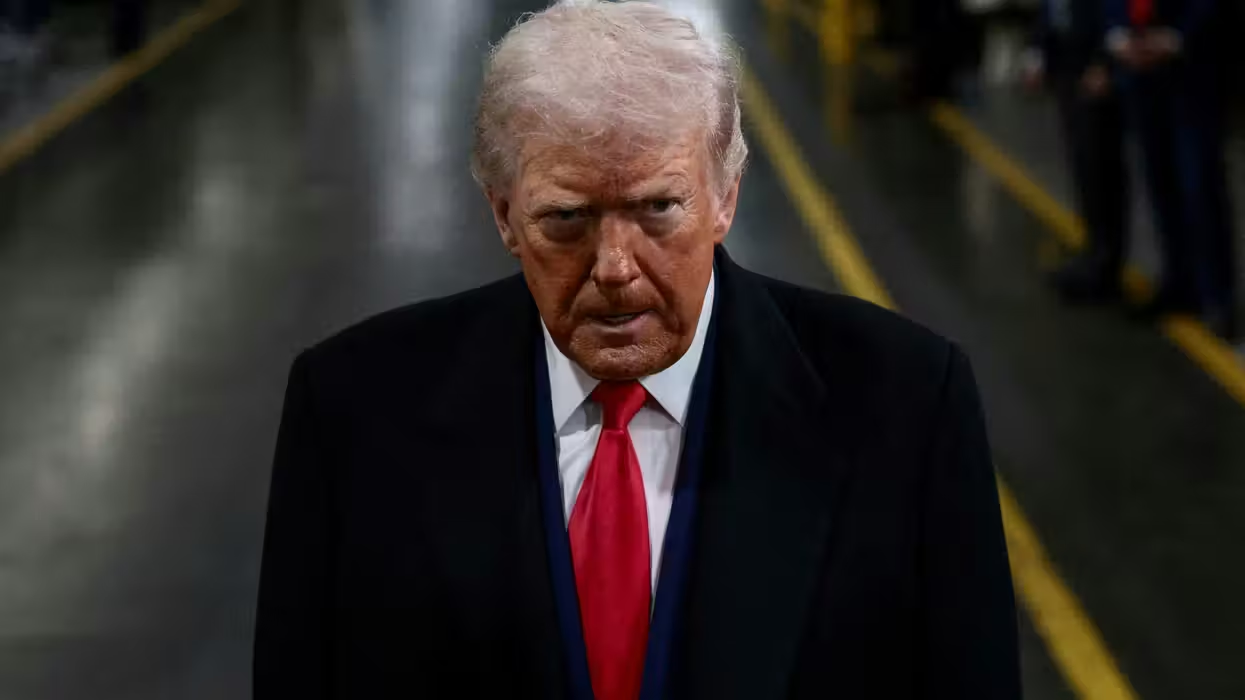
President Donald Trump continues to prove the legitimacy of the "TACO" theory with his continued failures in the Iran negotiations, according to a retired colonel, with each extended deadline showing that he "always chickens out" under pressure.
Jonathan Sweet is a retired Army colonel who served three decades as a military intelligence officer and also led the U.S. European Command Intelligence Engagement Division. On Thursday, he and national security writer Mark Toth wrote about the Trump administration's ongoing failure to come to grips with Iranian peace talks for The Hill.
"Less than 24 hours after President Trump accepted the off-ramp proposed by Pakistan’s leaders, granting an 'indefinite ceasefire' so Iran’s leaders could 'come up with a unified proposal,' the Islamic Revolutionary Guards Corps attacked three ships in the Strait of Hormuz," Sweet and Toth wrote. :Iran declined to send any negotiators to Islamabad and did not make a single concession to Washington — and still, the president wavered. With just hours remaining on the existing two-week ceasefire and repeated threats by the president to renew airstrikes, the president blinked. He extended the ceasefire, hoping the regime’s governance would fracture, relying upon his naval blockade to economically break the impasse."
The pair cited former Army Chief of Staff Gen. Gordan Sullivan, who once argued that "hope is not a method," and further suggested that Trump has not realized how "firmly in control" of Iran the Islamic Revolutionary Guard Corps is, despite his insistence that the government is "seriously fractured."
The leadership in Iran, they argued, sees through Trump's threats and believes that their closure of the Strait of Hormuz can help extract a much better deal from the U.S. soon.
"As we wrote in mid-March, the Islamic Revolutionary Guard Corps is the Iranian regime’s center of gravity," Sweet and Toth continued. "And its commander, Ahmad Vahidi, has broken the Trump 'art of the deal' code. He does not believe Trump will act, knowing it will take 'boots on the ground' to eradicate his regime. Tehran is playing for time, gambling that an estimated $2 billion in daily lost oil revenue to the world will hit harder than the $300 million hit Iran is taking daily. They reason that the longer the Strait remains closed, the more pressure Trump will be under to make a deal favorable to Iran."
The pair further stressed that the only option left for Trump is full-on regime change in Iran, which he must be prepared to carry out, instead of chickening out again when the Revolutionary Guard does not agree to an unconditional surrender.
"The Islamic Revolutionary Guard Corps cannot remain in power. It cannot continue to threaten its Gulf State neighbors, Israel, the U.S., and its own citizens, nor can it exercise control or influence over the Strait of Hormuz — an international waterway," Sweet and Toth concluded. "This is now more about what Trump has not done — bring about regime change and reopen the Strait of Hormuz. Ultimately, that is how he will be judged."