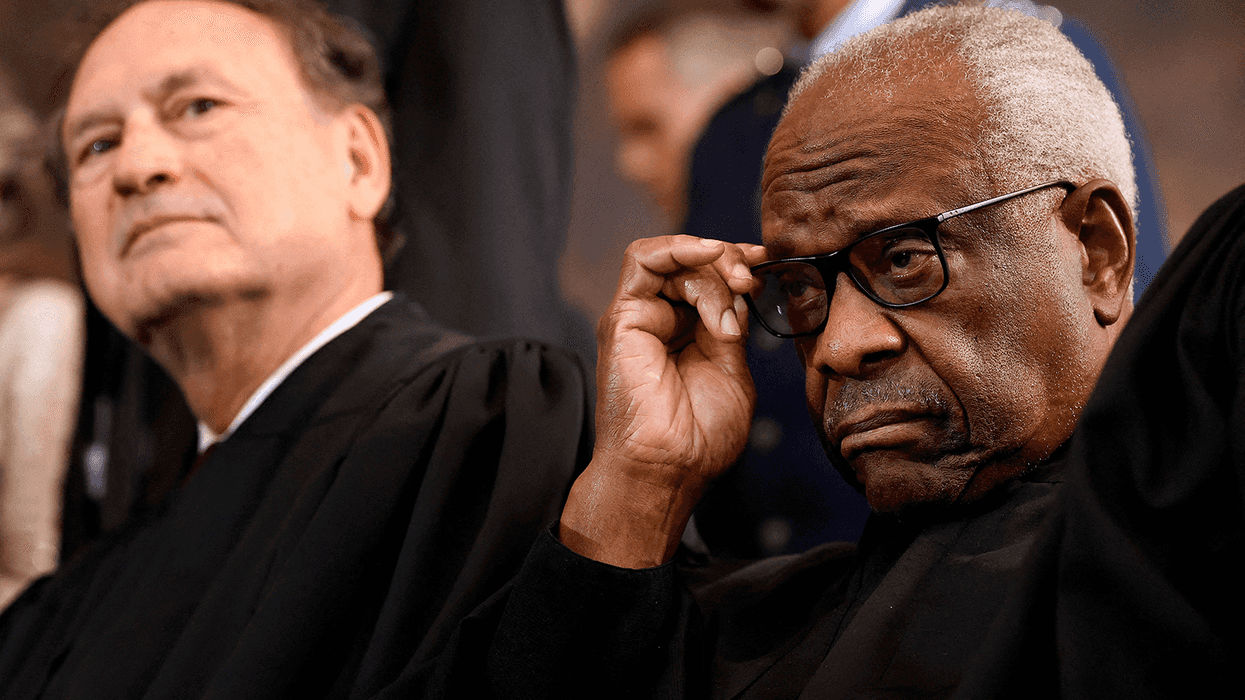
In April, the Supreme Court handed down a controversial decision which critics say “eviscerated” the Voting Rights Act. Now, according to new reporting from Vox, the impact of this decision is about to spread from the voting box to the workplace.
Per Vox, “President Donald Trump’s Department of Justice released an opinion on Tuesday that, in the likely event it is embraced by a Republican-controlled federal judiciary, would make it significantly harder for plaintiffs who face employment discrimination to prevail in court.” It was notable that the opinion was signed by T. Elliot Gaiser, head of the Office of Legal Counsel and a former law clerk to Justice Samuel Alito, author of the Supreme Court’s recent decision in Louisiana v. Callais, which gutted a key provision of the Voting Rights Act.
Essentially, Gaiser’s opinion argues that the same logic Alito used to attack voting rights can be applied to employment anti-discrimination law. According to Vox senior Supreme Court correspondent Ian Millhiser, “if you accept Alito’s opinion in Callais as legitimate, then Gaiser’s approach to employment discrimination is hardly a stretch. Indeed, it is the next logical move in the Republican Party’s broader campaign to weaken civil rights protections for racial minorities.”
As Millhiser explains, “The 1982 law that Alito targeted in Callais provided that voting rights plaintiffs who challenged a state election law did not need to prove that state lawmakers acted with racist intent in order to prevail. Under that law, which was repealed by Callais, a state law that ‘results’ in voters having their right to vote diminished due to their race may also be challenged.” Now, because of the Supreme Court’s decision, voting districts can more or less be gerrymandered at will, even scrubbing Black districts entirely out of existence, because the language in Alito's opinion makes it nearly impossible to prove racist intent.
Gaiser’s decision concerns a similar law regarding employment, and he’s making essentially the same argument raised by conservative justices: that a discrimination case can prevail only if racist or sexist intent is explicit. And given these similarities, says Millhiser, Gaiser’s claim “is likely to prevail before a Republican Supreme Court.”
According to Millhiser, there are two upshots to this conclusion: “One is that it should be significantly harder for many employment discrimination plaintiffs to prevail. The other, which is potentially even more significant, is that elected officials should lose much of their power to remedy discrimination of all kinds, and the scope of civil rights law should be determined primarily by the Supreme Court.”
As Millhiser explains, “both the Voting Rights Act’s results test and employment discrimination’s disparate impact test, after all, were enacted into law by Congress. But the Republican Party’s consistent position on civil rights laws is that democratically enacted civil rights laws must bow to the whims of Republican justices.”
In essence, it is the position of conservatives on the court that “these difficult policy questions should be removed from the democratic process and given to a Republican judiciary.” Millhiser asserts that this should raise troubling questions as to “why six Republican lawyers in black robes have more insight into US civil rights policy than the people American voters elected to make these decisions.”