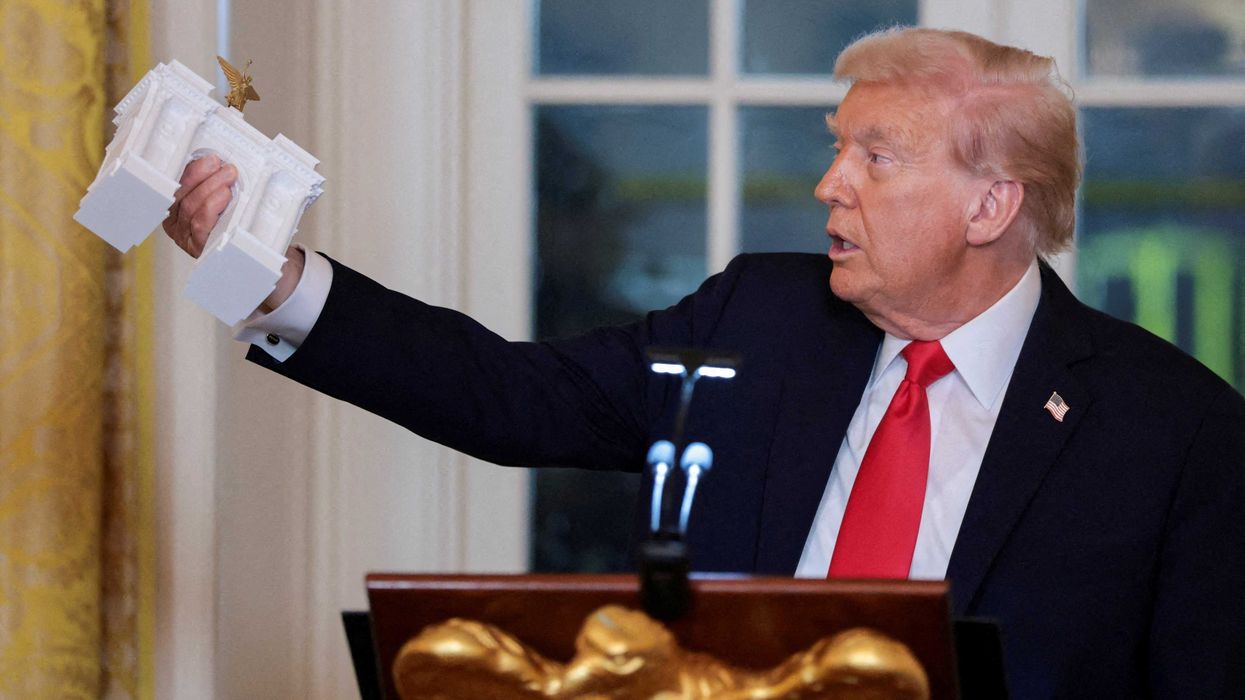
President Donald Trump has a key component of his communication style: he loves using props. On Tuesday, for example, while giving a tour of his ballroom construction site, he did so while holding a posterboard image of a columned building. While it may be easy to dismiss this tendency as a mere part of his instinct for showmanship, as HuffPost explains, “There’s actually real rhetorical power behind the objects (and people) Trump chooses to employ as props. And there’s neuroscience to back it up.”
According to body language and nonverbal communication expert Patti Wood, props are a key aspect of “persuasion theory,” helping alert the parts of the audience’s brain that interpret relevant information. As she explained, “Objects affect the brain in a totally different way — specifically the limbic brain, that primitive brain. That increases the speed in which we process it. If someone sees a prop, it hits their limbic brain, they’ll see it faster and it hits them emotionally.” Hitting those emotions allows a message to reach audiences in a way that is more “visceral,” regardless of the presence of facts or logic.
As HuffPost notes, Trump is hardly the first politician to use props. Ted Cruz famously read Dr. Seuss on the Senate floor in an effort to stave off a vote on the Affordable Care Act. President Barack Obama drank a glass of filtered water from Flint, Michigan, to prove that efforts to clean up contamination were underway. And congressional leaders love using what they call "floor charts" during hearings and debates.
But HuffPost asserts that few politicians are quite as enamored by props as Trump, whose prop highlights include the “binders of 'Epstein files' prepared for influencers, riffing with a binder clip while discussing his ‘365 Wins in 365 Days,’ using a garbage truck to attack Joe Biden over comments he had made in a back-and-forth over racist comments about Puerto Rico, ‘making fries’ at a McDonalds, and the various miscellaneous photo opps featuring hard paper copies of documents with his signature.”
And according to Wood, Trump’s use of props is only partly to aid communication. The other reason he so frequently uses them, she claims, is simple: “He is visibly delighted by them.”
“They know the power of the props, they plan the props and [Trump] likes to see the emotional effect of his presentations. He gets fed by that and that makes him speak better in those moments,” Wood explained. “I can see his [nonverbal communication], he delights and smiles when the props are on the table, when he’s holding a prop. He really enjoys it.”
Sometimes, Trump’s props are less about a specific message and more about building his brand, such as his red hats, blue suit with red tie, or the ear bandages he and his Republican supporters wore in the wake of the 2024 attempt on his life. When he does use them to promote a policy message, however, they can be a useful shorthand for reaching his base. Wood noted his use of large and small Tic Tac containers while campaigning as a simple means of illustrating shrinkflation.
“The complex concept was inflation. He was saying he was going to reduce inflation, so you don’t have the small container of Tic Tacs,” said Wood. “It makes it easier for even someone who can’t read to comprehend what Trump’s saying because it simplifies it so much.”
It didn’t matter that the Tic Tac example was an oversimplification that had less to do with explaining the reality of the concept than it did with communicating a memorable assertion: There was a problem, and Trump would fix it.
“The prop becomes a replacement for facts,” Wood explained. “That’s not a benefit, but it’s a power.”