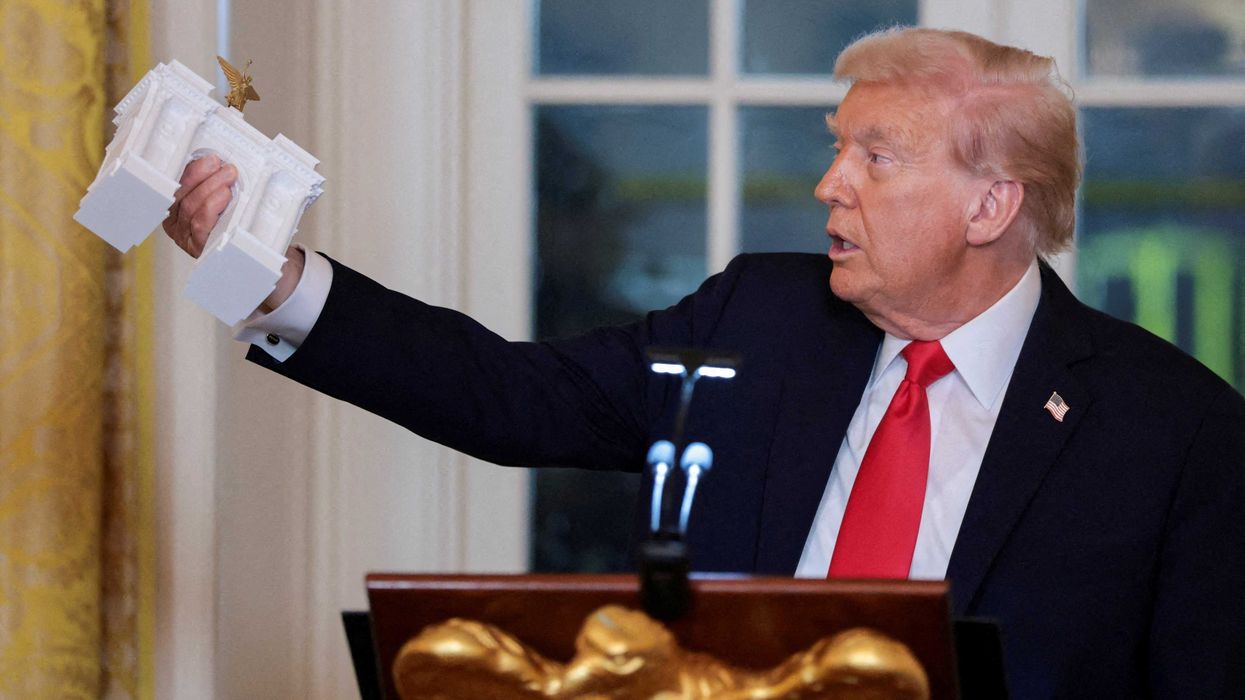
President Donald Trump reportedly wants to seize the Smithsonian Institution, one of America’s most prestigious collection of museums, and to use them to whitewash the United States’ history on issues like slavery.
“When President Trump summoned Lonnie Bunch, the secretary of the Smithsonian Institution, for lunch at the White House on August 28 of last year, Bunch’s advisers assumed that the end was near,” The Atlantic’s Clint Smith wrote on Monday. “Trump had spent months threatening the Smithsonian’s independence; just nine days earlier, he’d written on Truth Social that ‘the Smithsonian is OUT OF CONTROL, where everything discussed is how horrible our Country is, how bad Slavery was, and how unaccomplished the downtrodden have been.’”
Bunch, who unambiguously believes that slavery was a negative for America, was also the founding director of the Smithsonian’s National Museum of African American History and Culture. He is known to have pushed back against attempts by Vice President JD Vance and Rep. Carlos Giménez (R-FL), who sits on the Smithsonian’s Board of Regents, as well as others in the Trump administration to scrub so-called “woke” ideas in the museum that they described as a “divisive ideology.” Trump also tried to fire the director of the Smithsonian’s National Portrait Gallery, even though the Smithsonian is meant to be independent of the government.
Despite these challenges, Bunch was able to avoid winding up in the administration’s crosshairs, at least for a while. Yet as various key personnel step down from the museums’ boards, Smith anticipates that Trump may ultimately get his wish of hiring loyalists who will reshape the museum to his liking.
“The current and looming vacancies, and the need for congressional and presidential approval, raise the possibility that Trump could attempt to install new board members who are loyal to his agenda,” Smith wrote. “(Trump’s March 2025 executive order said that the White House would work with officials ‘to seek the appointment of citizen members to the Smithsonian Board of Regents committed to advancing the policy of this order.’)”
Smith added, “In April, The New York Times reported that the regents had agreed on nominations for some of the replacements, but the House committee responsible for reviewing and vetting the nominees before they move to the full legislature for approval had yet to receive the names under consideration—intrigue that suggests some manner of strategy, although it’s far from clear whose. Minutes from board meetings earlier this year show that the regents have voted to give existing members additional duties because of the current and expected vacancies.”
Despite these pressures, Bunch vowed in an internal memo to staff that “we remain steadfast in our mission to bring history, science, education, research and the arts to all Americans. We will continue to showcase world-class exhibits, collections and objects, rooted in expertise and accuracy.”
Earlier this month, federal Judge Angel Kelly ruled against Trump’s attempts to remove historic content that is featured at national parks. Trump specifically targeted content that discussed America’s history of racism, including slavery.
"To establish a likelihood of success on the merits, Defendants must do more than express disagreement with the Court’s prior ruling; they must make a strong showing that they are likely to prevail on appeal," Kelley explained in response to the administration’s objection to being forced to allow the National Parks Service to accurately represent American history.
She added, "To establish irreparable harm, Defendants bear the burden of demonstrating that, absent a stay, they will suffer irreparable injury that is substantial, certain, and inadequately remedied by monetary damages or later appellate relief. ... Here, Defendants raise three theories: (1) the Injunction Order hampers government speech by preventing the National Park Service (“NPS”) from proffering its preferred narrative at National Parks; (2) implementation of the Injunction Order is practically infeasible and costly; and (3) the Injunction Order conflicts with a recent order issued by the U.S. Court of Appeals for the Third Circuit regarding Independence National Historical Park in Philadelphia, PA, thus subjecting Defendants to inconsistent obligations with respect to that site. The Court is unpersuaded by these arguments and explains why."