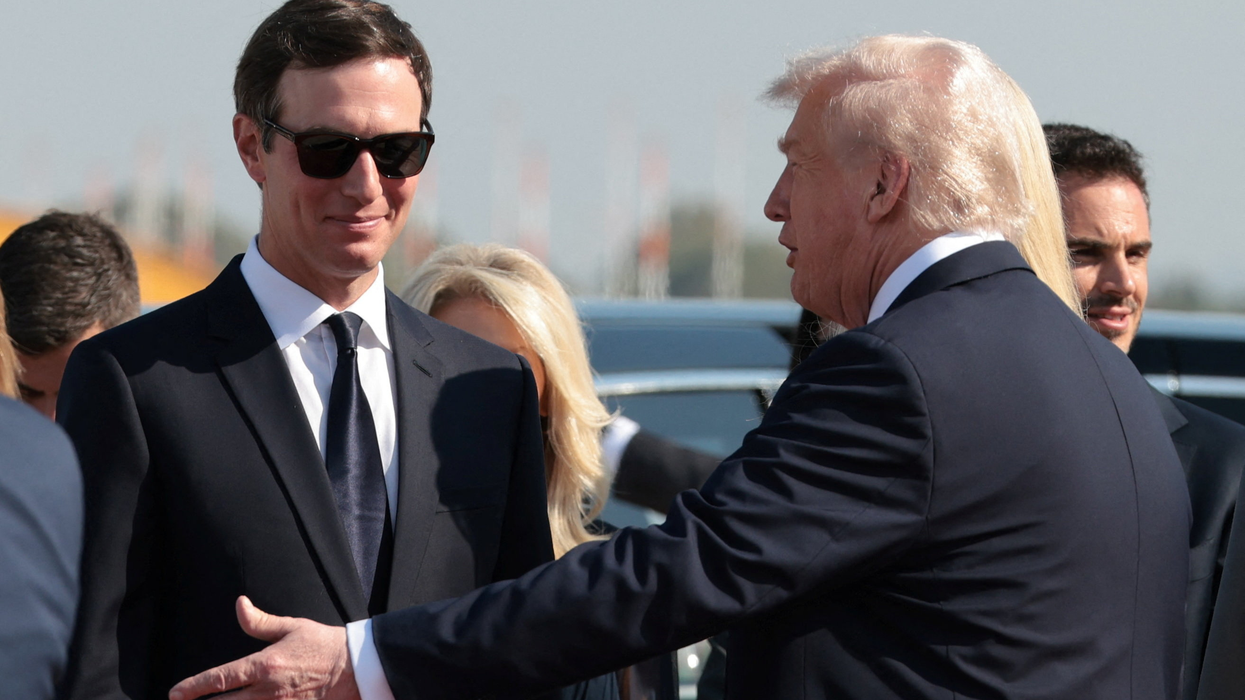
Over the course of President Donald Trump’s second administration, his son-in-law and envoy Jared Kushner has been raking in vast sums of money from Gulf nations that hope to buy White House influence. But according to new reporting from Bloomberg, while these countries have lined Kushner’s pockets, Trump’s decision to launch war on Iran shows that they got little in return, and they’re not happy about it.
As Bloomberg explains, Kushner has been “engaged in a campaign of official peacemaking and private moneymaking like none in modern American history. Between attempts to broker peace, Kushner has participated in investment meetings at his private equity firm, Affinity Partners, which manages billions for Qatar, Saudi Arabia and the United Arab Emirates, according to a person familiar with the matter. Those three energy-rich Gulf states aren’t just longtime allies of Washington but also key Affinity clients” who have “agreed to pay Kushner’s firm tens of millions of dollars in fees annually” hoping for sway with the administration.
But now, “according to interviews with more than a dozen people familiar with Kushner’s work and financial relationships in the Gulf, some government officials and wealth fund professionals — especially in Riyadh and Doha — have been disappointed with him given their large investments in Affinity.”
All three of the Gulf states in question opposed military action against Iran, and since Trump launched it anyway, they have borne the brunt of its consequences. The countries have faced large-scale retaliatory attacks, which have killed and injured citizens, damaged and destroyed infrastructure, spoiled their reputations as safe destinations for tourism and business, and further destabilized regional security.
“How the Trump administration has prosecuted the war and Kushner’s direct role in trying to end it have become a point of growing consternation, particularly for officials in Riyadh and Doha,” reports Bloomberg. “These officials believed that investing in Affinity might give them a greater say in Washington’s affairs in the Middle East. Their expectations haven’t been met, causing them to reassess alliances that go back decades.”
“The investments in Jared’s firm were meant to anchor ties with the Trump family,” said Sanam Vakil, director of the Middle East and North Africa program at the think tank Chatham House, which regularly hosts senior regional officials. “The Gulf states likely felt very angered, if not let down, that the US didn’t fully consider their security needs.”
According to Bloomberg, “The Qataris, in particular, had lobbied the Trump administration to avoid an all-out war with Iran. But Kushner and other Trump advisers eventually sided with one of Affinity's preferred investment destinations: Israel, whose Prime Minister, Benjamin Netanyahu, successfully pressured Trump into a joint campaign against Iran.”
While many have suggested that Kushner’s simultaneous role as both a diplomat and business mogul represents a conflict of interest, he characterizes it as “volunteer work.” The White House has mirrored that stance, with spokesperson Anna Kelly asserting, “Jared Kushner’s volunteer diplomacy efforts are conducted with the highest level of integrity and have nothing to do with his private businesses.” This is despite the well-documented fact that he conducts both at the same time, with major implications for U.S. foreign policy.
As Ebtesam Al-Ketbi, president of the Abu Dhabi-based Emirates Policy Center, which closely reflects the government’s thinking, explained, Kushner is seen as “a figure whose business interests now travel with him into every political conversation.”