
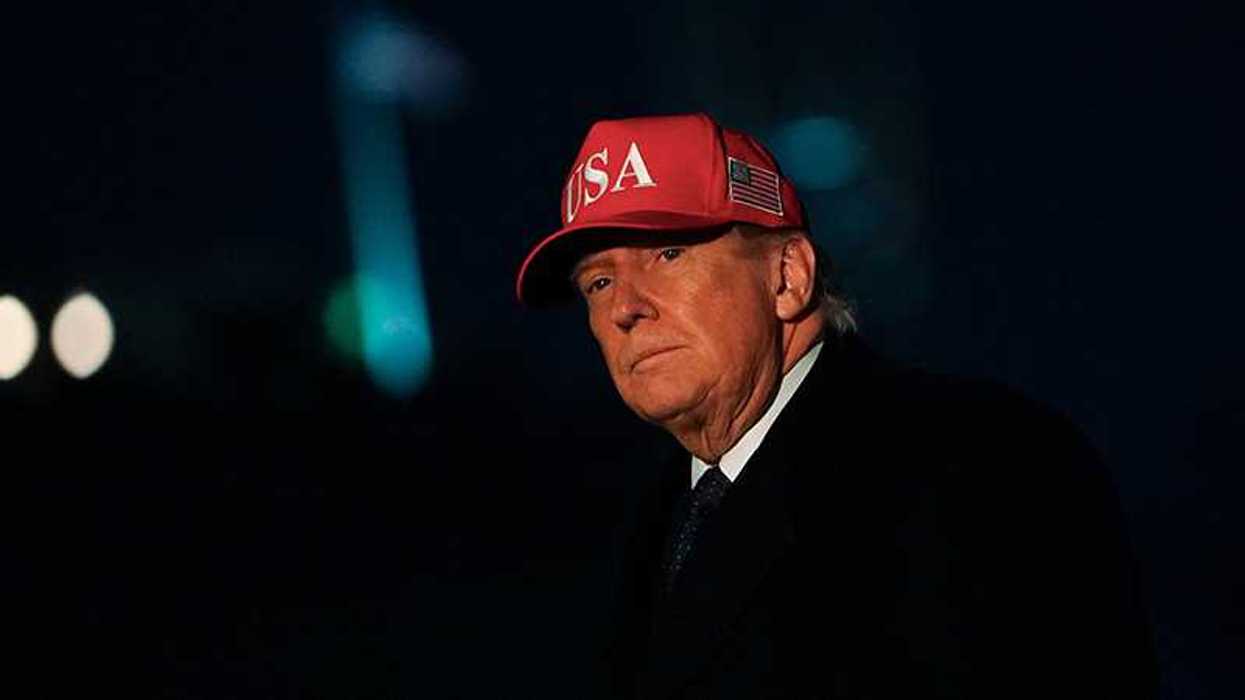


President Donald Trump spoke to reporters upon landing at Andrews Air Force Base late Sunday night after his weekend at Mar-a-Lago. What was noticeable is that he appears to give several different ideas and contradictory visions on the future of his war in Iran, the New York Times pointed out.
"He said he hoped the military and Guard Corps would surrender their weapons to the people, even though the same hardened forces killed thousands in the streets in Jan.," commented Times reporter Trip Gabriel.
National security expert Marcy Wheeler commented, "The Mad and Senile King is just using reporters as a sounding board to see what might sound good in the press."
She shared an X post from The Economist's Middle East correspondent Gregg Carlstrom, who observed Trump told the Washington Post that aim is "freedom for the people" of Iran. Meanwhile, he told the New York Times that the timeline is "four to five weeks," which Secretary of Defense Pete Hegseth reiterated in his Monday morning press conference. Trump claimed to the Times he has "three very good choices" on who could take over Iran.
Then, when speaking to ABC News, Carlstrom characterized Trump essentially saying, "actually, nevermind, we killed those choices."
Meanwhile, Trump told Axios that the timeline was "end it in two or three days" if Iran makes a deal.
"Wait, I thought it wasn't a war?" questioned historian Jane Haigh.
Author and lawyer Mark Raines commented, "Of course. Trump's positions change by the minute and are often contradictory. It somehow works because his supporters don't have any ideological consistency. They believe in whatever Trump is saying at that moment... It's a cult. It's always been a cult."
"Groundhog Day. Wrote this March 2012. The absurd contradictory narrative on Iran: strong enough to warrant a response worthy of an existential threat - weak enough to be threatened w/ war every other day and eventually be attacked with little thought," said historian Rouzbeh Parsi.
"Trump keeps saying contradictory things about the war in Iran. It makes it hard to know what to believe. And the war just widened for Israel with Hezbollah," agreed journalist and writer Bill Addis.
"I’m sorry a WHAT?" national security lawyer Bradley P. Moss asked, responding to Hegseth's bizarre claim, that Iran "could use a conventional umbrella to continue a pursuit of nuclear ambitions."
"Four U.S. service members have died. This is the Pentagon's explanation to their families," reporter Kelsey Reichmann said about the same quote from Hegseth.
"Note, Pete's voice goes up several notches, gets very high and girly when he is pressed on whether we will have boots on the ground," said law professor Jen Taub about whether the U.S. would send soldiers into Iran.
Another New York Times report by Edward Wong and Michael Crowley, "Since January, when Mr. Trump began threatening new action against Iran, his administration has presented varying and contradictory statements on what it wanted from the negotiations, a sign that the diplomacy was probably doomed even before it began — perhaps by design, some analysts said."
The Daily Beast reported Monday after Hegseth's briefing that he was just as all-over-the-place as Trump.
Other observers couldn't help but notice that the administration keeps citing 1979 as the starting point of the "war." Repeatedly, Hegseth claimed that they started the war, but the U.S. would finish it. It prompted some to ask if the administration was confused about who the actual leader of Iran was because their names are similar.
It seems Sen. Markwayne Mullin (R-Okla.) also didn't know the difference between former Supreme Leader Ruhollah Khomeini, who was in power in 1979 and Ali Khamenei, who Trump killed on Saturday.
"I just learned that Ayatollah Khamenei and Ayatollah Khomenei are not the same person. Here's my plan for regime change in Iran," the parody X account "NYTPitchbot" quipped.
Report typos and corrections to: feedback@alternet.org.

#story_page_sidebar
MOST POPULAR
{{ post.roar_specific_data.api_data.analytics }}
MOST POPULAR
ContactAdvertise with AlterNetPrivacy PolicyWriter GuidelinesPress InformationAbout AlterNetMeet the AlterNet StaffDebug Logs
@2026 - AlterNet Media Inc. All Rights Reserved. - "Poynter" fonts provided by fontsempire.com.